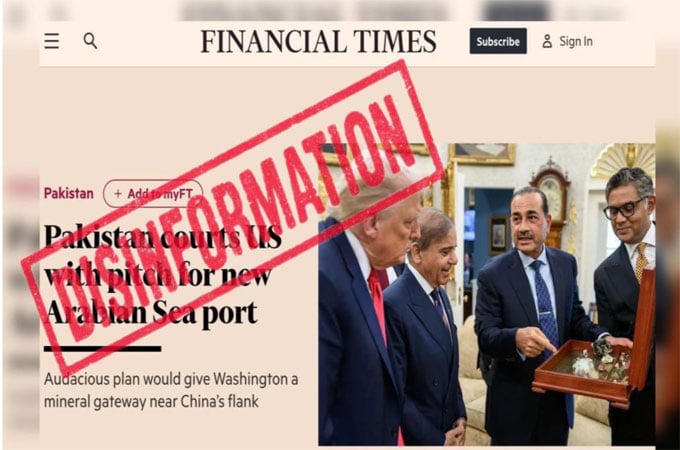
A Closer Look at the Controversial Report
A recent article published in the Financial Times, dated 4 October 2025, authored by Alec Russell and Humza Jilani, raised questions about a potential $1.2 billion plan for a US-backed Arabian Sea port at Pasni. The report suggested that this idea was presented to Washington, offering access to Pakistan’s critical minerals. It also claimed that this proposal was made ahead of a reported White House meeting with President Trump, positioning it as an effort to “counter China’s Gwadar port” and “rebalance Pakistan’s alliances.” While the headline may have been crafted to attract global attention, the article itself faces significant scrutiny.
No Official Offer Was Made
To clarify: no offer of any port at Pasni has been made by the Government of Pakistan, the Pakistan Army, or any official state body. There has been no discussion, proposal, or agenda item involving the White House or any US official regarding “Pasni port.” The report refers to a private commercial concept, discussed informally between business intermediaries exploring infrastructure possibilities on Pakistan’s southern coast. Such exploratory discussions are common and routine, falling entirely within the domain of private enterprise—not policy.
The Government of Pakistan’s institutional processes for strategic, commercial, or investment projects are well-defined. They begin at the ministerial level, undergo security and feasibility vetting, and only then move through cabinet approval channels. To conflate private curiosity with state policy is not just careless—it is misleading journalism.
Misattribution and Misrepresentation of Sources
One of the most glaring weaknesses in the FT article is its sourcing. The piece attributes the idea to “advisers to the Chief of the Army Staff,” without naming them, defining their capacity, or confirming their affiliation with the Inter-Services Public Relations (ISPR)—the only authorized body to speak on behalf of the Pakistan Army. Multiple sources within Pakistan’s security and intelligence establishment have confirmed that no such advisers exist in any official capacity, nor has the Chief of Army Staff appointed or empowered anyone to make representations to foreign governments or media on economic proposals. Any individuals described as “advisers” are therefore private actors mischaracterized by the publication.
Responsible journalism demands verification of titles and roles, particularly when reporting on matters involving national security and foreign relations. The FT’s decision to bypass institutional confirmation from ISPR, while still attributing the claim to unnamed “advisers,” falls short of basic editorial diligence.
Internal Contradictions Within the FT Story
Ironically, the FT story itself acknowledges that the Pasni port concept is “not official policy.” Yet it simultaneously implies proximity to the Chief of Army Staff’s agenda and the timing of his alleged meeting with President Trump—an assertion that even the White House has denied. This internal contradiction undermines the piece’s credibility. If the publication admits the proposal is unofficial, why then approach a senior White House official for “confirmation” of a non-existent policy? The very act of seeking official comment on an unofficial idea creates a false aura of state involvement, which is then amplified through selective framing.
The result is a manufactured narrative: a private, speculative concept is artificially elevated into an international policy headline—then “balanced” with an official denial, thereby presenting both as equivalent “sides.” This journalistic sleight of hand may serve editorial drama, but it does not serve the truth.
The China Angle: A Forced and Unnecessary Link
Perhaps the most conspicuous overreach in the FT report is its attempt to frame the supposed Pasni project as a counterweight to China’s Gwadar port. This is an unwarranted insertion that betrays a lack of understanding of Pakistan’s foreign and economic policy framework. Pakistan, like any sovereign state, engages multiple partners—including China, the United States, and Gulf nations—based on mutual interests and development priorities. To suggest that a non-existent private concept is part of an anti-China strategy is speculative sensationalism.
Moreover, the idea that Pakistan is seeking to “hedge” against China by creating a US-linked alternative to Gwadar ignores the very foundation of the China Pakistan Economic Corridor (CPEC), which remains a flagship strategic initiative firmly embedded in state policy. Any future engagements—if ever considered—would proceed transparently through institutional mechanisms and would in no way compromise existing commitments.
How Real Projects Are Formed
Pakistan’s economic and strategic decision-making processes are institutionalized and transparent. Major projects—whether in ports, minerals, or energy—originate from ministries such as Maritime Affairs, Petroleum, Commerce, or Planning and Development, not from private consultants or informal advisers. If a private idea holds merit, it is formally submitted to the relevant ministry, assessed for commercial viability, environmental impact, and national security, and only then advanced for approval. None of these procedural steps have occurred in the so-called Pasni proposal. Therefore, any impression that a port or mineral concession plan has been discussed or advanced through official channels is factually incorrect.
What Actually Happened: The Commercial Chatter Behind the Story
According to senior officials and industry insiders familiar with the matter, the only kernel of truth underlying the FT piece is that a private commercial group explored the concept of a southern coastal port with potential infrastructure investment by Mota-Engil, a Portuguese engineering company with global operations. This discussion was exploratory and preliminary. It was never tabled before the Army, Government of Pakistan, or any bilateral forum. At most, it represents an example of the kind of unsolicited proposals that private investors often float in emerging markets—dozens of which never proceed beyond conceptual stages. To elevate such informal discussions into a “strategic US-Pakistan port plan” is, at best, irresponsible extrapolation and, at worst, deliberate sensationalism.
A Case Study in Poor Journalism
Several analysts have described the FT’s portrayal as “unserious” and “ethically problematic.” They point out that equating private investor interest with a military or government proposal represents a grave journalistic lapse. Others note that Pakistan’s exploration of rare earth minerals is still in its early geological survey stage, requiring years of mapping and analysis before any financial or strategic decisions can even be contemplated. To link such a long-term scientific process with alleged geopolitical manoeuvring against China or Iran is a stretch beyond plausibility.
Security experts have also clarified that Pakistan’s defence posture and strategic sovereignty are non-negotiable. Even if foreign investments in coastal infrastructure occur in the future, security will remain exclusively under Pakistan’s control, as it always has.
Setting the Record Straight
The Financial Times story on the alleged “Pasni port proposal” is an example of how private sector noise can be mistaken for national policy when foreign media fail to observe the necessary discipline of verification. No offer has been made, no proposal discussed, and no policy shift initiated regarding any port or mineral concession linked to the United States.
Pakistan continues to pursue a balanced foreign policy rooted in economic cooperation, regional connectivity, and strategic autonomy. The FT’s article not only misattributes intent to Pakistan’s military leadership but also risks distorting perceptions of Pakistan’s diplomacy at a sensitive geopolitical juncture. Responsible journalism requires accuracy, proportion, and respect for institutional process—all of which were regrettably absent in this report. Until and unless a proposal is formally endorsed through official channels, private commercial speculation should not be treated as statecraft. The FT owes its readers—and Pakistan—a editorial correction that distinguishes between fact and fiction in what has become a textbook example of manufactured controversy.


