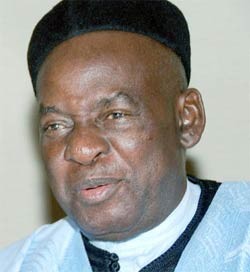
A Legacy of Integrity and Service
Engineer Muhammed Abba Gana, CON, stands as a beacon of integrity in the annals of Nigerian politics. His life and career offer a compelling narrative of service, sacrifice, and unwavering moral conviction. From his early days to his final years, he embodied the virtues that are often overlooked in today’s political landscape.
A Contrast in Abuja
In Abuja, where temptation has frequently overwhelmed principles and crippled consciences, Engineer Abba Gana’s record is a striking contrast with others who held high positions in government. He left office on May 29, 2003, after serving as Minister of the Federal Capital Territory, without acquiring a house, a plot of land, or even the whisper of scandal attached to his name. This, in a city that has for decades been synonymous with land speculation, inflated contracts, and the abuse of power, is remarkable to say the least.
His legacy is not simply in what he built or administered, but in what he refused to take, and in the incorruptible standards he set for himself and for the office he occupied and edified for a fleeting moment in our history.
The Laboratory of Nigerian Politics
From its inception, Abuja has been more than just a capital city. It has been a laboratory of Nigerian politics—a place where leadership is tested, where resources are contested, and where reputations are either burnished or destroyed. Many ministers before and after Engineer Abba Gana have found the city a slippery terrain, filled with opportunities for personal enrichment.
The lure of land allocations, the temptation of contract manipulation, and the pressure to serve sectional interests have undone many otherwise promising careers. Into this treacherous environment stepped Engineer Muhammed Abba Gana. With quiet resolve and deep moral conviction, he charted a different course.
The Hallmark of Public Life
The hallmark of Engineer Abba Gana’s public life has always been service and integrity. These are no longer fashionable virtues in Nigeria’s political space today, but they remain the qualities without which public office is reduced to mere speculation, plunder, and profiteering.
Engineer Abba Gana consistently demonstrated that integrity is not about grand gestures or loud proclamations, but about the quiet refusal to bend principle for gain. As minister, he was known for resisting pressure from powerful quarters, for turning down dubious deals, and for treating land, the lifeblood of Abuja politics and power play, as a trust rather than a commodity.
A Democrat in the Truest Sense
But Engineer Abba Gana was not merely an administrator; he was a democrat in the truest sense. Long before and long after his tenure as minister, he devoted himself to Nigeria’s difficult march toward democratic governance. He was an active participant in party politics, a loyal stalwart of his political family, and a consistent advocate of dialogue and compromise.
In Nigeria, where politics is often a zero-sum game, his approach was one of tolerance and balance. He believed in institutions rather than personalities, in processes rather than shortcuts and expediences. He understood that democracy is not perfected overnight, but through patience, negotiation, and the cultivation of trust.
Influence Across the Nation
Beyond Abuja, Engineer Abba Gana’s influence radiated across Nigeria’s political landscape. He served as Political Adviser to the President, a position that required both discretion and wisdom. In that role, he provided guidance at moments of national difficulty, always seeking to lower the temperature of politics and to emphasize the need for stability.
He was a bridge-builder, someone trusted across divides, and someone whose advice was valued because it was grounded in honesty rather than expediency. His service spanned decades, and in every role he left behind a reputation for integrity.
A Refreshing Reminder
In contemporary Nigeria, where cynicism about politicians and public officials runs deep, Engineer Abba Gana’s story is a refreshing reminder that another way is possible. His life is proof that one can serve the state without exploiting it, that one can hold high office without succumbing to greed, and that one can leave government poorer in material terms but richer in moral integrity and respect.
Today, as Nigeria grapples with profound challenges of governance, insecurity, development, and national cohesion, the example of Engineer Muhammed Abba Gana shines even brighter. It is not only a personal story of integrity; it is a national lesson in leadership.


