
Understanding the 30% Safe Asset Rule in Retirement Pension Accounts
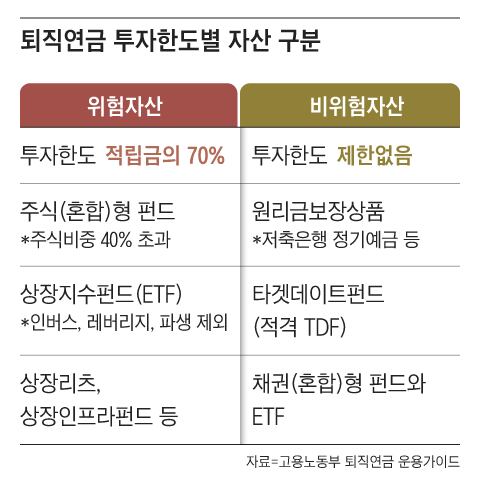
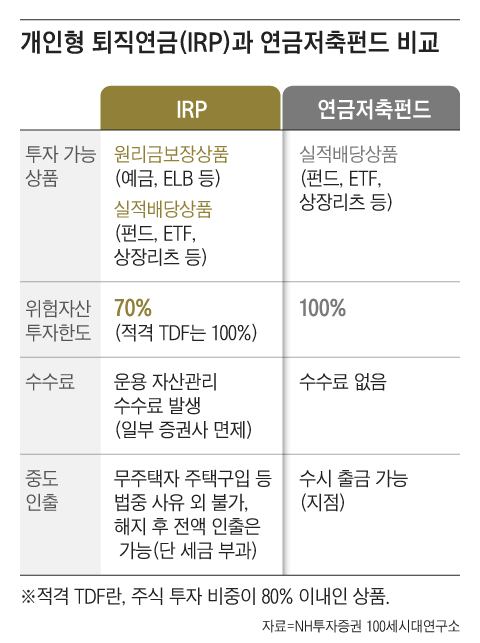
Retirement pension accounts are subject to specific investment regulations designed to ensure long-term stability. One of the most critical rules is the “30% safe asset rule.” This regulation mandates that at least 30% of the total accumulated funds in a retirement pension account must be allocated to safe assets, such as deposits and bonds. The remaining 70% can be invested in risk assets like equity funds, ETFs, and REITs. The rationale behind this rule is to balance the need for returns with the importance of preserving capital.
How to Earn Returns Despite the 70% Retirement Pension Regulation
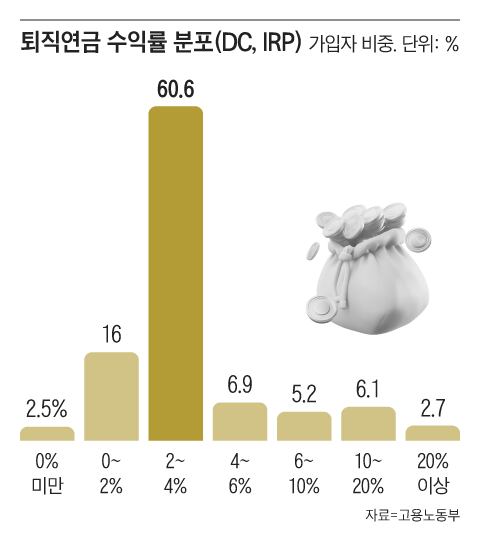
While the 30% safe asset rule is mandatory, many investors find it challenging to achieve satisfactory returns in an environment of low interest rates and high inflation. Locking funds in deposits or bonds that yield only 2–3% annually feels inadequate for long-term financial planning. To address this issue, a niche product known as the “fill-in ETF” has emerged. These hybrid products combine safe and risk assets, allowing investors to comply with the 30% safe asset rule while still pursuing additional returns.
As a reporter managing my own retirement pension, I conducted extensive research on these products and reached out to major asset management companies to gather insights on their offerings.
Betting on the U.S. Market: A Strategy for Growth
This year’s new “fill-in ETF” products have shown a strong focus on the U.S. market, which has delivered impressive returns over the past decade. Many of these products adopt a “sword and shield” strategy, investing in the high-growth U.S. market while hedging downside risks with stable bonds.
However, the characteristics of these products vary depending on the asset manager. Some are index-based, while others are stock-based or composed of U.S. and Korean bonds.
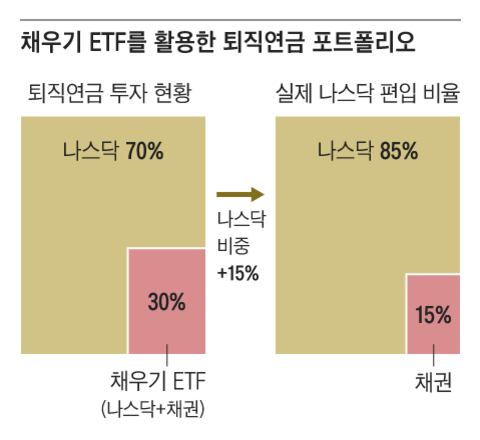
Four new “fill-in ETFs” investing in the Nasdaq were launched this year. Compared to earlier versions, their risk asset ratio has increased to 50%. If 70% of total funds are allocated to Nasdaq ETFs and the remaining 30% to “fill-in ETFs,” approximately 85% of the total is effectively invested in the Nasdaq.
Key Products and Their Features
Samsung Active Asset Management’s KoAct US Nasdaq Bond Hybrid 50 Active is an active fund that splits investments equally between 25 Nasdaq stocks and domestic short-term bonds. It focuses on promising stocks like NVIDIA, Palantir, Broadcom, and Bloom Energy. However, returns may fall short if the fund manager’s judgment diverges from market trends.
Hanwha Asset Management’s 1Q US Nasdaq 100 US Bond Hybrid 50 Active invests 50% each in the Nasdaq 100 index and U.S. short-term bonds (maturity under 6 months). It lowered fees to 0.05% to offset its late-mover disadvantage. The 1Q US S&P 500 US Bond Hybrid 50 Active, launched in June, also boasts cost efficiency with a 0.15% fee.
Hanwha Asset Management’s PLUS US Nasdaq 100 US Bond Hybrid 50 is a diversified product mixing 50% Nasdaq 100 and 50% U.S. short-term bonds. Its risk assets include the Nasdaq 100 ETF QQQM, NVIDIA, and Apple. As a currency-unhedged product, it offers dollar investment benefits. The PLUS US S&P 500 US Bond Hybrid 50, launched in June, follows the same strategy, evenly holding U.S.-listed S&P 500 ETFs like VOO, SPLG, and IVV.
Timefolio Asset Management’s TIMEFOLIO US Nasdaq 100 Bond Hybrid 50 Active combines global tech leaders like Alphabet, Meta, and Tesla with domestic short-term bonds (3–6 months). True to its reputation as an “active shop,” the fund manager actively trades, achieving a 25% return in six months and attracting over 1.1 trillion Korean won in assets within seven months. However, its total cost of 0.52% is relatively high compared to peers.
Shinhan Asset Management’s SOL US S&P 500 US Bond Hybrid 50 splits investments between the S&P 500 and 10-year U.S. Treasuries. Unlike other products, its long-term bond exposure means returns may fluctuate with interest rate changes. It pays monthly dividends, with distributions of 36 won in September and 16 won in October. The SOL US Dividend US Bond Hybrid 50, also a monthly dividend product, invests 50% each in 100 U.S. dividend stocks and 10-year U.S. Treasuries.
The first-generation “fill-in ETF,” Korea Investment Management’s ACE US Nasdaq 100 US Bond Hybrid 50 Active, increased its risk asset ratio from 30% to 50% last month and changed its name. It invests half in the ACE US Nasdaq 100 ETF, QQQ, and NVIDIA, with the remainder in U.S. short-term bonds. It currently holds over 300 billion Korean won in assets.
How to Raise Risk Asset Ratio to 94% with TDFs
Target Date Funds (TDFs), which automatically adjust asset ratios based on retirement timelines, are classified as safe assets in retirement pensions. Utilizing TDFs can push the risk asset ratio in a retirement pension account up to 94%.
Samsung Asset Management’s KODEX TDF2060 Active consists of 80% global stocks and 20% domestic bonds. If fully allocated to the “30% safe asset” portion, the account’s overall risk asset ratio reaches 94%. As the retirement date (2060) approaches, the equity ratio decreases, making it suitable for investors in the asset-accumulation phase with over 10 years until retirement. The total fee is 0.37%. For those nearing retirement, the KODEX TDF2030 Active, with a higher bond ratio, is more stable.
Note that the government is considering excluding ETF-formatted TDFs from retirement pension safe assets, so future regulatory changes should be monitored.
Buffett’s Safe Asset Choice: Should You Follow?
For stable returns without complex investment decisions, Mirae Asset Global Investments’ TIGER US Ultra-Short-Term (3 Months or Less) Treasury Bonds, launched in April, is an option. It mirrors the U.S. ETF “SGOV,” famously purchased by Warren Buffett. SGOV, managed by BlackRock as the “iShares 0–3 Month U.S. Treasury Bond ETF,” serves as the benchmark. The TIGER product pays monthly dividends of 30–35 won and is highly stable. However, as it is unhedged, returns in won terms may decrease if the won weakens against the dollar.
“Dividend + Bonds” Combo for Ultra-Conservative Investors
Though not a 2024 “fill-in ETF,” Hanwha Asset Management’s PLUS High Dividend Stock Bond Hybrid is a sibling product to the domestic largest dividend stock ETF, PLUS High Dividend Stock. It invests 60% in Korean high-dividend stocks and 40% in Korean bonds. Over the past year, including dividends, it achieved a 15% total return. Since it invests in domestic stocks and bonds, exchange rate fluctuations are irrelevant. Its short bond maturity (under 3 years) reduces volatility, attracting conservative bank customers.
Monthly 2% Cash Bonus via Palantir Stock
Shinhan Asset Management’s SOL Palantir Covered Call OTM Bond Hybrid, launched in April, has already surpassed 1.7 trillion Korean won in assets. Currently priced at around 10,250 won, it has paid monthly dividends of 210–240 won (approximately 2%) since May, drawing investor interest.
It allocates 70% to domestic short-term bonds and uses a “covered call” strategy on Palantir stock, selling out-of-the-money call options to generate additional income. While steady cash flow is a strength, a decline in Palantir’s stock price could lead to valuation losses.
What to Do If You Receive a Risk Asset Excess Notification
If you receive a notification that your retirement pension’s risk asset ratio exceeds 70%, you don’t need to immediately sell profitable products to reduce the ratio. However, note that you cannot invest in new products until the risk asset ratio drops below 70%.


