Director-General of the Debt Management Office (DMO), Ms. Patience Oniha, has called on state governments, the Federal Capital Territory (FCT), and other stakeholders to treat debt management with utmost seriousness, stressing its critical implications for Nigeria’s fiscal stability.
She advised State Governments to strictly adhere to the provisions of the Fiscal Responsibility Act regarding borrowing.
Oniha said debt has become a crucial fiscal variable that must be properly managed to ensure sustainability, noting that governments cannot afford to get it wrong at a time of heightened economic pressures.
In addition to adherence to the relevant laws, she also urged the participants to ensure Responsible borrowing by their various sub-nationals.
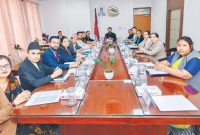
She spoke on Tuesday at the Northern edition of the States Action on Business Enabling Reforms (SABER) Workshop on borrowing guidelines for top policymakers, organised with the support of the World Bank.
“Really, at a time like this, we can’t stop talking about debt. Debt is such an important fiscal variable that we must get it right so that it can be sustainable,” Oniha said.
She explained that the workshop was designed to demystify the borrowing process, clarify documentation requirements, and empower senior policymakers to make informed decisions that would strengthen their states’ capacity to meet financing needs responsibly.
Emphasising strict adherence to borrowing guidelines and proper documentation, the DMO chief warned of the consequences faced by countries that have had to restructure their debts, including credit rating downgrades, reduced access to borrowing, revenue constraints, and increased debt service pressures.
“Debt is important, and that is why we continue to engage at these high levels. When you return to your offices, extend this knowledge to your colleagues,” she urged participants.
Oniha stressed that borrowing is governed by clear laws and procedures, noting that debt decisions cannot be taken arbitrarily, adding that the legal framework applies not only to states, but also to the Federal Government and the FCT.
She further cautioned that borrowing processes must be transparent and inclusive, with clearly defined purposes, proper documentation, monitoring, and reporting to ensure timely servicing of obligations.
“When debt is not serviced, the consequences are not good. That is when we talk about debt sustainability. If you don’t have proper records of your debt, how will you know what is due or when you have reached your limit?” she asked.
According to the D-G, “We have been doing capacity building for what we call the sub-national governments, meaning the 36 states of the Federation and the Federal Capital Territory to put them through the things that we do, debt recording, debt sustainability analysis, medium-term debt management strategy, how to record debt, all of that we put them through.
“This is very important because we the states to be familiar with the guidelines for borrowing, to adhere to the provisions of the Fiscal Responsibility Act which have set the conditions for borrowing.
“This part of it -which is the workshop on borrowing guidelines. It is a targeted training. So it’s not about what your debt stock is. It’s a case of what the requirements are, and what the process for borrowing is.
“Our experience several years back was that, each time a state wanted to borrow, because one way or the other, based on the laws, the Fiscal Responsibility Act, the DMO Act, and the Investment and Securities Act, it had to pass through the Honorable Minister of Finance and through the Debt Management Office. So we saw the process was taking time, because there wasn’t clarity or understanding. That was when we initiated this workshop.
“Maybe five years ago, we had the first one in Lagos. But this time, we decided to split it to accommodate more people.
“As you saw today, each state has about five, six, or some eight people, so that they can all understand the borrowing guidelines which basically explain the major laws that govern borrowing.
“There’s the Constitution of the Federal Republic of Nigeria, there’s the Fiscal Responsibility Act, and then there’s the Debt Management Office Act, which has provisions for borrowing. What that means is that there’s no flexibility. If it’s in the law, you really have to comply.
“So how do we make the process work? How do we make the sub-national governments understand the process of borrowing, so that they can raise the funds that they need for development?
“This is very critical because if they haven’t understood the process, they can’t comply and they can’t raise the funds. So any lender, whether they’re borrowing from, even if it’s from a development finance institution like the World Bank, still has to go through that process.
“The idea is to equip them with all the skills, the knowledge they need, so that each time they want to borrow, they are ready and the process is smooth.
“Ultimately, the expectation is that the funds that they raise will be used for development in the state.”
Also speaking, the Acting Head of Service of the Federal Capital Territory, Mrs. Nancy Sabanti Nathan, urged participants to critically review their borrowing practices following the workshop.
She encouraged collaboration, open engagement, and knowledge sharing among participants, noting that collective efforts are essential to ensuring effective and sustainable borrowing strategies.
“Together, we can ensure that borrowing strategies are not only effective but sustainable, fostering growth and prosperity for current and future generations,” Nathan said.
She added that access to finance remains a critical enabler of development, stressing the need for states and the FCT to be equipped with the right knowledge and tools to navigate the complexities of borrowing in an evolving economic landscape.
FROM NIGERIAN TRIBUNE
Provided by SyndiGate Media Inc. (Syndigate.info).