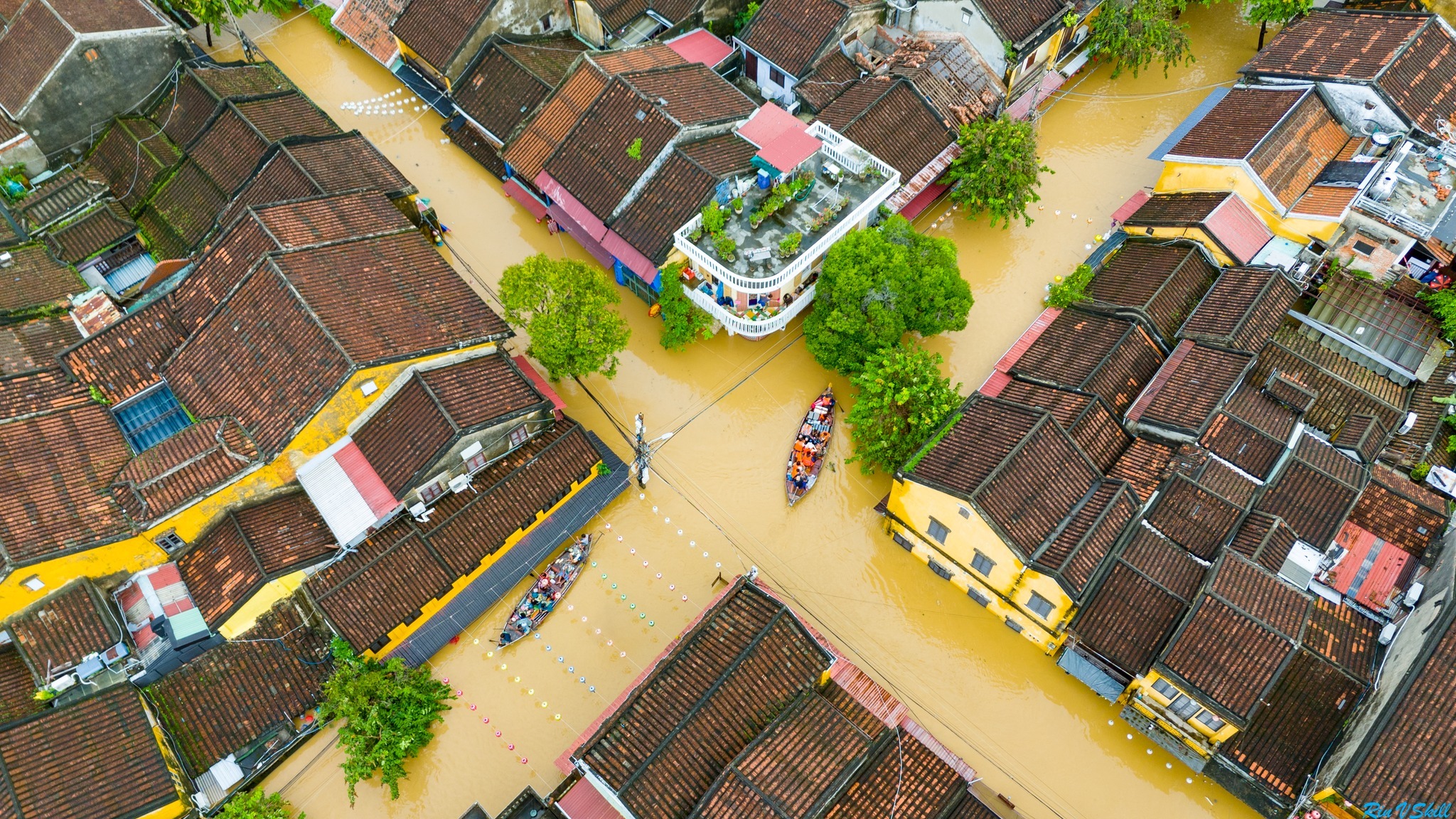
Many tourists visiting Hue, Da Nang, and Hoi An found themselves in an unexpected situation as floodwaters submerged key attractions and hotels, disrupting their travel plans. The sudden and severe flooding has left many travelers shocked and forced them to adjust their itineraries.
Noa, a French traveler, had planned a trip across Vietnam from north to south with a group of friends. They arrived in Hue on October 26, just as the weather began to deteriorate. Initially, they were supposed to visit the Imperial City the next day, but their tour guide suggested they go earlier due to the heavy rain, fearing the site might close.
“We started our trip with light flooding, but no one expected the situation to escalate so quickly,” Noa said. At first, the group remained calm as locals seemed unfazed and in good spirits. However, an hour after leaving the Hue Citadel, the water rose above their knees, making it difficult to reach their hotel. They had to navigate through congested streets filled with boats and flooded cars.
Noa shared, “Many people in the group began to fear being stuck in the rising floodwaters. Luckily, we were able to return to the hotel without losing electricity and water.” All sightseeing plans were canceled, and the group had to change their itinerary, flying directly to Ho Chi Minh City instead of stopping in Hoi An.
Kylie, a Canadian tourist, was in Hoi An during the peak of the flooding between October 26 and 28. She had known it was the rainy season in the central region but had not anticipated such deep flooding. “I live in Vancouver, where it rains and stays cloudy year-round. But the floods in Hoi An are on an entirely different scale, far beyond anything I could have imagined.”
What struck her most was how people continued with their daily lives, working and living as though “nothing was happening.” Despite the floods, everyone remained calm and smiled, facing the situation with incredible composure. She stayed at a hotel along the Hoai River, an area that was severely flooded. The entire lobby and first floor were submerged. On October 27, a day after the flooding began, the water levels were still rising, and the hotel had lost power. Tourism in the old town was nearly paralyzed.
She said, “Can’t go anywhere, can’t do anything. Shops were closed, floodwaters were everywhere.” On the morning of October 28, after being trapped for 48 hours in the floodwaters, Kylie was helped by the hotel staff to board a boat that took her out of the flooded area and toward Da Nang, where she caught a flight to Ho Chi Minh City. By the time she left, the water had almost reached the second floor of the hotel.
“The experience was unbelievable and definitely unforgettable,” she said, adding she would definitely return but during the dry season.
Gemma, an Australian traveler, visited Hoi An with her mother and brother during a 17-day trip around Vietnam. The trip had been planned well in advance, and the family only learned about the flooding after they had already booked tickets. “Friends assured us that by the time we arrived in Hoi An, the water would have receded, and so we weren’t too worried,” she explained.
The family arrived on October 26 and had planned to stay five nights. They had originally booked a hotel near the beach, but bad weather forced them to cancel their beach vacation plans and move to the old town. However, upon arrival, they were shocked to see the flooding in the streets.
“The sight of the sea in the old town was a completely new experience for my family,” Gemma said. This meant the Airbnb unit they had rented had to cancel their booking due to power outages and the rising water levels. All activities in the old town had ceased, and restaurants were closed.
But Gemma and her family made the best of the situation and tried to enjoy the trip. Wading through the water with other tourists was “memorable and different” from her previous visits to Hoi An, she said.

Gemma’s family wear raincoats and wade through floodwaters in Hoi An, October 2025. Photo courtesy of Gemma
She too was impressed by the way locals responded to the natural disaster: “They were calm, walking or cycling through the flooded areas. Life just goes on.” Her family received a lot of assistance from locals and hotel staff, such as finding new accommodation and having their luggage transported by boat through the flooded areas.
In Da Nang, Indonesian tourist Aditya endured several days of heavy rain. He arrived in the city on October 25 intending to stay for a week of relaxation, but the continuous downpours canceled all his outdoor plans. He had previously visited Lombok in his home country, climbed Mount Rinjani during the rainy season, and even experienced a motorbike accident.
“The weather in Da Nang this time has been much more extreme,” he remarked. He took a leisurely approach, though, sipping coffee, enjoying pho, going to the spa, and walking around in the rain. As soon as the sun appeared briefly, he rushed to the beach, only for the rain to start again shortly afterward.
Originally, he had planned to spend seven days in Vietnam, including a stop in Hoi An, but the severe flooding forced him to stay in Da Nang until it was time to head home.
Though the heavy rains and floods disrupted their trips, Noa, Kylie, Gemma, and Aditya all agreed that it was an unforgettable experience. “The weather was harsh, but the Vietnamese people were wonderful,” Aditya said.
The heavy rainfall in the central region was due to a combination of cold air, tropical convergence zone, and easterly winds from the ocean. Since October 23, the region between Quang Tri and Quang Ngai has received very heavy rain, with Hue receiving an average of 500-700 mm between the evening of October 24 and the morning of October 28. Hue and Hoi An are now grappling with the worst flooding in years, with torrential rains submerging ancient landmarks, streets, and homes.


