There are physical data that even OpenAI or Google find difficult to access. Our goal is to create new value by applying artificial intelligence (AI) to the on-site data hidden throughout the industry.
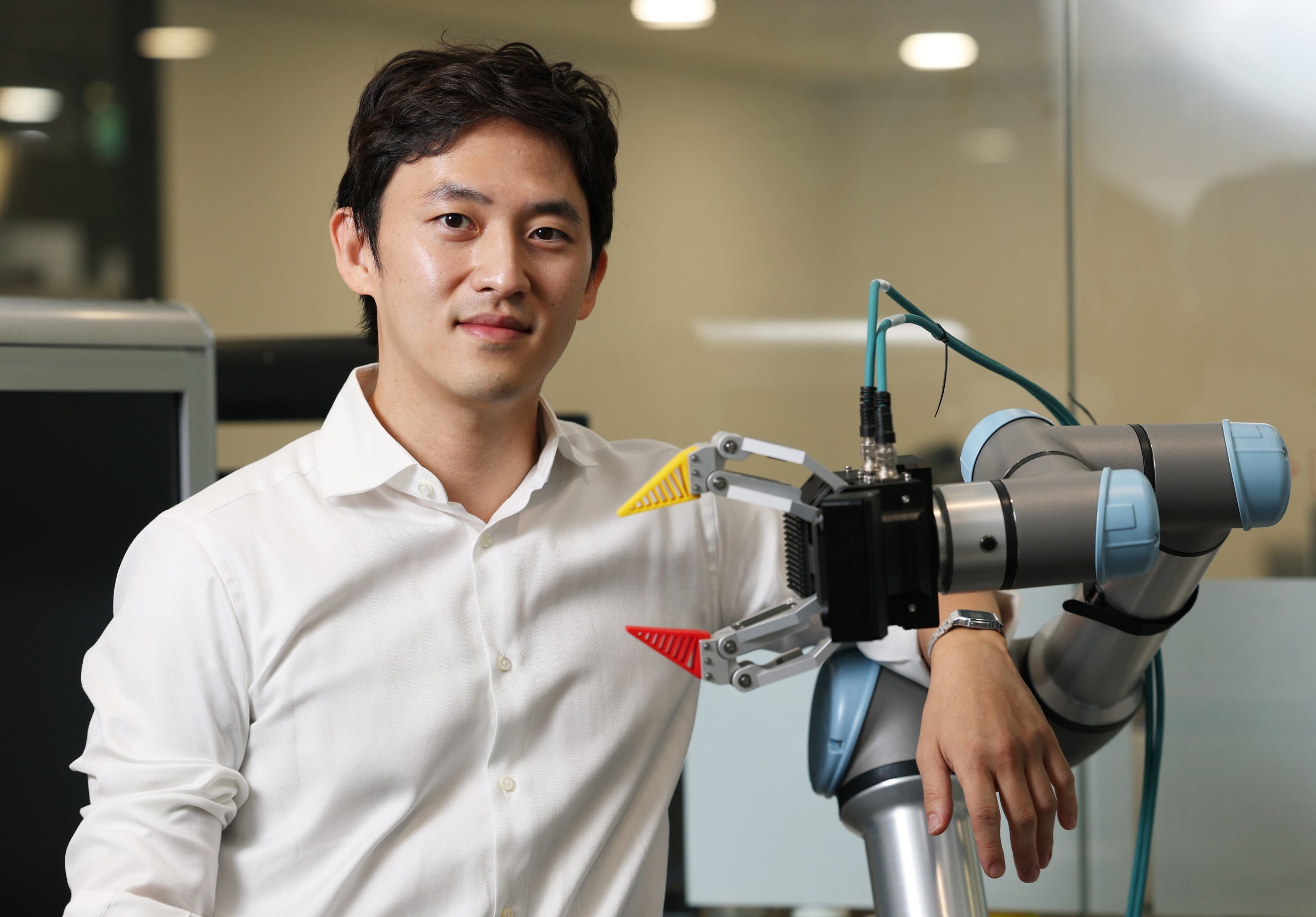
Moon Tae-yeon, CEO of Carbon Black, shared this insight during an interview with this publication at the company’s office in Seocho-gu, Seoul. Moon, who co-founded Sualab, which was acquired by Cognex for $200 million in 2019, has now established Carbon Black after five years of development. This marks his first media interview since the sale of Sualab.
Manufacturing Field’s ‘Digital Rare Earth’
AI models like ChatGPT and Perplexity have gained popularity by learning from vast online data. However, there is a critical data layer they cannot access: the physical data found in industrial sites. Moon refers to this as the “digital rare earth,” emphasizing its importance similar to rare earth elements for advanced industries. Spencer Hwang, General Manager of NVIDIA Robotics, also highlighted South Korea as a high-growth market due to its vertically integrated manufacturing factories.
Carbon Black operates under the “company builder” model, which is uncommon in Korea. This approach involves internally developing ideas and investing initial capital, personnel, and systems to establish and grow another company. Unlike venture capitalists (VCs), company builders take on the role of active founders and investors. In the U.S., the venture studio model has already developed, with companies like Flagship Pioneering creating over 100 companies in 20 years. Moderna, known for its COVID-19 vaccine, was also born through this model.
Moon stated, “There are many attractive business ideas in the physical AI sector that no one has yet monopolized.”

‘Thinking Robots’
The first company launched by Carbon Black in September last year is Carbon Six, which develops physical AI specialized for manufacturing. Moon personally recruited co-CEO Kim Je-hyeok and CTO Seo Hyung-joo, researchers from MIT and Yale University, by traveling to the U.S. and Japan. Carbon Six aims to introduce robot automation even to manufacturing processes that are difficult to predict and vary depending on the situation.
On the 18th of last month, they released their first product, the ‘Sigma Kit,’ a robot combining software and hardware based on robotic AI imitation learning. The Sigma Kit learns by observing human actions and chose a toolkit (standard product) rather than a complete product to make it easily applicable in any field.
The Sigma Kit requires approximately 100 inputs per action through a teaching tool. Usually, all actions can be input within an hour. After learning this data for about a day, it can be introduced into the process the next day. Previously, experts had to be dispatched to the site for 1-2 weeks to manually code and adjust for automation robots. With the Sigma Kit, it can be utilized without AI expertise. The Sigma Kit flexibly responds to various variables through AI learning. In a demonstration, a robot attempted to peel a wet thin film; when it didn’t peel off in one try, it judged on its own and peeled it again. It is advantageous for non-standardized processes where shapes and situations vary each time, differentiating it from automation robots that repeat simple actions.
Carbon Six secured $4 million (approximately 5.7 billion Korean won) in seed investment from overseas VCs and established its headquarters in Delaware, U.S., targeting global market expansion. Moon explained, “Manufacturing factories are concentrated in Asia where labor costs are low, and South Korea has high accessibility. We plan to quickly verify and accumulate data here, then expand to the U.S., which is bringing manufacturing factories back. U.S. VCs highly evaluated this point.” According to the International Federation of Robotics’ 2023 report, South Korea’s robot density is 1,012 per 10,000 manufacturing workers, the only country exceeding 1,000, ranking first. This means there are many customers actively adopting automation solutions.
‘AI That Gets Smarter with Use’
The Sigma Kit exemplifies the core of Carbon Black’s physical AI business model. It can be applied with minimal data, allowing users to immediately experience automation benefits. As adoption increases, the company can accumulate more physical data, enabling the rapid construction of a large-scale robot foundation model. This overcomes the limitation of difficulty in building an initial data network, as physical data cannot be collected online. Moon explained, “A ‘data flywheel’ structure that collects data while providing immediate value is crucial.” This is similar to Tesla, which sells electric vehicles to collect driving data and build an autonomous driving network. It’s a virtuous cycle of providing products where customers quickly perceive benefits, collecting data, and releasing more advanced AI models.
The company name Carbon Black refers to the key substance that makes tires black. Moon, who majored in mechanical engineering, had a keen interest in industrial sites. As an undergraduate, he sent emails to 200-300 Korean SMEs expanding into Southeast Asia to gain firsthand experience in Asian manufacturing sites. He got the opportunity to work for six months at an Indonesian bicycle tire factory. This allowed him to experience everything from rubber plantations in Papua New Guinea, which import raw materials for tires, to the tire manufacturing process. When he returned home, black water would come out of his nostrils. Based on this experience, he co-founded Sualab with his senior Song Ki-young. It was his field experience that enabled him to identify the specific area of manufacturing vision inspection.
Carbon Black’s portfolio includes MechanicalAI, a company specializing in AI agent-based CAD design and analysis automation, and Upgrade Manufacturing, which focuses on AI-based supply chain management efficiency. They plan to continue founding companies in other fields.


