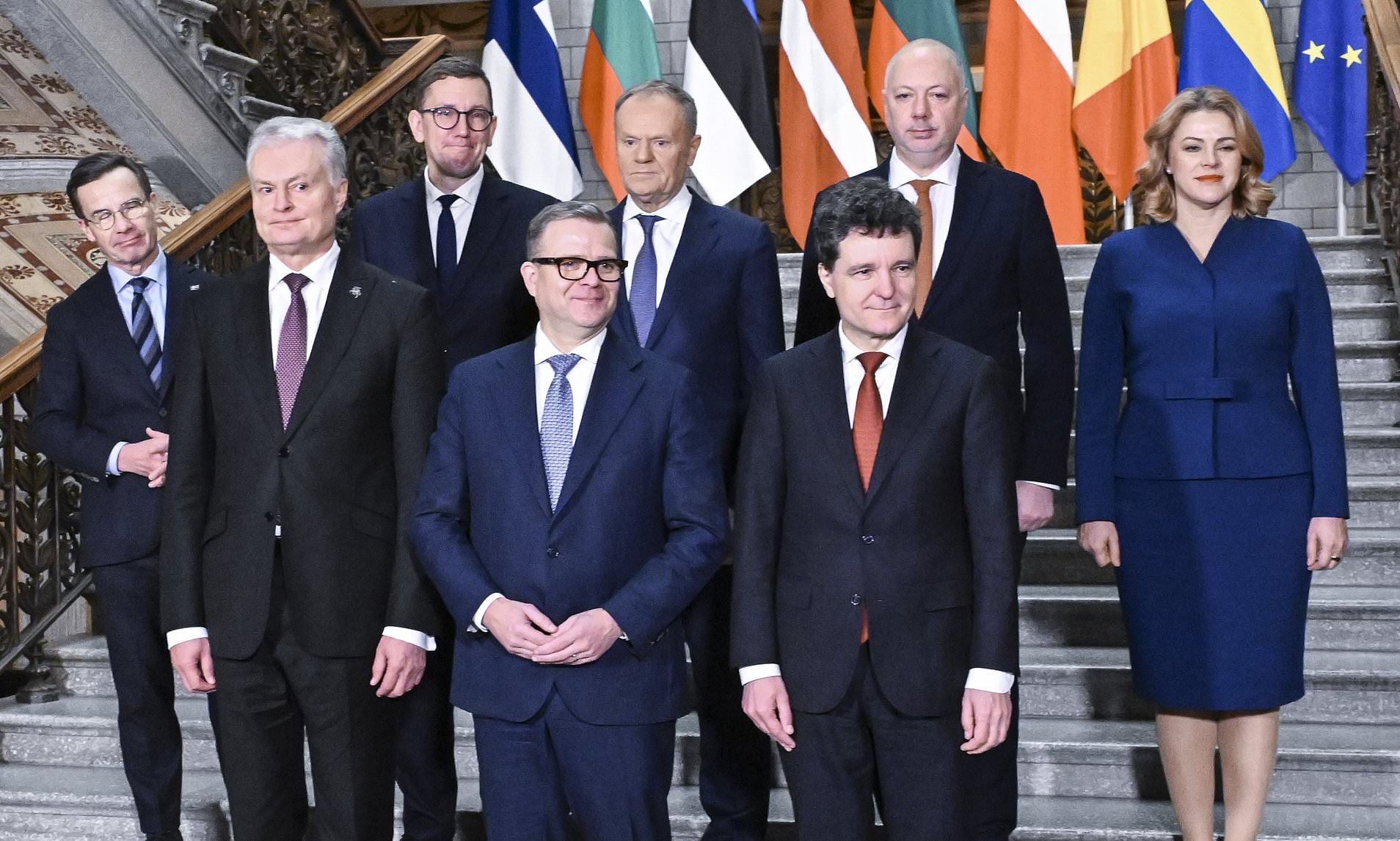
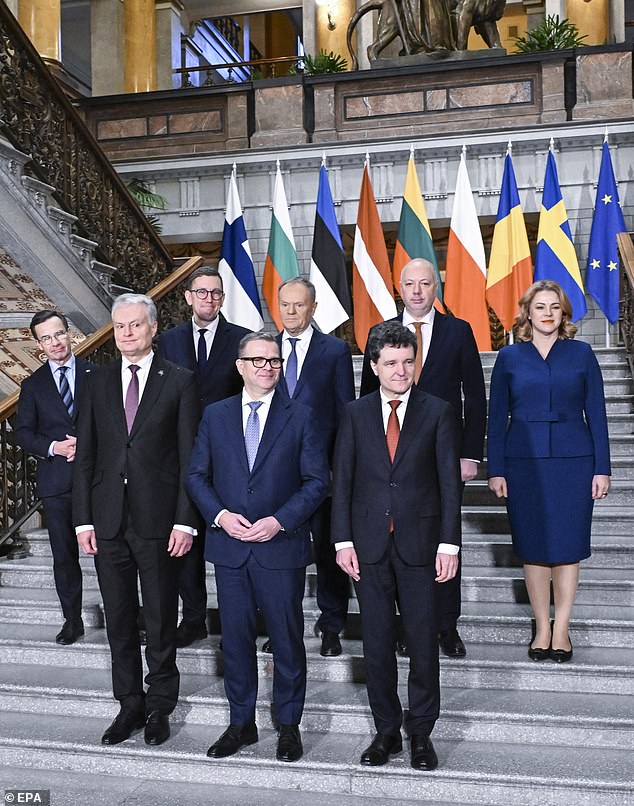
Defending Europe’s eastern flank is an ‘immediate’ priority for the European Union in the face of the threat posed by Russia, eight EU leaders meeting in Helsinki said today.
‘The situation calls for an immediate prioritisation of the EU’s eastern flank through a coordinated and multi-domain operational approach’, read a final declaration signed by the leaders of Sweden, Finland, Poland, Estonia, Latvia, Lithuania, Romania and Bulgaria.
That includes ‘ground combat capabilities, drone defence, air and missile defence, border and critical infrastructure protection, military mobility and counter mobility’, said the leaders, each of whom are in charge of NATO member states.
‘Russia remains a threat today, tomorrow and in the foreseeable future for the whole of Europe,’ Finnish prime minister Petteri Orpo said at a press conference.
Citing Russia’s ‘increasing… hybrid operations and acts of sabotage against Europe’, the leaders of the eight NATO nations said: ‘Russia is the most significant, direct and long-term threat to our security and to peace and stability in the Euro-Atlantic area’.
The statement reads: ‘Russia’s strategic goals remain unchanged: to create a buffer zone stretching from the Arctic region through the Baltic and Black Seas to the Mediterranean.
‘The Eastern Flank of the European Union and NATO is at the forefront of this threat, but the threat affects the entire European continent, calling for urgent and coordinated action.’
The declaration also placed blame on Belarus, one of Russia’s few allies in Europe, for taking part in hybrid warfare tactics that ‘underscore[s] the need to strengthen Europe’s resilience and defence’.
The European leader also called on the EU to support efforts to build up defence capabilities on the eastern flank, with Swedish PM Ulf Kristersson saying: ‘The EU can play an important role in supporting member states’ individual efforts to strengthen their defence capabilities by defining financing, by simplifying regulations and strengthening military mobility’.
‘The EU and NATO have obviously different important but very complementary roles in relation to the eastern flank.’
The statement is among the strongest collective rebukes of Russian aggression against Europe since Vladmir Putin launched his invasion of Ukraine nearly four years ago.
Since then, Moscow has tested the continent’s response to increasing aggression.
The most notable incident came in September this year, when Russia sent a swarm of drones into Polish airspace.
Polish and NATO planes were scrambled to investigate and destroy the drones, which Poland’s prime minister Donald Tusk said at the time ‘posed a direct threat’ to his nation.
In response, NATO launched Operation Eastern Sentry, a move to increase the bloc’s attack and defence capabilities on Europe’s eastern flank.
Just over a week after the drone incursion into Poland, three Russian fighter jets flew into Estonian airspace.
The MiG-31 planes, heavy interceptors capable of carrying Kinzhal hypersonic missiles, circled for around 12 minutes before NATO scrambled a series of Italian F-35s to send them away.
And just last week, Russian foreign minister Sergey Lavrov issued a veiled threat to Finland, warning of consequences if it did not leave NATO.
Tuesday’s declaration comes as Ukraine, backed by European countries, tries to reach a compromise with the United States on a proposal to end the war, of which the initial version was deemed favourable to Moscow.
Volodymyr Zelensky said late last night that peace deal proposals that may end the nearly-four-year invasion of Ukraine could be finalised in the coming days.
He said a draft peace plan discussed with American officials during talks in Berlin earlier in the day is ‘very workable.’
If these plans are finalised, then they will be presented to the Kremlin before further possible meetings in the US next weekend.
The US on Monday said that there’s consensus from Ukraine and Europe on about 90% of the peace plan, while Donald Trump added: ‘I think we’re closer now than we have been, ever’ to a peace settlement.
But Zelensky warned that key issues, including the fate of Ukrainian territory captured by Vladimir Putin’s invading forces, are yet to be resolved.
He reiterated that Kyiv rules out recognising Moscow’s control over any part of the Donbas, an economically important region in eastern Ukraine made up of Luhansk and Donetsk, neither of which Russia’s army fully controls.
‘The Americans are trying to find a compromise,’ Zelensky said, before visiting the Netherlands on Tuesday. ‘They are proposing a “free economic zone” [in the Donbas region]. And I want to stress once again: a “free economic zone” does not mean under the control of the Russian Federation.’
Read more
- As Europe’s leaders rally behind Ukraine, what critical actions are being taken to fortify the continent against Russian aggression?
- Are European leaders, rallying behind Zelensky, ready to defy Trump’s surprising shift in policy to fast-track a peace deal with Russia?
- Will Europe’s leaders unite to counter Russian aggression after Trump’s explosive clash with Zelensky in a tense Washington showdown?
- Will Europe and the US hold the key to Ukraine’s defense against Putin amid Zelensky’s controversial maneuvers?
- Will Europe’s bold leaders finally cut reliance on America and boost their own military might to shield Ukraine and secure the continent’s peace?