The Government’s Revival of Embossed Number Plates in Nepal
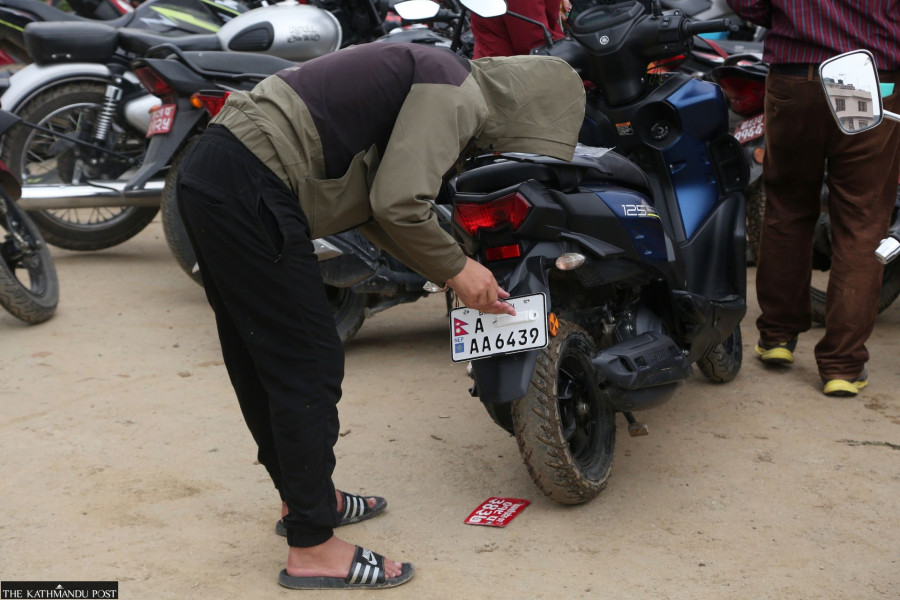
The government has announced that all registered vehicles in Nepal must carry embossed number plates starting from September 17, reviving a long-delayed initiative first introduced in 2021. This move is expected to digitize vehicle records, enhance traffic security, and align the country with global standards. However, the decision has once again sparked public resistance over various concerns, including high costs, the use of English script instead of Devanagari, and inadequate technical preparedness.
The enforcement of embossed number plates was decided during a thematic committee meeting chaired by Minister for Physical Infrastructure and Transportation Devendra Dahal on August 5. Attendees included ministers and secretaries from all seven provinces. The meeting also resolved to coordinate with the Ministry of Home Affairs to mobilize traffic police for enforcement. From mid-September, transport offices across the provinces will issue embossed number plates during vehicle registration, ownership transfer, and renewal.
Officials claim that the system will help digitize records, strengthen monitoring, and ensure more secure and tamper-proof plates. Director General at the Department of Transport Management, Rajeev Pokharel, stated that although the service will be available from September 17, there is no mandatory requirement to obtain it within a specific timeframe. “It will be implemented gradually,” he said.
According to the government’s pricing structure, owners will have to pay Rs2,500 for motorcycles and scooters, Rs3,200 for cars, jeeps, vans, and tractors, and Rs3,600 for heavy vehicles during installation of the embossed plate. The project was initially rolled out in 2021 but faced delays due to public resistance and confusion.
Now, the government’s plan to replace current number plates with embossed ones has reignited controversy. Public debate has largely centered on the use of English language on the plates, their quality, and their high cost. Transport expert Ashish Gajurel pointed out that public opposition is natural because people are being asked to pay significantly more for number plates than they currently do. He emphasized that the government has failed to clearly communicate the benefits of embossed number plates, which has fueled resistance. Gajurel also suggested that Devanagari script should be used on the plates.
Nepal is the only South Asian country yet to introduce embossed number plates. Globally, around 95 percent of countries have already adopted the system. One of the key controversies is the use of English on the plates. Previously, the government justified this by citing the BBIN (Bangladesh, Bhutan, India, Nepal) agreement, arguing that uniformity was needed for cross-border transport. However, Bhutan has withdrawn from the BBIN framework, and relations between Bangladesh and India have soured, raising further questions about the rationale.
An embossed number plate features camera-readable digits and is embedded with an RFID (radio-frequency identification) microchip. Officials claim that this technology will help trace vehicles in cases of theft, disappearance, or accidents. However, there are only two RFID-enabled gates in operation across the country, leading to criticism that the government rushed to implement embossed number plates before completing necessary technical preparations.
Krishna Pant, an official overseeing the transport sector under the Ministry of Physical Infrastructure and Transport, acknowledged this criticism. He mentioned that while two gates are ready for full operation and others are under construction, the government needs to accelerate these preparations. Pant added that since the contract period with the company responsible for producing embossed number plates is nearing its end, the government is determined to move ahead with implementation this time.
Meanwhile, the Federation of Nepalese National Transport Entrepreneurs, along with other transport operators, has criticized the government’s decision as “impractical.” Saroj Sitaula, senior vice-chair of Transport Entrepreneurs, noted that similar announcements in the past did not work and questioned the feasibility of the current plan. He also expressed concerns about the use of English on the plates, as many Nepalis are still uncomfortable with it in daily life.
In a statement, the Federation’s General Secretary Deknath Gautam called on all transport entrepreneurs to defy the government’s order to convert number plates into embossed ones. He argued that the decision can only be implemented after the government ensures proper technology and logistical arrangements are in place, so that people do not face unnecessary hassles.
The government’s plan to launch embossed number plates dates back a decade. It was included in the Three-Year Interim Plan 2007-2010 but was put on hold due to various reasons, including delays in conducting a proper study to roll out the project. In 2016, the government attempted to distribute embossed number plates based on the provincial structure, but this was halted in 2018 when the Supreme Court issued an interim order to stop the distribution. The court later vacated the stay order in 2019, allowing the resumption of embossed number plate distribution.


