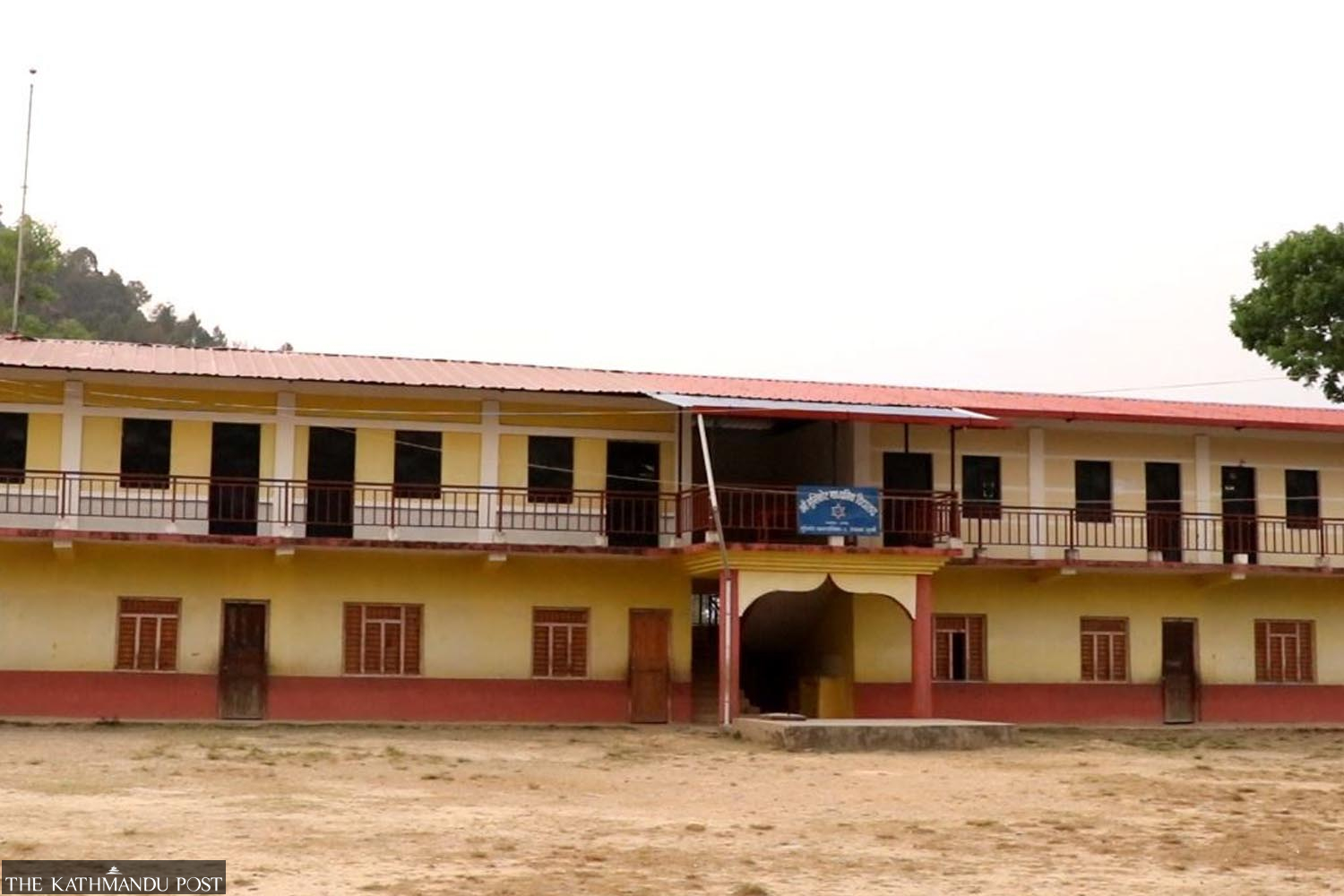
Persistent Teacher Shortages in Nepal’s Rural Schools
In various districts across Nepal, the shortage of qualified subject teachers has become a critical issue affecting the quality of education. This problem is particularly evident in secondary schools where the absence of mathematics, science, and English teachers has led to significant disruptions in teaching and learning.
Musikot Municipality in Gulmi has repeatedly tried to fill vacancies for a secondary-level mathematics teacher under the federal grant programme. Despite issuing the vacancy announcement 15 times, there were no applicants. The education branch of the municipality has also struggled for over a year and a half to hire English and science teachers, with the posts remaining unfilled. Shyam Thapa, principal of Musikot Secondary School, explained that the school is now forced to use lower secondary teachers for higher classes, which has made teaching extremely challenging.
Similar situations are reported in other regions. In Malika Rural Municipality’s Jamal Pokhara Secondary School, three advertisements for science teachers went unanswered. Principal Dhundhi Raj Aryal stated that the school now relies on lower secondary teachers to cover higher grades. At Shukra Secondary School in Khadgakot, four advertisements for a math teacher resulted in no applications. Principal Prem Bahadur Pun mentioned that due to student complaints, lower-level teachers have been assigned to teach secondary classes as well.
The lack of qualified subject teachers has severely impacted the quality of education. Thaneshwar Ghimire, chief of the Education Development and Coordination Unit in Gulmi, noted that finding mathematics, science, and English teachers has become nearly impossible, leading to a visible decline in educational quality.
This issue is not limited to Gulmi. In Kapilvastu district, Aniruddha Public Secondary School has published four advertisements in the past eight months for lower secondary math and science teachers but could not appoint anyone. Principal Ramesh Kumar Pandey said that the burden has shifted to existing teachers, causing strain on both students and staff. Even offers for teachers from other districts have not attracted interest.
Krishnanagar Municipality announced 51 volunteer teacher positions last year, but no one applied for mathematics. Students performing poorly in these subjects is unsurprising. Last year, out of 9,000 students who sat the Secondary Education Examination (SEE), 3,400 failed, with 2,400 failing in mathematics alone.
Education officials attribute the shortage to structural reasons. Arjun Kunwar, an education officer, explained that students who study math and science often pursue careers in medical science, engineering, computer science, or forestry. Those who remain may migrate abroad, and among those who stay, very few want to pursue a teaching career. These technical subjects do not attract enough candidates.
In Bardiya, repeated advertisements bring little relief. Dal Bahadur Chaudhary, senior education officer of Rajapur Municipality, noted that while some applicants may come after a couple of calls for mathematics and English, no one comes forward for science. Many who studied science lack teaching licenses, and those who do are not interested in rural postings.
The situation is even worse in remote districts like Kalikot. Kalika Secondary School in Shubhakalika Rural Municipality advertised for a science teacher five times in the last academic year but found no eligible applicant. Principal Saraswati Basnet mentioned that the federal grant for science was returned unused, and the school eventually hired an unlicensed teacher by collecting Rs25,000 monthly from parents.
Man Bahadur Shahi, chairman of ward 2 of Shubhakalika, admitted that even offering higher pay failed to attract qualified staff. Nawaraj Acharya, head of the education, youth and sports branch of Shubhakalika, said that the federal grant for three subjects is going unused in many of their schools.
Principals complain that the licensing requirement is another barrier. According to them, even after completing a bachelor’s in science, one must either work for a year or complete a one-year B Ed to get a teaching license. Those with licenses prefer government service jobs or urban postings, leaving remote schools behind.
Veteran educators describe desperate measures. Man Bahadur Rokaya, principal of Dudhesillo Secondary School, mentioned that he contacted networks across the country to find a science teacher. When no one came, he convinced a neighboring school’s science teacher by offering an additional 10,000 rupees from their own funds. Even then, retention remains uncertain.
The shortage is not confined to rural districts. According to the Teachers Service Commission, out of 290 lower secondary science positions announced last year, only 281 could be recommended. While 3,873 people applied, just 1,213 passed the preliminary test, and only 326 cleared the subject exam. At the secondary level, merely 11 percent passed the science teacher recruitment exam. For English and mathematics, the success rates were just 4 and 11 percent, respectively.
Madhu Prasad Regmi, chairperson of the Teachers Service Commission, explained that the problem is twofold: too few posts in mathematics, science, and English compared to demand, and teachers not wanting to go to remote areas. Even when permanent posts are filled, temporary or contract positions remain empty across the country.
Regmi also noted a deeper trend: those who pass often do not stay. As soon as they get the chance, they move to other government services, making long-term stability difficult to ensure.
A recent study by the Ministry of Education confirms that while there are more posts than needed at the primary level, both secondary and lower secondary schools face severe shortages. As the shortage deepens, the quality gap between rural and urban schools continues to grow. For parents in districts like Gulmi and Kalikot, it is a daily anxiety. Ward chairperson Shahi said, “We want our children to learn science and math properly. But without teachers, we are watching their future slip away.”


