Plus other fun facts about bell peppers to fascinate your friends.
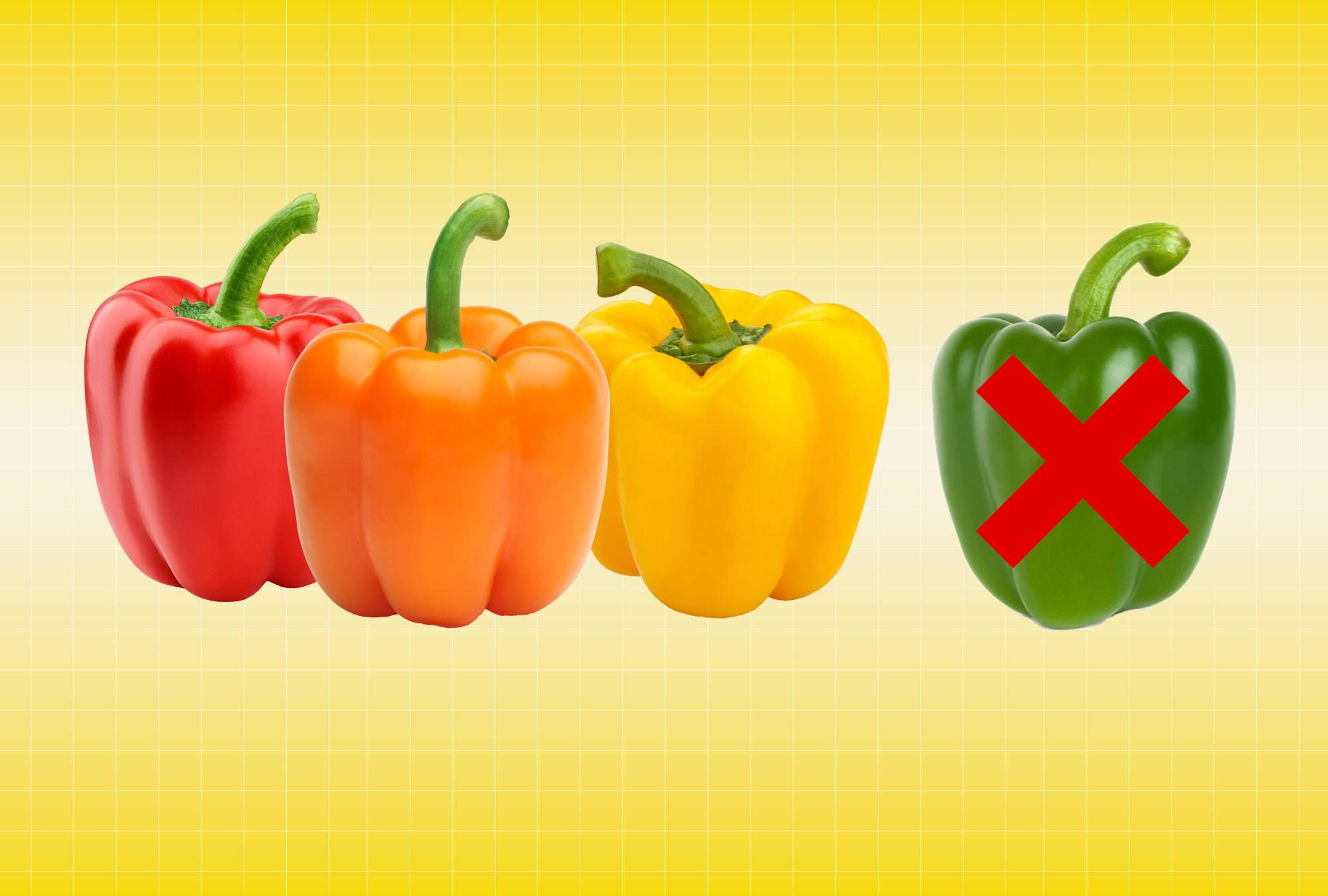
” in order to get the widest variety of nutrients. But when you pick up a three-pack of bell peppers at your local grocery store, you might notice that those colors are always the same—red, yellow and orange. But, paradoxically, there’s often a large display of single green peppers stacked up nearby. What gives?
The background story on this green-free predicament can be summed up with a couple well-worn adages: 1) follow the money and 2) chef knows best. Here’s why you won’t find green peppers in a three-pack of bell peppers.

6 ‘Bad’ Foods You Should Be Eating for Better Heart Health, According to Dietitians
Reason No. 1: Follow the Money
,” he explains. “So putting one much cheaper pepper in a sealed package with costlier red, yellow and/or orange peppers gives customers the sense that they aren’t getting a good deal.”
It comes down, as so many things do, to economics. “You can buy the green ones in bulk and pay less overall,” Schueller says. Customers haven’t been thrilled about buying a humdrum ol’ green variety when it’s bundled up with those fancier types. And Schueller has the customer feedback to support the change: “Here at Melissa’s Produce, we used to put our peppers in what we called ‘traffic stop’ packs of red, green and yellow, but consumers pushed back. We had calls and emails, so we reconfigured our packages to include just red, yellow and orange.”
6 High-Fiber Pantry Items That Are in My Shopping Cart Every Week, According to a Food Writer
Reason No. 2: Chef Knows Best
If you’re using a recipe that calls for cooked peppers, you’re probably shopping for green bell peppers. “They tend to be viewed as a better choice for cooking,” Schueller says. But for raw applications, many prefer the sweetness they can find in other varieties. That sweetness varies by specific hue: yellow and orange bell peppers tend to be sweeter than the green variety, and a red bell pepper will be even sweeter still.
and more.
Really taking that “eat the rainbow” thing to the limit? You might be able to find even more colorful peppers in your local grocery store, or grow some truly gorgeous varieties in your home or community garden. There are now some varieties of bell pepper that are brown, white, lavender and even dark purple.
The Surprising Food That Can Help Reduce Bloating, According to a Gastroenterologist
Fun Facts About Bell Peppers
Once Schueller started dropping his pepper-shaped knowledge bombs, he shared other fun facts—from how the peppers got their name to what you should know about how they grow.
.
The peppers we call chile peppers all have spiciness, measured in Scoville units from mild to very spicy. But bell peppers don’t have any heat, and they ended up being named “bell” because a) they aren’t chile peppers and b) they’re shaped like a bell.
All peppers start out green, then change colors as they mature. Even green bell peppers such as Emerald Giants will turn red and grow sweeter if left on the plant, but by that time their texture will be too soft to be able to be distributed to a store or farmers’ market.
6 Tips to Fix Dishes That Are Too Spicy
The Bottom Line
If you’re sticking to a budget, green bell peppers will probably always be a good choice for any cooking projects you’re doing. If you’re aiming to create a world-class tray of crudités, however, it might be worth it to splurge on a variety pack of red, yellow and orange bell peppers, and save the green ones for other uses.
12 Groceries You Should Be Buying at Costco, According to a Dietitian


