During two-day visit to the Chinese capital, Johann Wadephul also calls for Beijing to recognise Europe’s concerns and ‘take action’
German Foreign Minister Johann Wadephul has warned that Europe must be “extremely cautious” about slapping tariffs on China, as it could prompt Beijing to take countermeasures that could turn into a “spiral”.
The remarks came after French President Emmanuel Macron said he had told Beijing during his visit to China last week that Europe would be forced to take “strong measures” against Chinese goods if the trade imbalance was not addressed.
“I told them that if they do not react, we Europeans will be forced, in the next several months, to take strong measures and to de-cooperate, following the example of the United States – for instance, by imposing tariffs on Chinese products,” Macron said, according to a report in business newspaper Les Echos on Sunday.
Do you have questions about the biggest topics and trends from around the world? Get the answers with SCMP Knowledge, our new platform of curated content with explainers, FAQs, analyses and infographics brought to you by our award-winning team.
Wadephul, who is on a two-day visit to China, on Monday said Berlin had similar concerns to Paris about Chinese overcapacity – especially in the automotive sector – and that Beijing needed to recognise them and “take action”.
But he added that he remained “sceptical that more tariffs will help us”. “Germany fundamentally does not pursue a policy of protectionism,” Wadephul said.
“I would say that such measures should only be considered as a last resort and we should be extremely cautious.
“Because once you get into such a cycle, there is usually a ping-pong effect or a spiral with further counter-reactions and this only harms free trade,” he said.
Wadephul was speaking to reporters in Beijing after meeting Chinese Commerce Minister Wang Wentao and top diplomat Wang Yi.
According to the official readout from Beijing, Foreign Minister Wang told Wadephul during their talks that Beijing was willing to work with Germany to deepen strategic communication and advance cooperation while urging Berlin to adopt a “rational and pragmatic” China policy.
“The world is currently experiencing a period of turmoil and instability. Sino-German cooperation is beneficial to the development of both countries and to jointly addressing global challenges,” Wang said.
A separate Chinese readout said Wang had explained Taiwan’s history to Wadephul and discussed Japanese leader Sanae Takaichi’s remarks on Taiwan that have soured ties between Beijing and Tokyo, stressing that “Taiwan has been Chinese territory since ancient times”.
Wang said Japan should reflect on its past actions as a defeated nation of World War II and be more cautious in its words. “The Chinese people and all peace-loving peoples in the world have a responsibility to uphold the purposes and principles of the UN Charter and an obligation to prevent Japan from remilitarising or even attempting to revive militarism,” he said.
Wadephul’s trip, on the heels of Macron’s three-day visit to China last week, comes as concerns have increased in Europe over Beijing’s stance on the Ukraine war, its control of critical mineral supplies, and manufacturing overcapacity.
It was Wadephul’s first visit to China since taking office. He cancelled a planned visit to China in October after securing only one meeting with Wang Yi.
The cancellation came after Wadephul in August accused Beijing of making repeated threats to “unilaterally change the status quo and shift borders in its favour” in the Taiwan Strait, East China Sea and South China Sea.
According to the Chinese statement, Wang Yi told Wadephul that it was not the timing of the visit that mattered but rather the purpose of the visit.
“As the Chinese saying goes, ‘good things come to those who wait’,” he said. “[The visit] should be for cooperation not for arguments, for enhancing understanding and trust, not for widening differences.”
Wadephul said his discussions with Chinese officials had been “open” and “constructive” and that it was necessary for Berlin to have dialogue with Beijing even during politically challenging times.
“We Europeans want economic cooperation with China. We are not afraid of competition either but this competition must be based on rules,” he said.
The German diplomat also hinted that he had made some progress on rare earths with the Chinese officials – an issue that has contributed to heightened tensions between Europe and China.
Beijing in October announced an expansion of its rare earth export curbs, which Europe said had forced some of its firms to halt production. The restrictions were eventually suspended for a year after the summit between Chinese President Xi Jinping and US President Donald Trump on October 30.
But Berlin has sought greater assurances from Beijing, which has a tight grip on the globe’s rare earth supplies. German Vice-Chancellor and Finance Minister Lars Klingbeil was promised a “reliable” flow of rare earth mineral exports when she visited China last month.
Wadephul on Monday described Beijing’s export curbs as a huge concern for German businesses, adding that China had said it would give “priority” to addressing minerals supply shortages among European firms.
He said Beijing had also given an assurance that it would take a “constructive” approach to granting rare earth export licences to German firms.
According to state media, Chinese Commerce Minister Wang said during his sit-down with Wadephul that Beijing “attaches importance to Germany’s concerns regarding export controls”.
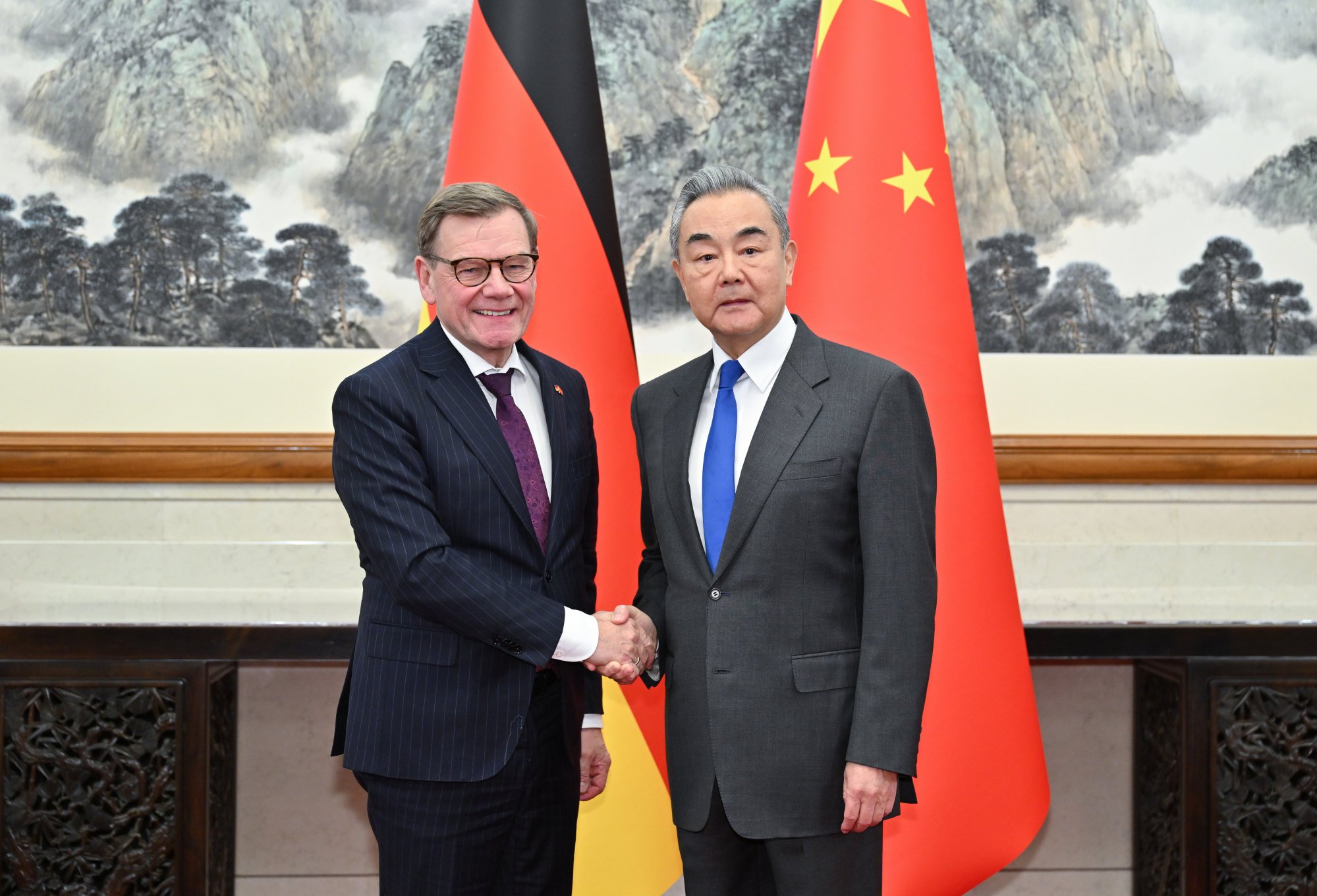
State media reported that Wadephul also met Liu Haixing, head of the Communist Party’s International Department, on Monday, when they traded views on developing ties between China and Germany as well as China and the European Union.
Wadephul also told reporters on Monday that he had urged Beijing to use its sway over Moscow to end the war in Ukraine. He said he had made clear to Chinese officials that the war had continued because Russia had the support of some countries including China.
“If there is one country in the world that has a strong influence on Russia, it is China,” he said.
More Articles from SCMP
Hong Kong’s MPF marks 25 years with strong returns, ‘growing public confidence’
Hong Kong’s new legislature to be youngest in 2 decades, averaging 51 years old
‘High-quality democracy’: what does Beijing’s new phrase for Hong Kong really mean?
Could ICC warrants against Duterte allies alter Philippine Senate’s balance of power?
This article originally appeared on the South China Morning Post (www.scmp.com), the leading news media reporting on China and Asia.
Copyright (c) 2025. South China Morning Post Publishers Ltd. All rights reserved.