Speaking at Belt and Road Summit, chief executive says city is taking structured approach to new markets in Southeast Asia, Middle East and Central Asia
Hong Kong will continue to serve as a gateway linking belt and road economies with mainland China and global markets, the chief executive has said, underscoring the city’s role in bringing together capital, talent and businesses to advance the national initiative.
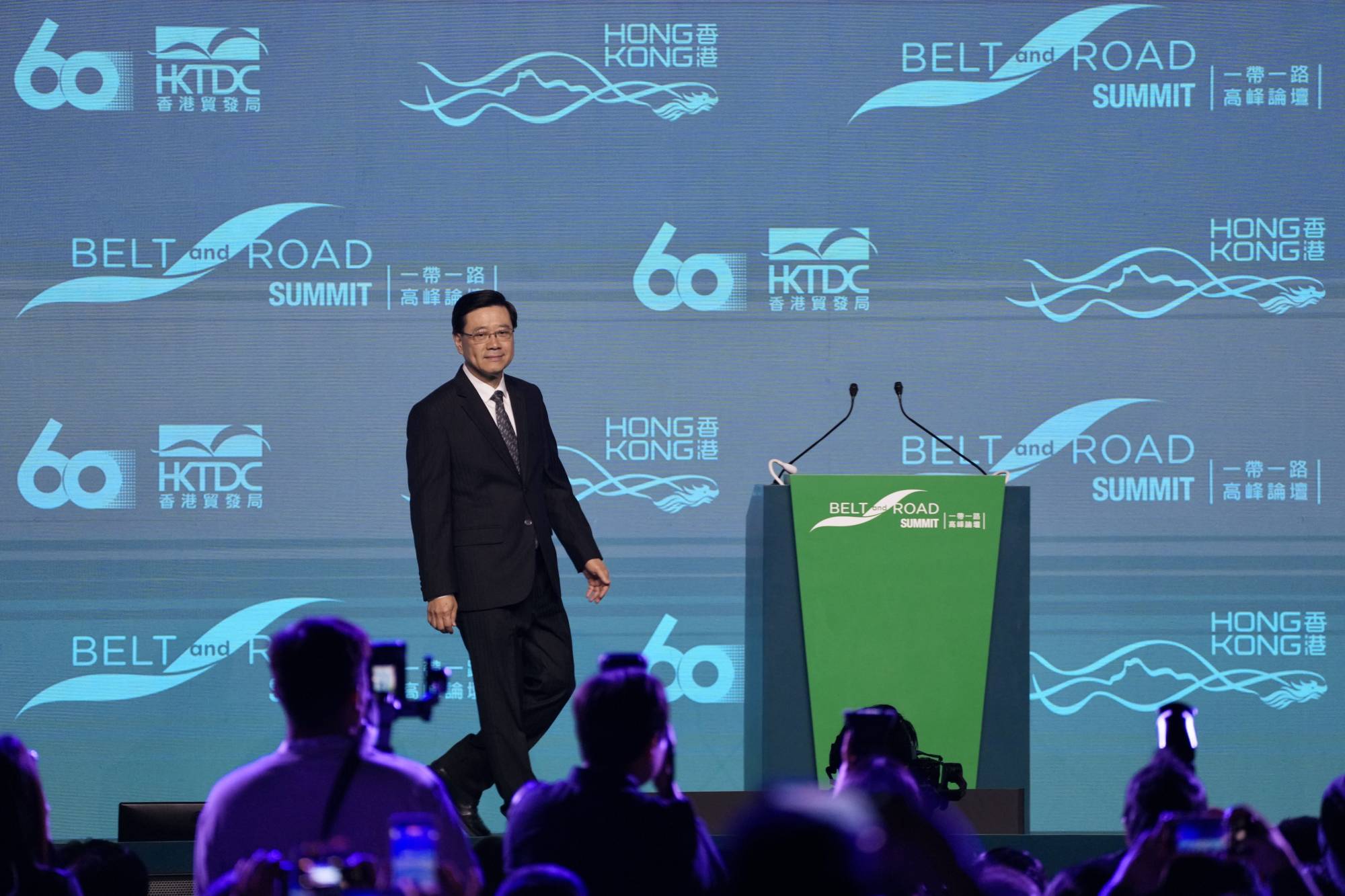
Speaking at the opening of the annual Belt and Road Summit on Wednesday, John Lee Ka-chiu said more than 60 government and business agreements and memorandums of understanding (MOUs) would be signed during the event, with the total value of projects and deals exceeding US$3 billion.
“In a world struggling with unprecedented change and geopolitical fragmentation, connectivity, cooperation, and consensus are essential. That’s precisely what the Belt and Road Summit offers,” he said.
Do you have questions about the biggest topics and trends from around the world? Get the answers with SCMP Knowledge, our new platform of curated content with explainers, FAQs, analyses and infographics brought to you by our award-winning team.
“The Belt and Road Initiative is not a map of the past, but a shared blueprint for the future. And Hong Kong is where we realise that future: where East meets West, where capital, talent, businesses and opportunities converge.”
Lee described Hong Kong as a “two-way springboard” for mainland enterprises seeking to expand overseas and international companies looking to access the mainland market.
He said the city would serve as a global gateway for belt and road businesses to raise capital, citing recent examples such as Kazakhstan’s national railway company applying to list on the city’s stock exchange.
Lee said Hong Kong had adopted a strategic and structured approach to exploring new markets, strengthening ties with regions including Southeast Asia, the Middle East and Central Asia following visits he made to them.
“Our regional focus is structured. Our reach remains flexible. Our drive stems from meeting the needs and interests of the business community,” Lee said.
“[The visits] underline Hong Kong’s long-standing focus on opening new markets, forming new partnerships and advancing regional cooperation.”
He highlighted his visit to Kazakhstan and Uzbekistan in June, which aimed to create an interconnected network of hubs and had already produced tangible results. The South China Morning Post organised the inaugural “China Conference: Central Asia 2026” in the Kazakh capital Astana on Monday.
Lee also emphasised efforts to promote cultural and educational exchanges with belt and road countries, noting that the government’s scholarship scheme had supported more than 830 students from the nations, while about 600 had taken up internships in Hong Kong.
The two-day summit, themed “Advancing high-quality development, embarking on a new journey”, promotes business among nations participating in the Belt and Road Initiative, Beijing’s project to build a China-centred global trading network.
For the first time, a dedicated “Go Global Chapter” will support mainland firms expanding overseas.
Speaking at the summit’s keynote lunch, Financial Secretary Paul Chan Mo-po said Southeast Asia had a huge young population, a rapidly expanding middle class and market, and was an important partner in technological advancement and industrial upgrading.
He stressed that Hong Kong could leverage its strengths to help the region better capture economic and technological gains.
“By building on our respective strengths and working together, we can turn these assets into greater progress and shared prosperity across the region,” Chan said.
“Hong Kong is ready to play its part: connecting innovators with global markets, mobilising patient capital and providing a place where talent from across the region can thrive.”
Chan cited the city’s leading position in global initial public offerings last year, with a growing number of listings from Southeast Asian and other belt and road economies.
He also highlighted the Greater Bay Area’s unique advantages, which offered businesses a vast consumer market and a concentration of frontier research and industries within easy reach, with the Northern Metropolis megaproject deepening cross-regional collaboration.
He added that the city continued to attract outstanding overseas scientists, engineers and entrepreneurs, thereby bringing in more long-term investors and patient capital.
Frederick Ma Si-hang, chairman of the Trade Development Council, the summit’s organiser, said belt and road initiatives aimed to turn potential into opportunity that benefited the world, with momentum coming from high-growth regions such as Southeast Asia, Central Asia, the Middle East, Africa and Latin America.
He noted that this year’s summit had introduced dedicated Central Asia and Middle East zones to help attendees expand their networks with business communities from those regions.
He added that Hong Kong was ideally positioned to connect belt and road businesses, citing its strength as a global financial centre, a hub for trade and logistics, a pool of top international talent and recent advances in innovation and technology.
More than 6,000 government leaders and professionals from over 70 countries are attending the summit, which Ma described as a “powerful testament” to Hong Kong’s unique role.
“Today’s presence of so many distinguished guests and leaders from around the world is a powerful testament to the value of connecting, which leads to tangible action and, eventually, results,” Ma said.
“It is also a powerful testament to Hong Kong as a viable commercial platform for the Belt and Road Initiative.”
More Articles from SCMP
Chinese stock recovery faces US Fed and oil pressures in September, says top fund manager
Chinese court guidance aims to smooth developer bankruptcies, reassure creditors
Horoscopes: what’s your luck like in September 2026, the Fire Rooster month?
‘Keep pushing, never fear hardships,’ Hong Kong’s first astronaut tells students
This article originally appeared on the South China Morning Post (www.scmp.com), the leading news media reporting on China and Asia.
Copyright (c) 2026. South China Morning Post Publishers Ltd. All rights reserved.