
Hungary’s Veto and the Need for EU Reform
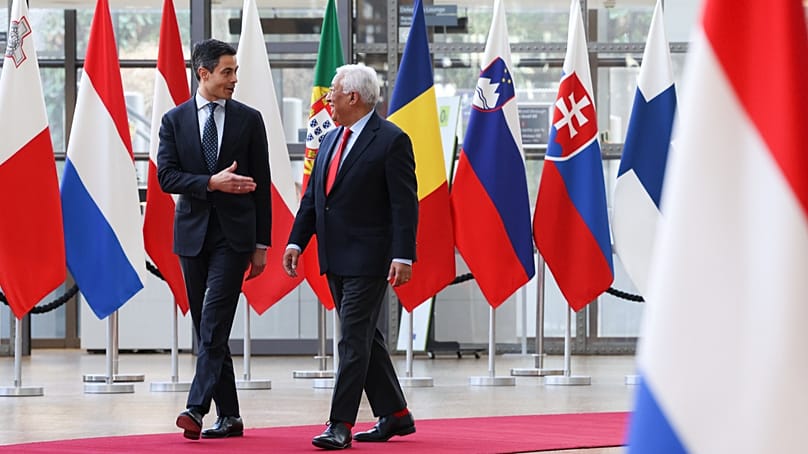
Rob Jetten, the new prime minister of the Netherlands, has emphasized the need for the European Union to move away from decision-making by unanimity. This call came during his first trip to Brussels since taking office, where he highlighted the importance of more efficient and effective governance within the bloc.
Jetten stated that the new Dutch government supports reducing the reliance on unanimous decisions at the European level. He pointed to Hungary’s last-minute veto on a €90 billion loan to Ukraine as a clear example of why this shift is necessary. “We cannot explain to our constituents that Europe is sometimes way too slow in reacting to great issues that affect us all,” he said.
He urged Hungarian Prime Minister Viktor Orbán to respect the delicate deal reached by the 27 EU leaders in December. The compromise involved Hungary, Slovakia, and the Czech Republic agreeing to amend EU budget rules in exchange for being exempted from joint borrowing. However, officials in Brussels believe Orbán’s veto breached the principle of sincere cooperation among member states.
“If you reach political agreement on the Council level, we expect every member state to uphold that agreement. And if not, it’s a big task for the European Commission to take action,” Jetten said.
Reforms to Article 7 Procedure
In the new coalition programme, the Netherlands has called for the simplification of the Article 7 procedure, which can deprive member states of voting rights when they commit grave violations of the rule of law. Hungary has been under Article 7 for years, but there has never been sufficient political momentum to move to the harder enforcement phase.
Jetten also emphasized the importance of supporting Ukraine in the coming months to ensure they can continue their fight against Russian aggression. With decreasing American support for Ukraine in terms of money and weapons, it is up to the Europeans to deliver.
The Druzhba Pipeline Controversy
Orbán’s veto centers on the interruption of Russian oil supplies through the Druzhba pipeline, which Kyiv claims was attacked by Russian drones on 27 January and has remained non-operational since then. Orbán, however, accuses Ukrainian President Volodymyr Zelenskyy of deliberately shutting down the pipeline for “political reasons” to influence the results of the upcoming Hungarian elections.
Caught between the two camps, the European Commission has asked Zelenskyy to repair the Druzhba pipeline and Orbán to lift his veto. Meanwhile, Hungary and Slovakia have proposed a fact-finding mission to inspect the damaged section of the pipeline.
“We expect the European Commission to solve this issue,” Jetten said. “If it’s helpful to have any fact-finding missions on the pipeline to fix this issue, I’m open to it. But everything begins with: a political agreement at the Council level is a political agreement.”
Ukraine’s Accession Timeline
Among the first debates facing Jetten as premier is the future of enlargement, a topic on which the Netherlands has expressed well-known reservations. Zelenskyy is advocating for a specific date for Ukraine’s accession to be enshrined in a prospective peace deal, something that could offset the pain of territorial concessions.
The Commission says it cannot commit to a clear-cut date but is working on legal avenues to revamp the notoriously complex process and ensure the Ukrainian people have greater certainty in their path to membership.
Jetten said enlargement should be reconsidered from a “geopolitical perspective” but urged the bloc to be “careful” with next steps, warning that the essence of the European project risks being undermined.
“It is too early to set a date for enlargement with Ukraine, but it is possible to talk with them, and I will do that with President Zelenskyy, about how Europeans can support Ukraine in the important reforms that they have undertaken.”
Broader Concerns in the Middle East
Jetten also touched upon the US-Iranian strikes on Iran, which have pushed the Middle East into uncharted territory. Wholesale gas prices have soared in reaction to the war, prompting fears that Europe might soon face a prohibitive bill to refill its underground reserves, which are running low after the heating season.
“Obviously, the Iran war can have a big impact on strategic reserves, not only in Europe but also in Asia. So we have to prepare ourselves for any case that this war will continue for many more weeks and impact the strategic reserves in the Netherlands and abroad,” he said, noting extra measures would be taken “if necessary”.
The Netherlands’ Return to European Leadership
Jetten’s liberal D66 party has formed a minority government with the centrist VVD and the conservative CDA, all of which support European integration. His tenure puts an end to the fractious four-party coalition headed by the right-wing, Eurosceptic Party for Freedom of Geert Wilders, which was marked by constant disagreements.
Among the priorities, his executive has pledged to ramp up defense spending, simplify regulation, promote new technologies, and expand renewable energy.
“As a founding (member) and the fifth (largest) economy within the EU, the Netherlands is back at the table to work closely together with everyone here in Brussels and our allies within the EU,” Jetten said.
Future Challenges and Priorities
Jetten and the other 26 leaders are heading for a no-holds-barred fight on the next Multiannual Financial Framework (MFF), the bloc’s seven-year budget. Brussels has proposed a €2-trillion template that some capitals consider politically unpalatable.
Where to cut spending will be a major fracture line. Germany, the Nordics, and the Baltics want a greater focus on strategic priorities, while Spain, Italy, and Eastern Europe want to preserve the prominence of agriculture and cohesion funds.
The Dutch premier made it clear that the next budget should focus on the big transitions shaping the continent’s future: defense, technology, and climate.
“A modern MFF doesn’t mean an exploded MFF in terms of numbers,” he said. “The Netherlands will look into the numbers very closely, and we will have a lot of debate on this topic in the months to come.”


