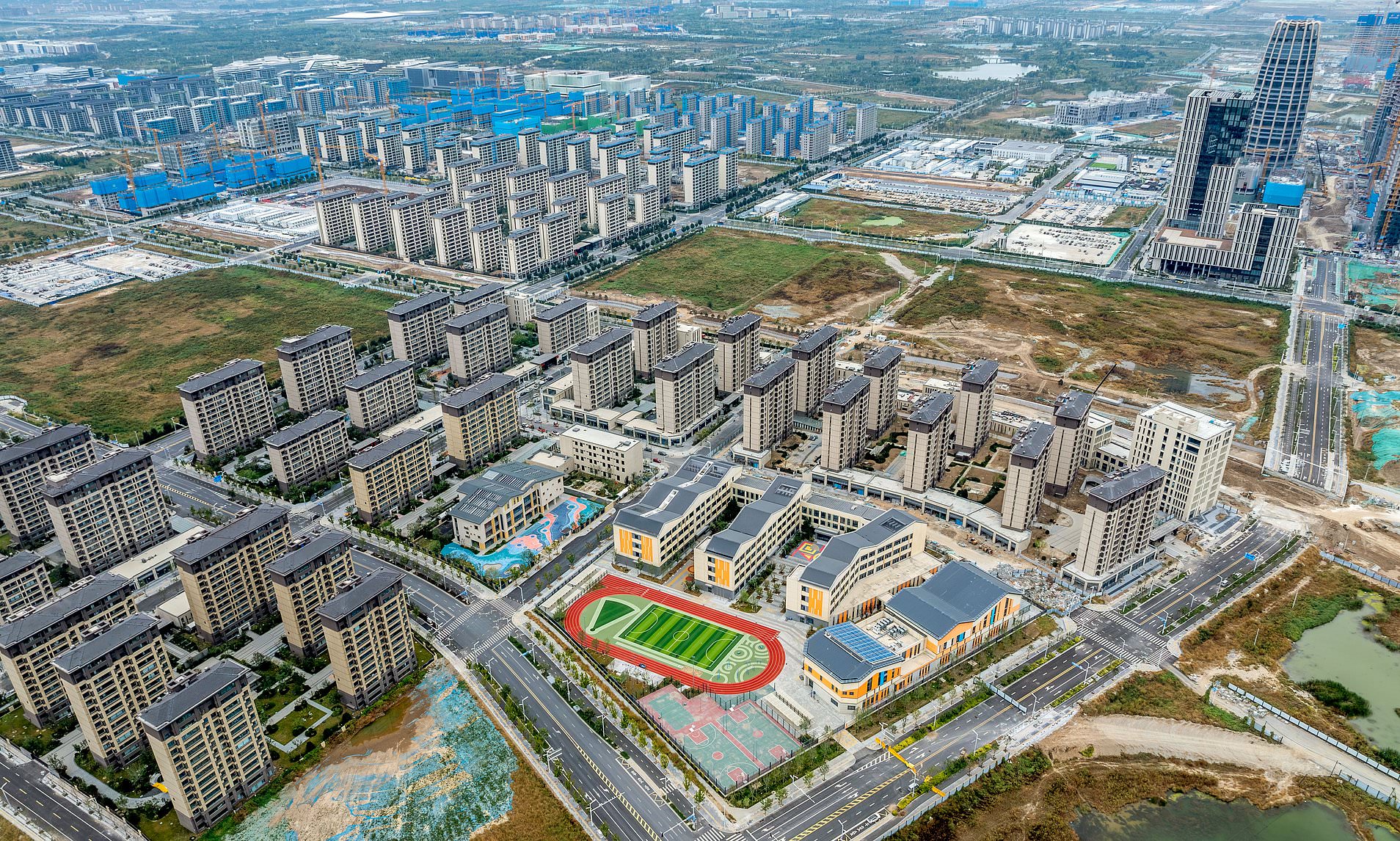
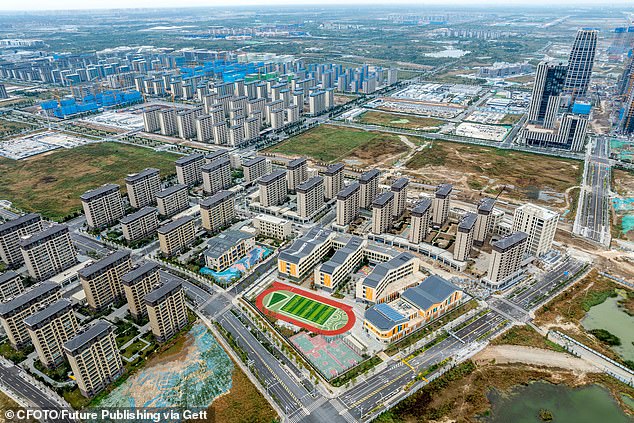
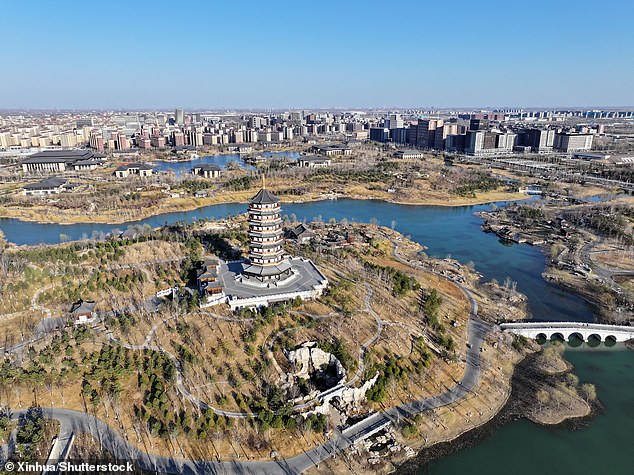
A high-tech megacity developed in China appears to have it all when it comes to attracting residents: glittering skyscrapers, vast green spaces, a massive train station with 23 tracks, and even ‘pandemic-proof’ neighbourhoods.
So why, eight years since it was officially announced as a state-level new area by the government, has Xiong’an now been declared a ghost town?
Located 60 miles south of Beijing, the $85 billion (£60 billion) ‘model’ city was initially designed to ease traffic, housing, and administrative burdens in the overcrowded capital, which is home to more than 20 million people.
Showcasing itself as an innovative ‘smart city’ that blends smart tech and nature, Xiong’an first began welcoming residents in October 2021, offering substantial advantages to those who chose to make it their home.
The city boasts 15-minute living circles, designed for convenience with easy access to schools, shops and healthcare institutions.
Locals are encouraged to use public transport, walk or cycle around the city, with a focus on smart and green transport.
State-owned housing is also provided to new residents to help cut their living costs, allowing them to spend more time – and money – enjoying local life, dining out, and relaxing in its green spaces, such as Yuerong Park and Xiong’an Jiaoye Park.
Throughout the city, high-spec technology plays a huge part in daily operations, with a 5G network, sensors, AI cameras and a vast data centre – known as the ‘super brain’ – together managing the area like a digital organism.
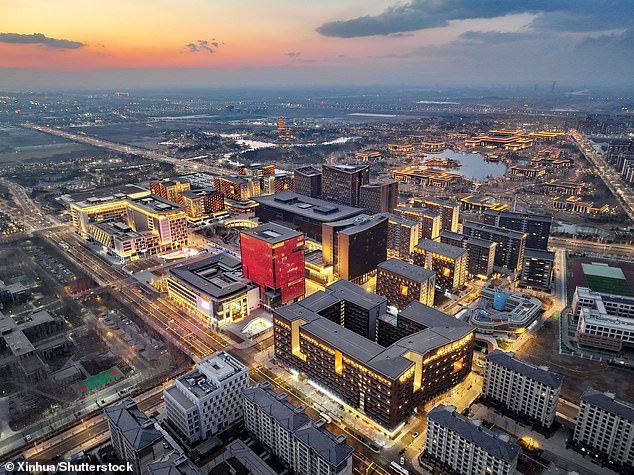
Traffic is optimised with smart signals, driverless transport is the norm, and rubbish left on the ground, along with cars not parked in the correct position, is detected automatically.
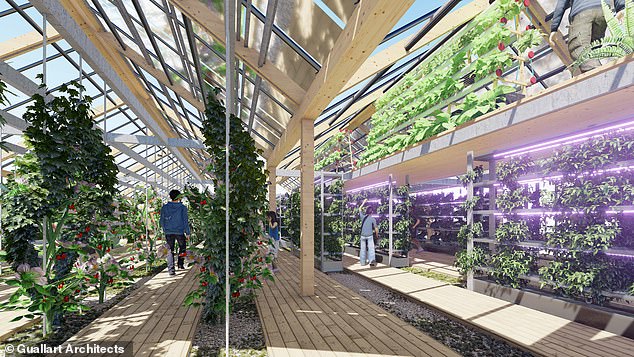
The city has even been developed to withstand a pandemic, with apartments designed for remote work, shops and administrative centres located within walking distance, and buildings created with systems to recycle water and grow food.
Its pedestrian-friendly streets and large open spaces also allow for social distancing, while terraces and balconies serve as drop-off points for emergency and essential deliveries via drone, according to The China Project.
Being an innovation hub, Xiong’an had hoped to attract tech firms, universities, and research institutes in fields like AI, big data, and life sciences.
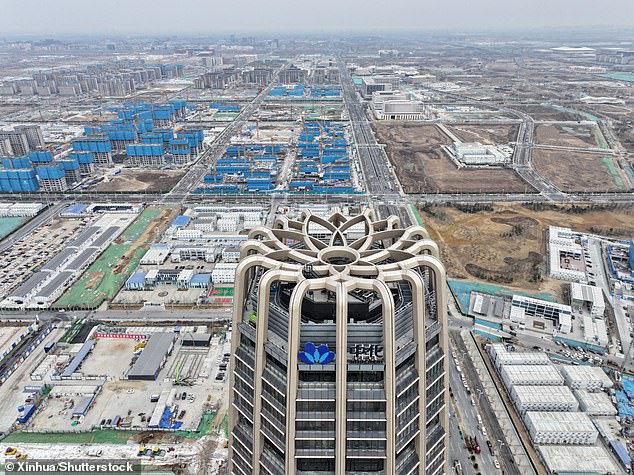
As of 2025, Xiong’an has a population of 1.2 million, and more than 140,000 people have relocated to new homes in areas such as Rongxi and Xiongdong – yet much of the city remains deserted, with hundreds of buildings starved of life.
According to residents, this all boils down to Xiong’an being too boring.
Locals also say the idea of the city being a utopia is all smoke and mirrors, with strict rules regarding housing and social activities being virtually non-existent.
Speaking to The Times in January 2025, a young female resident sent to the city by her employer said the city is ‘boring.’
She added: ‘There isn’t much social life. Young people all work overtime, and there aren’t many opportunities for leisure or socialising. As for finding a boyfriend, you’ll just have to make do with hoping your friends provide.’
Meanwhile, small business owner, Zhang Cheng, recounted how he was tempted by an offer to move to the city, but instead prioritised the quality of life of his employees.
He told The Times: ‘Many of them enjoy social activities – dating, eating out and so on. Investors and partners expect to meet over dinner, drinks or karaoke.
‘Even with the hiring subsidies, if I asked my staff to relocate here, even at their current salaries, many probably wouldn’t agree.’

Despite subsidised housing costs, ownership is a challenge, as buyers are expected to live in any property they purchase.
However, with nearly 5,000 new homes built in early 2025, further plans for 13 housing districts, and major government departments expected to move to the city in 2035, President Xi endeavours to push ahead with Xiong’an’s rapid development.
At a Xiong’an summit in late 2024, officials announced a new city management system combining four district committees and 21 municipal departments overseen by 25 government agencies.
As reported by the The Sun, a statement said: ‘A city management system that matches high-quality construction, high-level management, and high-quality relocation and development has been essentially established.’
Read more
- How does Chongqing’s neon-lit ‘cyberpunk’ skyline outshine Shanghai and Beijing in China’s hidden mega-city of 32 million inhabitants?
- Can a luxury mega-building in China’s Qianjiang Century City truly create a self-sufficient utopia or is it a modern gilded cage?
- Why is this 32 million-strong megacity in China turning heads in the tech world?
- Is Chongqing the world’s most dystopian city with its massive surveillance cameras and dizzying futuristic landscape?
- Is Chongqing the world’s most dystopian megacity with its cyberpunk factories and draconian surveillance?