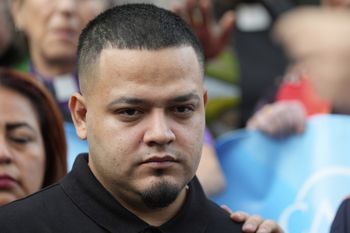
A New Chapter in the Legal Struggle of Kilmar Abrego Garcia
Kilmar Abrego Garcia, a 30-year-old construction worker from El Salvador, has become a central figure in the ongoing debate over U.S. immigration policy and the rights of noncitizens. His case has drawn national attention, especially due to its connection with former President Donald Trump’s aggressive stance on deporting undocumented immigrants. Recently, Abrego Garcia was detained by immigration authorities in Baltimore, marking a new phase in his legal battle.
Abrego Garcia was taken into custody after a brief period of freedom, as immigration officials resumed efforts to remove him from the United States. His attorneys swiftly filed a lawsuit challenging the deportation, arguing that sending him back to Uganda—where he is currently being considered for removal—would place him in a country where his safety cannot be assured. The lawsuit led to a court order halting all deportation efforts for two days, applying to other immigrants in Maryland who are contesting their detention.
The situation escalated quickly, with Abrego Garcia’s legal team engaging in discussions with Department of Justice attorneys and a federal judge in Maryland. The judge emphasized that Abrego Garcia could not be removed at this time, as he must be allowed to exercise his constitutional right to challenge his deportation. U.S. District Judge Paula Xinis extended her temporary restraining order, preventing his immediate removal.
Drew Ensign, a Justice Department attorney, stated that while Abrego Garcia’s removal is not imminent, the process can take time. Despite this, the legal team continues to push for his protection, highlighting the potential risks of sending him to Uganda, a country with a history of human rights concerns.
A Rally for Justice
Before his detention, Abrego Garcia spoke at a protest rally in Baltimore, where hundreds gathered to show support. He expressed hope and faith, saying, “God is with us, and God will never leave us.” The crowd cheered as he walked into the Immigration and Customs Enforcement (ICE) office, but the mood turned tense when his lawyer and wife left without him. The crowd erupted in shouts of “Shame!”
Abrego Garcia had lived in Maryland for years with his American wife and children, working in construction. He was wrongfully deported in March 2023 to El Salvador, where he was held in a notorious prison. This action violated an earlier immigration judge’s ruling that shielded him from deportation because he had a “well-founded fear” of threats from a gang in his home country.
His wife launched a legal battle to bring him back, which eventually led to his return in June 2023 under pressure from the U.S. Supreme Court. However, he was soon charged in Tennessee with human smuggling, a charge he denies. He pleaded not guilty, claiming the case was brought with vindictive intent.
Legal Challenges and Uncertain Future
The allegations against Abrego Garcia stem from a 2022 traffic stop in Tennessee, during which he was driving with nine passengers. Officers suspected smuggling but ultimately gave him a warning. A federal judge in Tennessee determined that he was not a flight risk or a danger to the community, leading to his release and return to Maryland.
Despite this, the Trump administration continues to push for his deportation, citing his alleged membership in the MS-13 gang. Federal officials argue that he came to the U.S. illegally and that the 2019 immigration judge’s ruling only prevented his deportation to El Salvador, not to other countries.
Abrego Garcia is currently held in a detention facility in Virginia. His attorneys have raised concerns about the conditions in Uganda, where he may be sent. They question whether he will be allowed to live freely or if he might be imprisoned. There are also unanswered questions about whether he could be sent to El Salvador, which is prohibited by the 2019 order.
A Fight for Safety and Fairness
Simon Sandoval-Moshenberg, Abrego Garcia’s lead immigration attorney, said the process for third-country deportations is still unclear. He explained that if immigration officials determine he lacks a reasonable fear of persecution in Uganda, he should be able to seek a review from a U.S. immigration judge and then appeal to the U.S. Court of Appeals.
Abrego Garcia has also informed ICE that Costa Rica would be an acceptable country of removal, based on assurances that he would receive refugee status and not be sent back to El Salvador. However, his attorney called this option “an acceptably less-bad option.”
The case remains in flux, with legal teams and advocates continuing to fight for his right to remain in the U.S. and for a fair assessment of his safety if he is forced to leave. As the legal battle unfolds, the broader implications for immigration policy and the rights of noncitizens remain a focal point of national discussion.


