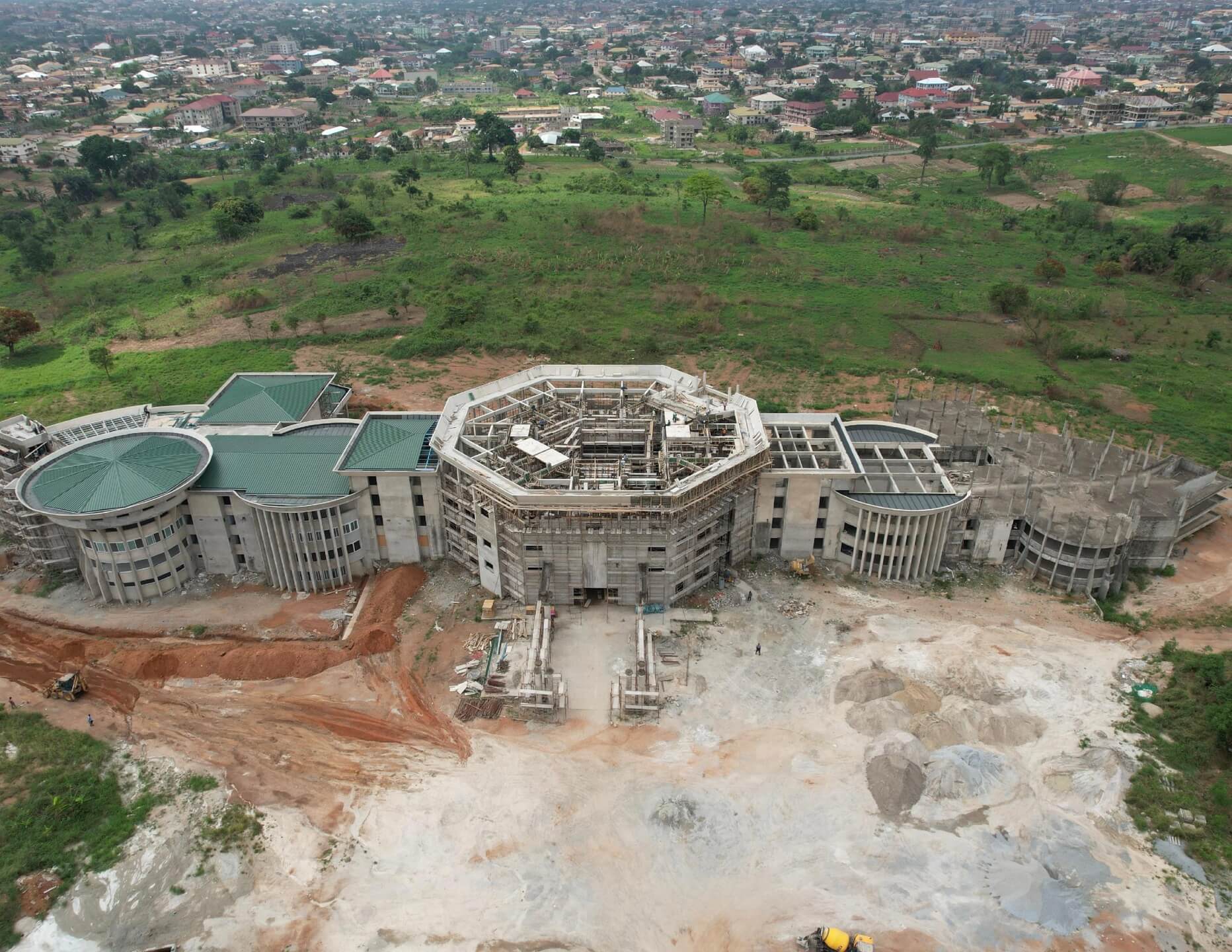
The Revival of KNUST Teaching Hospital and the Need for Financial Innovation
After more than a decade of neglect, the Kwame Nkrumah University of Science and Technology (KNUST) Teaching Hospital project is finally being revived following the injection of government funds. The government has pledged GH¢46 million to restart and complete the long-stalled facility — a development that brings hope to students, faculty, and residents of Kumasi and nearby communities. However, experts argue that this revival could have happened much sooner if Ghana had adopted a different approach to infrastructure financing.
At the 50th Anniversary Grand Durbar of the KNUST School of Medical Sciences (SMS), Minister of Education Haruna Iddrisu announced that contractors have been instructed to return to the site within 30 days. For years, the unfinished hospital stood as a reminder of stalled ambition — a symbol of what happens when good ideas meet financial and administrative roadblocks.
When completed, the hospital will serve as both a modern teaching and research facility for medical students and a key healthcare center for the Ashanti Region. Initially estimated at $125 million, the project was launched through a partnership between KNUST and the Ghana Education Trust Fund (GETFund) and was to be completed within six years. Twelve years later, the site is still incomplete. Mr. Iddrisu added that GETFund will now provide an additional $38 million to equip and complete the facility, marking a renewed push to bring the long-awaited project to life.
The revival of the project deserves recognition. Government’s perseverance and KNUST’s unrelenting advocacy for its completion are commendable. The University’s vision to establish a world-class teaching hospital underscores its commitment to excellence in medical education and healthcare delivery. Yet, this news carries a measure of sadness. For ten years, the hospital’s empty halls could have been filled with doctors in training, patients receiving care, and researchers making breakthroughs.
The decade-long delay has likely cost Ghana in human lives, lost opportunities, and diminished healthcare outcomes. This painful reality highlights a persistent problem in Ghana’s infrastructure landscape — the overreliance on public funds to finance large-scale projects, even when viable alternatives exist.
Rethinking How Ghana Finances Major Projects
It is reasonable for governments to align development with fiscal capacity. However, waiting for limited public funds before starting projects has proven inefficient and expensive. The KNUST Teaching Hospital could have been completed years ago if Ghana had adopted a Public-Private Partnership (PPP) financing model. Under PPPs, private investors fund and manage infrastructure projects while the government retains ownership and oversight.
The investors recoup their funds through service fees or long-term contracts, ensuring both accountability and efficiency. Had this model been used, KNUST’s hospital might have opened years ago — without adding to Ghana’s growing public debt. Instead, the reliance on loan financing adds to the national debt burden, tightening fiscal space and making it harder to fund other priorities like education, energy, and agriculture.
High debt levels also lead to increased borrowing costs and recurring dependence on international bailouts from institutions like the IMF — a pattern Ghana has experienced repeatedly. A properly structured PPP would have avoided these challenges. Private capital could have carried much of the financial weight, while government and KNUST contributed strategically to demonstrate commitment. This would have freed up public funds for other development needs and ensured faster completion.
Lessons from the PPP Model
Across Africa and beyond, Public-Private Partnerships have transformed infrastructure delivery. From hospitals in Kenya and Nigeria to toll roads in South Africa, PPPs have shown how collaboration between government and private investors can accelerate development. Ghana has also had some PPP success stories in energy and transport.
Yet, the approach remains underutilized, often due to a lack of awareness, limited technical expertise, and bureaucratic resistance to change. To truly “reset” its development model — as the government often calls for — Ghana must move from public-only financing to a PPP-first policy for commercially viable infrastructure such as hospitals, schools, and certain roads. Projects like the KNUST Teaching Hospital are ideal for PPPs.
With clear revenue potential from medical services, insurance partnerships, and research collaborations, investors could see predictable returns while serving the public good. A basic feasibility study could have demonstrated this viability years ago. The same is true of the large number of Agenda 111 projects wasting away because of a lack of funds.
The Missed Opportunity — and How to Fix It
The tragedy of Ghana’s infrastructure delays is not a lack of money, but a lack of strategy. There is no shortage of global investors seeking bankable projects in Africa. What’s missing is proactive engagement and project packaging that meets investor expectations.
At a recent PPP Expert Panel Roundtable in Accra, stakeholders highlighted two key gaps: the absence of well-structured, investor-ready projects and the shortage of trained professionals who understand PPP frameworks. Addressing these will be crucial to changing Ghana’s development trajectory.
Building local capacity in PPP design and marketing investment-ready projects to global financiers could unlock billions of dollars in private capital — reducing dependence on debt and ensuring timely project completion. If Ghana can make PPPs its default development strategy, infrastructure delivery could become faster, more efficient, and less costly. Projects like the KNUST Teaching Hospital would no longer languish for a decade before revival.
Turning Lessons into Action
The KNUST Teaching Hospital’s return to life is welcome news — but it must also serve as a national wake-up call. Ghana cannot afford to continue building major infrastructure the old way: slow, debt-driven, and politically constrained.
The government’s commitment deserves applause, but the greater victory will come when the country learns from this delay and institutionalizes smarter, sustainable financing models. The shift toward PPPs would not only save public funds but also unleash Ghana’s infrastructure potential — from healthcare and education to transport and energy.
As construction resumes on the KNUST campus, optimism is rising again. The hospital promises to give medical students the hands-on training they need and provide quality healthcare to thousands. Yet, beyond the concrete and steel lies a deeper lesson: development depends not just on funding, but on financial innovation and foresight.
If Ghana embraces that truth, the next generation of national projects won’t take ten years to finish — they’ll take just the time they should.


