A Journey Through Memory and Resistance
It was the first day of March, when the cold north wind still bit fiercely, when I went with a friend to a newly opened bathhouse. I had heard from a friend not long ago that a sentō-style bathhouse had arrived even in Gwangju. A modern building with clean corridors, separate changing rooms and washing areas for men and women, and a spacious hot tub. Back then, in my hometown, people would set a time to bathe in the stream. How amazing it was to be able to soak in a tub of hot water heated by a wood fire. The 10-jeon entrance fee was not a waste. As I hurried into the bathhouse, my friend told me I should clean my body before entering the tub. I said, “Ever since you started at the normal school, you’ve been trying to teach me everything,” and we both laughed heartily.
Inside the tub, about five or six people were warming themselves. I, ever impatient, first poured water from a small ladle over my body and handed it to my friend. He took the ladle I passed him and leisurely poured the warm water over himself. Just as my outstretched foot was about to enter the tub, a man around our age asked me a question. It was in Japanese. The sound echoed inside the bathhouse, and I didn’t understand it right away. The man asked again. My friend, sitting next to me, answered as if he were me: Lee Seok-gyu. As I stared blankly at my friend’s face while he spoke, the people in the tub one by one turned their heads toward us. The man who had spoken to me glared. “Dirty Joseonjin.” My hair stood on end. I made eye contact with my friend, my frightened face dripping with water. I signaled that we shouldn’t stay and should leave immediately. But Seok-gyu suddenly spoke to the Japanese man: “Why are we dirty? Would you like it if we called you a dirty Japanese?” At that moment, the men in the tub, who had been looking down on us, stood up abruptly. Then they rushed toward Seok-gyu. As I watched Seok-gyu being beaten for a while, I shouted that a policeman was coming from far away. Everything became quiet instantly. I took the opportunity to pull Seok-gyu up and ran out of the bathhouse. I didn’t know then that this incident would change our seventeenth year.
Reflections on a Fractured Past
One evening, we were sitting around the dormitory dining hall eating. A friend came into the dining hall, huffing and puffing. He was a roommate who commuted from Damyang, and as soon as he sat down on the creaking wooden chair, he said: “I encountered some Japanese people at the train station, and I felt disdained. Even though it’s been over ten years, didn’t hundreds of Korean and Japanese students clash in front of Gwangju Station in 1929? Now, the methods of disdain are even more vicious.” My friend and I listened silently. That night, Seok-gyu couldn’t sleep at all, tossing and turning, then came out of the dormitory and looked up at the sky. The cold wind cut through his collar and pierced his skin. I saw the words he spoke that night carried away by the white wind.
What use is teaching the Imperial Subject Oath?
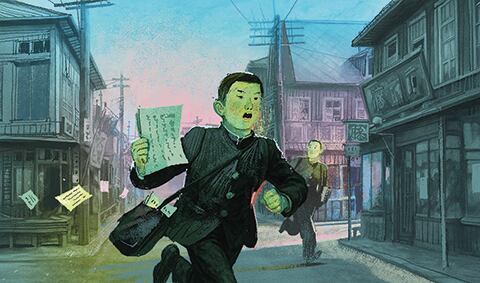
The next morning, as the assembly was ending, we were reciting the Imperial Subject Oath. It was a habit for us. One, we are subjects of the Great Japanese Empire. Two, we devote our hearts… Seok-gyu stood silently throughout the assembly. After the assembly, he didn’t go into the school building but stood in the playground for a while, then finally left the school grounds. Following him, I saw he was heading to Daein-dong Railway Station. I was nervous that Seok-gyu, who was always upright, might cause trouble because of yesterday’s memory. A Japanese man bumped into Seok-gyu’s shoulder. Seok-gyu glared at him fiercely. The man picked a fight with Seok-gyu. Seok-gyu beat him mercilessly, then ran back to school. At that time, Seok-gyu said: “Running is what I’m really good at. I have the skills to win first place at the Jeollabuk-do Sports Festival.”
After returning to school, Seok-gyu went down to the basement through a small corridor in the dormitory. I didn’t even know the school had such a place. When we stood in front of a small room at the end of the corridor, the friend who had told us about the railway station incident opened the door for us. I learned then that this was the path to a secret organization called the “Mudeung Reading Society.” A friend with a loud voice said: “Comrades, welcome to the discussion meeting on knowing our history correctly.”
We learned many things that day. The fact that rice and cotton were being shipped to Japan through the railway station, why the education we received was like military training, where the blood of young Joseon people conscripted into the army was being sent, and the reality that Japan was retreating in the Pacific War. We must not get involved in the war for Japan until Japan is defeated. We made posters with the content we heard that day. Someone said a person was needed to paste them. Seok-gyu said: “I have a recognized running ability,” and laughed. “The normal school is a normal school. People from all over the country have gathered here.” Everyone laughed loudly at someone’s words. That laughter replaced passion. Our hearts were boiling like lava. We must reclaim our lost country. Only then will we have a future. Only then can we teach the right things to our children.
The Struggle for Freedom
That afternoon, Seok-gyu was called to the teachers’ office. They said he would be suspended for a month for provoking and assaulting a Japanese person. While delivering the message, a Korean supervisor said to Seok-gyu:
Seok-gyu, you must stay quiet.
Strange things happened. After that incident, Seok-gyu became more energetic. He said he finally knew what to do. Every early morning, we went around Gwangju pasting the posters. The members of the reading society also received secret orders from Shanghai and gathered and delivered information. Only then did we realize what mindset we, attending the normal school, should have and what we should teach, Seok-gyu often said. The summer light became hotter and the air more humid, but the wind that blew was still sharp.
The joy didn’t last long. The activities were discovered, and all the members of the reading society were arrested by the police. Who betrayed us? Was there a spy among us, as the rumor said? The events that followed… They beat us with long leather straps, whipped our thighs mercilessly with bamboo canes, pushed our faces into tubs, hung us upside down to threaten us, burned our calves with iron chopsticks heated in a fire, and poured water mixed with chili powder into our nostrils. But you know what? The memory that remains clearest in all those scenes is this: The Japanese sat in a chair, laughing mischievously, but the ones torturing were Koreans. Even if their bodies were torn and broken, there were Koreans who wanted them to suffer more intensely. Even then and now, that was the most resentful thing.
I heard the news that Japan had surrendered while leaving prison. One by one, familiar faces appeared. Although none of us were physically unharmed, we were happy. The future of our country, which we had worried about during our imprisonment. Liberation, something we had to obtain even if we had to give up our youth. That day was today and tomorrow of my country. We had to risk our lives. Because without my country, there is no future for me. I couldn’t let the children who will live in this land, the Republic of Korea, recite the Imperial Subject Oath.
Republic of Korea, hurrah.
We went out chanting slogans. It was midday in a summer of intense heat. They said there was thick fog until the morning, but when it became daytime, the sky became very clear, as a woman in a white skirt told us. Celebrating liberation, we ran together. Receiving the Taegeukgi flags handed by the people, we waved them vigorously and shed tears of emotion. No one who came out after suffering thought of themselves as independence activists. They became ordinary faces who fulfilled the mission of the times, following the crowd into Gwangju, deeper and deeper.
A Legacy of Courage
Child, your mother told me that you are going to Dongmyeong-dong with friends to celebrate your seventeenth birthday. That place is now filled with restaurants. Dongmyeong-dong 200. It is a place where many people were imprisoned and longed for their country’s independence. Hearing Dongmyeong-dong, our seventeenth year came to mind clearly. Seok-gyu recently celebrated his 100th birthday. Still with clear eyes, he rejoiced that the world where he could shout “Long live the Republic of Korea” had come. For him, the country was the past, present, and future. My friend, who worried more about the country’s future than his own safety. In the country he dreamed of, I hope you will be a little more peaceful and a little more free. Seok-gyu made me dream of such a future.
Child, I hope you meet at least one such friend in your lifetime.

Lee Seok-gyu (1926~)
Born in Wanju, Jeollabuk-do, in 1943, while attending Gwangju Normal School, he organized the “Mudeung Reading Society” to promote national consciousness by reading books and distributing anti-Japanese leaflets and posters. In 1945, he planned an uprising in time for the Allied forces’ landing in Korea, but the plan was exposed in advance, and he suffered imprisonment.

Novelist Choi Yoo-an
Began her writing career in 2018 when her novella
Regarding the Case I Made
was selected for the Dong-A Ilbo New Year’s Literary Contest. She has written the short story collection
Average Taste
, the novels
White Office
and
Shadow of Dawn
, and the essay collection
Kafka’s Prague
. She won the No Gun Ri Peace Literature Award.


