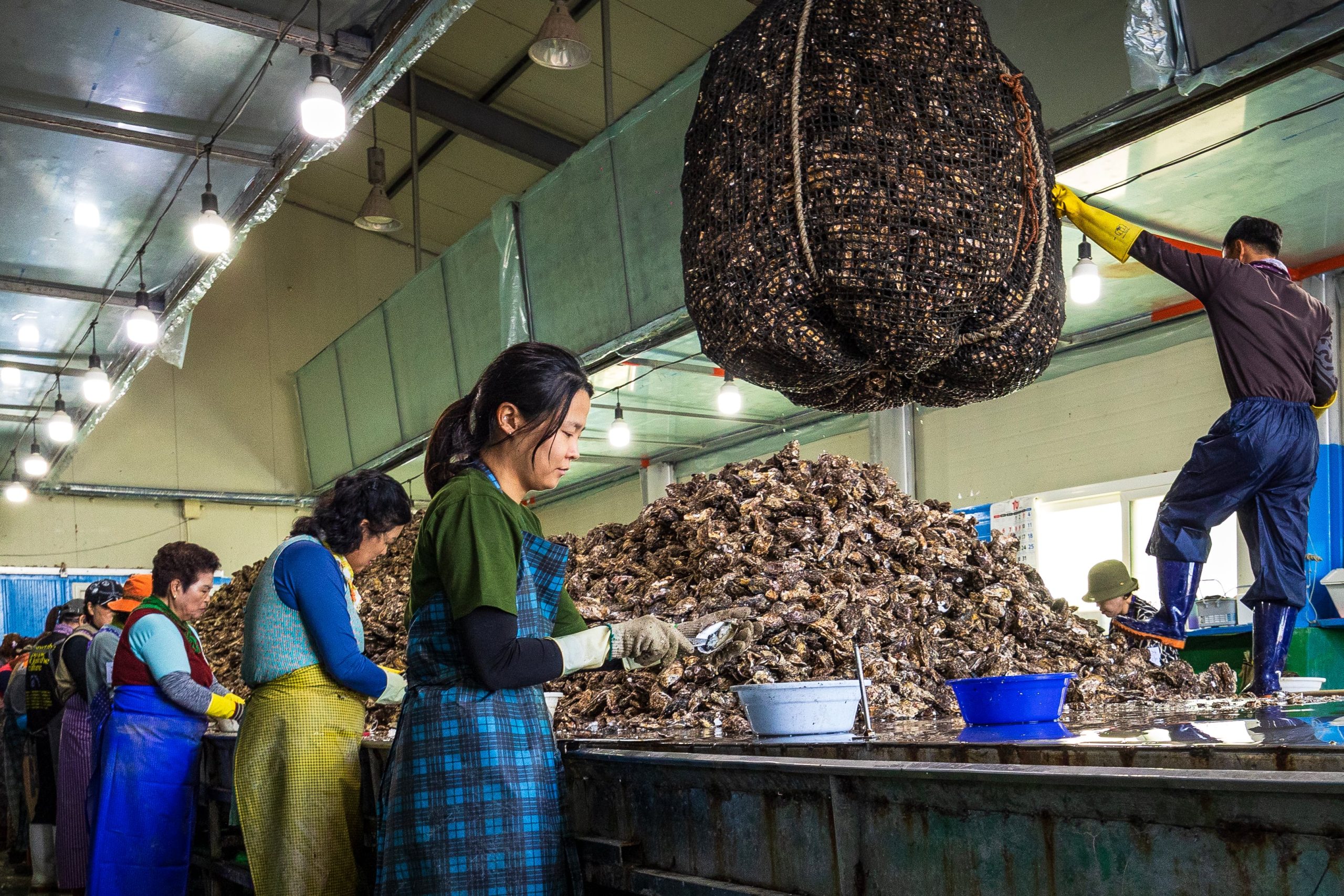
I wrestled with the oyster shell until I finally shattered its edge. The woman next to me shucked oysters at a rate of one every three seconds. Even an otter couldn’t shuck this fast.
“You could introduce yourself as an otter,” I muttered, looking at the mountain of ‘eachul’ (oysters with shells attached, pre-shucked) piled on the worktable. The woman, giving me a look that said, “Otters live in rivers—what are you talking about?” held up a freshly shucked, milky-white Tongyeong raw oyster and said,
“My, look at how plump this ‘ggul’ (oyster) is.”
Here, the word ‘ggul’ (oyster) sounded like ‘kkul’ (honey). Was it because of the Gyeongsang Province accent, or because the seasonal oysters tasted as sweet as honey?
By early autumn, the southern coast becomes bustling with oyster harvesting. Raw oysters from the southern coast account for over 70% of the nation’s oyster production. According to this year’s government ‘Oyster Farming Industry Development Plan,’ South Korea is the world’s second-largest oyster producer, with an annual average production of over 300,000 tons (1st: China, approximately 5.56 million tons). Of this, around 10,000 tons are exported, ranking third in export value after France and China. The remaining 290,000 tons are consumed domestically. A source from the Ministry of Oceans and Fisheries said, “Even if demand for oysters during kimchi-making season decreases, all production is consumed through supermarkets and markets,” adding, “They are eaten seasoned, pan-fried, or in soups.”
Most Korean oysters are distributed in their raw state. There are approximately 400 oyster-shucking factories nationwide. At this moment, 13,000 workers are energetically shucking oysters to the beat of trot music. Unlike last year, when production plummeted due to high seawater temperatures, this year’s production is expected to increase by about 20% compared to previous years, thanks to relatively stable seawater temperatures and nutrient supply, according to the Tongyeong Gulsuhahsik Suhyup (Oyster Suhyup). Thus, on the 27th of last month, I visited an oyster-shucking factory in Tongyeong, Gyeongnam Province, to become an ‘oyster-shucking woman.’ Let’s go shuck oysters!


◇Find the Oyster’s ‘Eye’
Around 9:30 a.m., at Haebarak Su-san in Yongnam-myeon, Tongyeong. About 20 women in their 40s to 60s were in the midst of shucking oysters in a 150-pyeong workspace. This factory produces an average of 1.3 tons of raw oysters daily from October to April. Park Min-hyeong (40), the second-generation owner in the oyster industry, said, “These are fresh suhahsik (垂下式·grown by hanging from underwater supports) oysters harvested from designated waters since dawn.”
Workers labor four days a week, from 3 a.m. to 3–4 p.m. Wages are calculated by weight (kg). According to the Oyster Suhyup, the labor cost on that day was 3,000 Korean won per kilogram. Skilled workers shuck an average of 70 kg of oysters per day—earning 210,000 Korean won.


I began preparations. I put on three layers of gloves: thin cloth gloves, rubber gloves, and then leather gloves on top. This was to prevent cuts from the rough shells. Holding an oyster knife (clamshell knife) about 10 cm long, I was instructed to “find the oyster’s ‘eye.’” In the workplace, the muscle (adductor muscle) that attaches the oyster to its shell is called the ‘eye’—equivalent to the hinge in a scallop.
Kim Hee-bong (62), an ‘oyster-shucking master’ with nearly 40 years of experience, said, “Push the tip of the knife between the shells until it catches with a ‘click,’ then cut it. That’s the eye. Then it’ll open.” Looking closely at the eachul, one side was concave, and the other flat. When holding the concave side, the oyster’s eye is usually at the 10 o’clock position.
I stared at the eachul for a minute, but couldn’t find a gap to insert the knife. Unable to watch anymore, Ms. Kim said, “Don’t look for a gap—stab the edge with the knife,” and disappeared after advising, “If you scrape the knife close to the top shell’s lid, it’ll open easily.” I started shucking in earnest.
◇Rice Taste, Oyster Taste, Honey Taste


“My, the girl from Seoul is shucking pretty well for a first-timer,” the women shucking oysters said, looking at my basin. Thanks to Jang Pyeong-suk (60), my neighbor with 20 years of experience. She must have felt sorry for me hacking at the shells and placed easier-to-shuck eachul in front of me. “Push the knife in hard and wiggle the tip to feel the meat detach,” she said. Oysters with deeper concave sides were easier to shuck because the eye was easier to find.
Ah, I did it! A whole, milky-white raw oyster revealed its plump, appetizing form. Ms. Jang said, “Don’t forcibly tear the meat—push it into the basin with the flat side of the knife.” I carefully pushed it in, fearing I might damage the precious oyster. Somewhere, a hawk-like gaze pierced me. Park Uk-ju (64), who founded this factory over 40 years ago, glanced at the shell and said, “Hmm. Defective,” then vanished. A part of the oyster’s eye was still attached. Oh, how difficult.
“Let’s eat rice~.” Around 11:30 a.m., a welcome sound echoed. Since they work 12–13 hours straight, they eat breakfast and lunch in a space attached to the factory. The menu was radish soup, seaweed salad, stir-fried oysters, braised pollock, and kimchi. Tareuk (36), an Indonesian contract worker, said, “Rice taste, oyster taste, honey taste.” He unloads 700–800 kg piles of oysters lifted by net and distributes them with a rake. The women said, “Even meal times are a waste,” and finished their rice in 15 minutes. I hurriedly ate mine too.
◇I Filled a Basin with Just Water~

I resumed shucking. The properly shucked eachul opened with a satisfying ‘plop.’ After breaking and halving shells several times, I finally heard that liberating sound. Just as I thought I was getting the hang of it, my calves and the back of my head began to ache. My hands also tingled from moving my fingers while wearing three layers of gloves.
To forget the pain, I chatted. Ms. Jang, born and raised in Tongyeong, started working at the factory to support her two sons when they entered elementary school. “This was the only job I could do between sending the kids to school and having free time,” she said. “Isn’t it hard?” I asked. She replied, “It’s hard, but it’s not hard. When I shuck a lot, I feel happy.” She weaves oyster shells into strings from June to August to create devices (spat collectors) where oyster larvae (seeds) settle, and shucks oysters from September to the following April. The day before, she shucked 63 kg of raw oysters—earning 189,000 Korean won. “Since the effort returns directly, I don’t feel the hardship,” she said.
Around 3 p.m., I proudly headed to the cleaning room with a basin full of shucked oysters. The raw oysters undergo four to five washes before being sent to the market in a hygienic and clean state. After draining the water, I weighed them. My heart raced. 0.5 kg… Only? That would be 1,500 Korean won? I couldn’t even shuck 100 eachul. A typical basin holds 2 kg, but I’d filled mine with just water.
Ms. Jang laughed and said, “You’re now an oyster-shucking woman.” On the way back to Seoul, I recalled that foreigners visiting Korea are surprised to see us scooping oysters with spoons. The beads of sweat on the Tongyeong women’s foreheads and their faint humming echoed in my mind. The 300,000 tons of K-oysters on our tables every year felt admirable. For late-night snacks, I decided on boiled pork with fresh kimchi. The finishing touch would be juicy raw oysters brimming with the scent of the sea.


