The National Assembly Audit: A Controversial Process
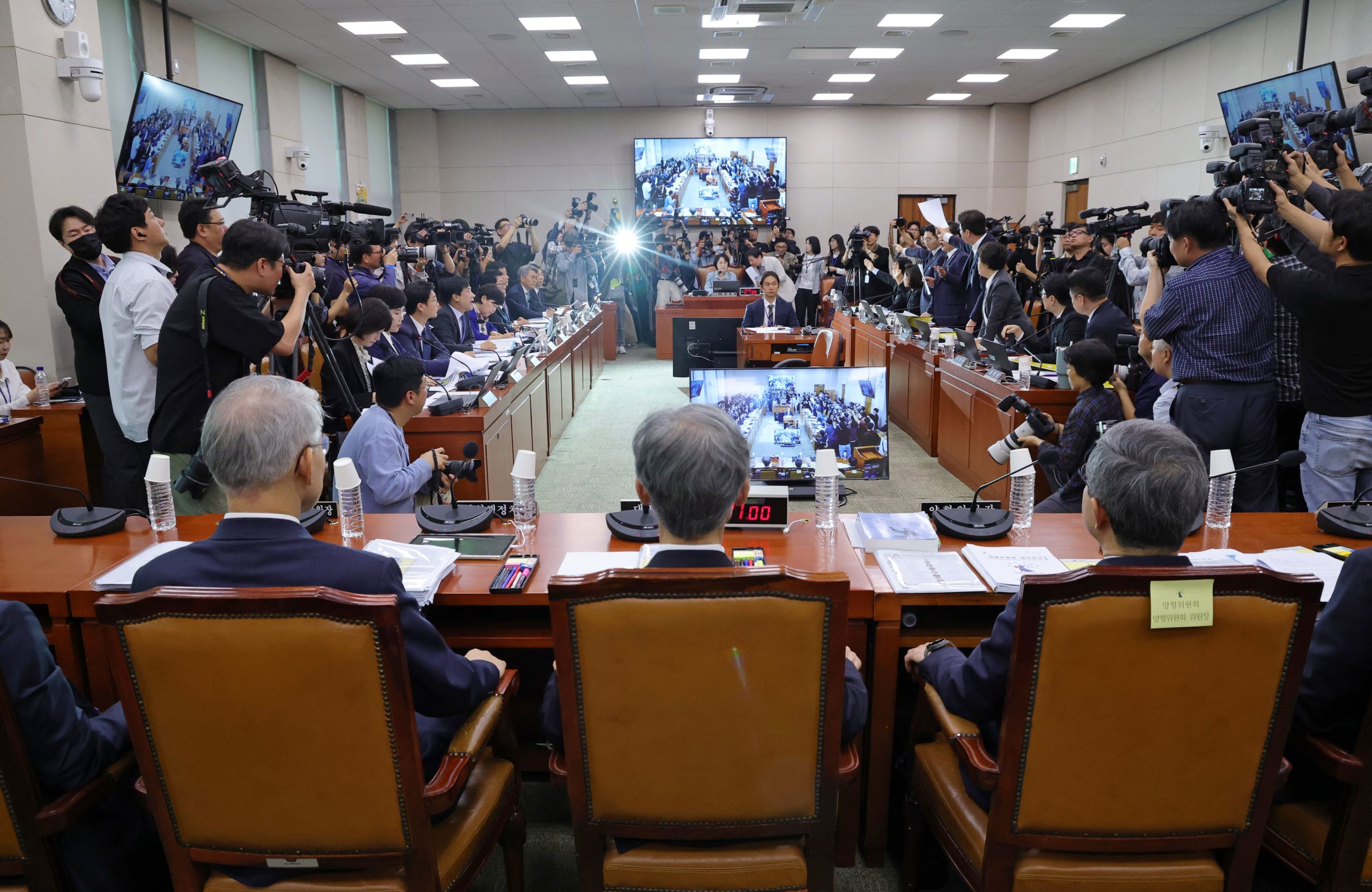
The audit of the Lee Jae-myung government by the National Assembly has reached its final stages, but it is being criticized as the “worst low-quality audit in history.” This audit has been marred by political tensions between the ruling and opposition parties, with numerous standing committees experiencing disruptions due to loud arguments and profanity. Critics have pointed out that the audit started with controversy over the Jo Heedeo Chief Justice and Toyotomi Hideyoshi and ended with a scandal involving the wedding ceremony of Choi Min-hee, head of SIBCC.
Audit Schedules and Evaluations
By the end of last month, the ruling and opposition parties had concluded the audit schedules for 14 out of 17 National Assembly standing committees. The remaining audits will be completed early this month by the Operations Committee, Intelligence Committee, and Gender Equality and Family Committee. The National Assembly Audit NGO Monitoring Team gave an “F” grade in its midterm evaluation, calling it the worst low-quality audit in history. They criticized the chairs of the Legislation and Judiciary Committee and the Science, ICT, Broadcasting, and Communications Committee for biased proceedings and excessive power.
Issues with the Audit Proceedings
Throughout the audit, the arbitrary and one-sided proceedings by standing committee chairs have come under fire. Chair Choo Mi-ae from the Democratic Party prevented Chief Justice Jo Hee-de from leaving the audit venue on the first day, subjecting him to one-sided questioning. During this time, Democratic Party lawmakers criticized the chief justice, asking about the reasons for remanding the President Lee Jae-myung election law case. An independent lawmaker even waved a composite photo of the so-called “Jo Heedeo Chief Justice + Toyotomi Hideyoshi” in front of the chief justice. The People Power Party expressed concern about the humiliation of the chief justice.
The National Assembly Audit NGO Monitoring Team also criticized Chair Choo’s order for opposition party lawmakers to leave without sufficient grounds as “biased proceedings.” They viewed Chair Choi Min-hee’s actions during the audit as “expelling journalists” after she switched the audit to a closed session amid controversy over her daughter’s wedding ceremony. Chair Choi faced criticism for overshadowing SIBCC policy issues with various explanations, including stating that she was too busy studying quantum mechanics to pay attention to her daughter’s wedding ceremony. Demands for her resignation emerged even within the pro-ruling party camp after she expelled an MBC reporting director, claiming the coverage of her was biased.

Microphone Monopoly Phenomenon
The “microphone monopoly phenomenon” by standing committee chairs, who are supposed to lead the audit proceedings, was also prominent. Chair Choo spoke for up to 3.9 times the average lawmaker’s speaking time during four audits, while Chair Choi held the microphone for 4.21 times the average during the audit targeting the Broadcasting, Media, and Communications Committee. While committee chairs typically speak more to facilitate proceedings, Chairs Choo Mi-ae and Choi Min-hee spoke even more than usual. There is criticism that the questioning by ruling and opposition party lawmakers during the audit was “below average.” The People Power Party has also been criticized for having no presence as the main opposition party.

During the Legislation and Judiciary Committee session on the 30th of last month, Democratic Party lawmaker Seo Young-kyo called People Power Party lawmaker Kwak Gyu-taek a “squeaker,” to which Kwak retaliated by calling Seo a “Seo Pal-gaye” (a derogatory term). During the SIBCC audit on the 14th of last month, Democratic Party lawmaker Kim Woo-young revealed that People Power Party lawmaker Park Jeong-hoon had sent him a text message saying, “Ugh, you pathetic guy!” leading to an exchange of profanity. Lawmaker Park responded by calling Lawmaker Kim a “pitiful XX” in protest of his phone number being exposed. The two lawmakers reportedly exchanged remarks such as “a punchable face,” “I’ll beat you,” and “follow me to the rooftop” even during a closed-door meeting afterward. In the Operations Committee, the ruling and opposition parties clashed from the start to the end of the audit over whether Kim Hyun-ji, the First Deputy Chief of Staff to President Lee and one of his closest aides, should attend the audit. In the end, the parties failed to reach an agreement on adopting Kim as a witness.

Press Complaints and Institutional Absences
As critical articles about the ruling party poured in, the Democratic Party filed 19 complaints with the Press Arbitration Committee (PAC) during the audit period (October 13–30) against media outlets critical of them. According to the office of People Power Party lawmaker Kim Seung-soo, the Democratic Party applied for mediation eight times. Separately, Democratic Party members Choi Min-hee, head of SIBCC (6 cases), Choo Mi-ae, chair of the Legislation and Judiciary Committee (4 cases), and Kim Yong-min, a member of the same committee (1 case), also raised issues with critical coverage. Lawmaker Kim Seung-soo pointed out, “This was an attempt to ‘muzzle the press’ through indiscriminate PAC complaints.”

Witness Absences and Expert Opinions
Amid the ruling and opposition parties’ political strife, many witnesses and references left without being able to answer even once. From the start of this audit on the 13th of last month until the 22nd, halfway through the period, a total of 474 institutions were adopted as witnesses, but 180 of them (38%) were never questioned even once.
Professor Lee Jae-mook of Hankuk University of Foreign Studies stated, “The repeated behavior of National Assembly members, who are part of the legislative branch, abandoning their own oversight authority is undermining the significance of the audit as a check on the executive branch.” Professor Kim Sung-soo of Hanyang University said, “As some in the political sphere are even discussing the uselessness of audits, it is time to consider institutional changes,” adding, “The authority of standing committee chairs should be adjusted (reduced), and the right to speak of witnesses and institutions should be guaranteed.”

Related posts:

Fiction park: He was the best in class. He still wasn’t good enough

Gagan Thapa takes oath as Congress president, vows to regain public trust

Inside knowledge that has locals gripped by fear after gran’s body found decomposing in cattle dip

New property purchase disclosure rule in Japan sparks fears it may curb foreign investment

Dino-mite treasures: inside Singapore’s Fort Knox storing playthings of ultra-rich