The Persistent Challenge of Poverty in Nigeria
The latest World Bank Nigeria country assessment reveals a troubling reality: despite economic reforms, the majority of Nigerians continue to face severe hardship. As of 2025, an estimated 139 million people live in poverty, a significant increase from 87 million in 2018. This sharp rise highlights the urgent need for focused and effective action to address multidimensional poverty.
At the launch of the October 2025 Nigeria Development Update in Abuja, the World Bank Country Director, Mathew Verghis, acknowledged that recent policy reforms, including monetary tightening, subsidy removal, and exchange rate unification, have led to some stabilization gains. However, he emphasized that many households are still struggling with eroded purchasing power. The report underscores that poverty, which began to rise in 2018 due to policy missteps and external shocks like the COVID-19 pandemic, has continued to increase even after the reforms.
These figures are alarming but not surprising. They reflect the daily experiences of millions of Nigerians grappling with soaring food prices, stagnant incomes, and declining purchasing power. The disconnect between macroeconomic stability and household-level improvements remains a critical issue. The World Bank’s assessment highlights a long-standing contradiction in Nigeria’s economic trajectory: the gap between policy success on paper and lived realities on the ground.
Following the release of the report, President Bola Tinubu’s Special Adviser on Media and Public Communication, Sunday Dare, attempted to downplay the poverty figures. He argued that they should be “properly contextualised” within the limits of global poverty measurement models. He claimed that the $2.15 per day global poverty line is an “analytical construct” rather than a real reflection of Nigerian income realities. While this may sound persuasive, it ultimately confirms the gap between official optimism and the harsh realities faced by many Nigerians.
Data from the National Bureau of Statistics (NBS) shows that the national average cost of a healthy diet per adult per day stood at N1,255 as of August 2024. This translates to N75,300 per month for one person consuming two meals a day and nearly N400,000 for a family of four. When juxtaposed with the new minimum wage of N70,000, the gap between income and basic sustenance becomes glaring. For millions of Nigerians, the daily struggle is not about purchasing luxuries but about affording food that sustains life.
Food inflation eased to 16.87% in September from 21.87% the previous month, but remains a moral and social crisis that demands urgent policy intervention. The World Bank’s report also highlights that over 46% of Nigerians live below the poverty line, with poor households spending up to 70% of their income on food. High inflation, inadequate state capacity, infrastructural deficits—especially in power, transportation, and logistics—and insecurity continue to stifle domestic markets and productivity.
Government efforts must prioritize tackling inflation, especially food inflation, enhancing public resource efficiency, and expanding social protection coverage for the vulnerable. These areas where Nigeria has historically fallen short are crucial for addressing the root causes of poverty.
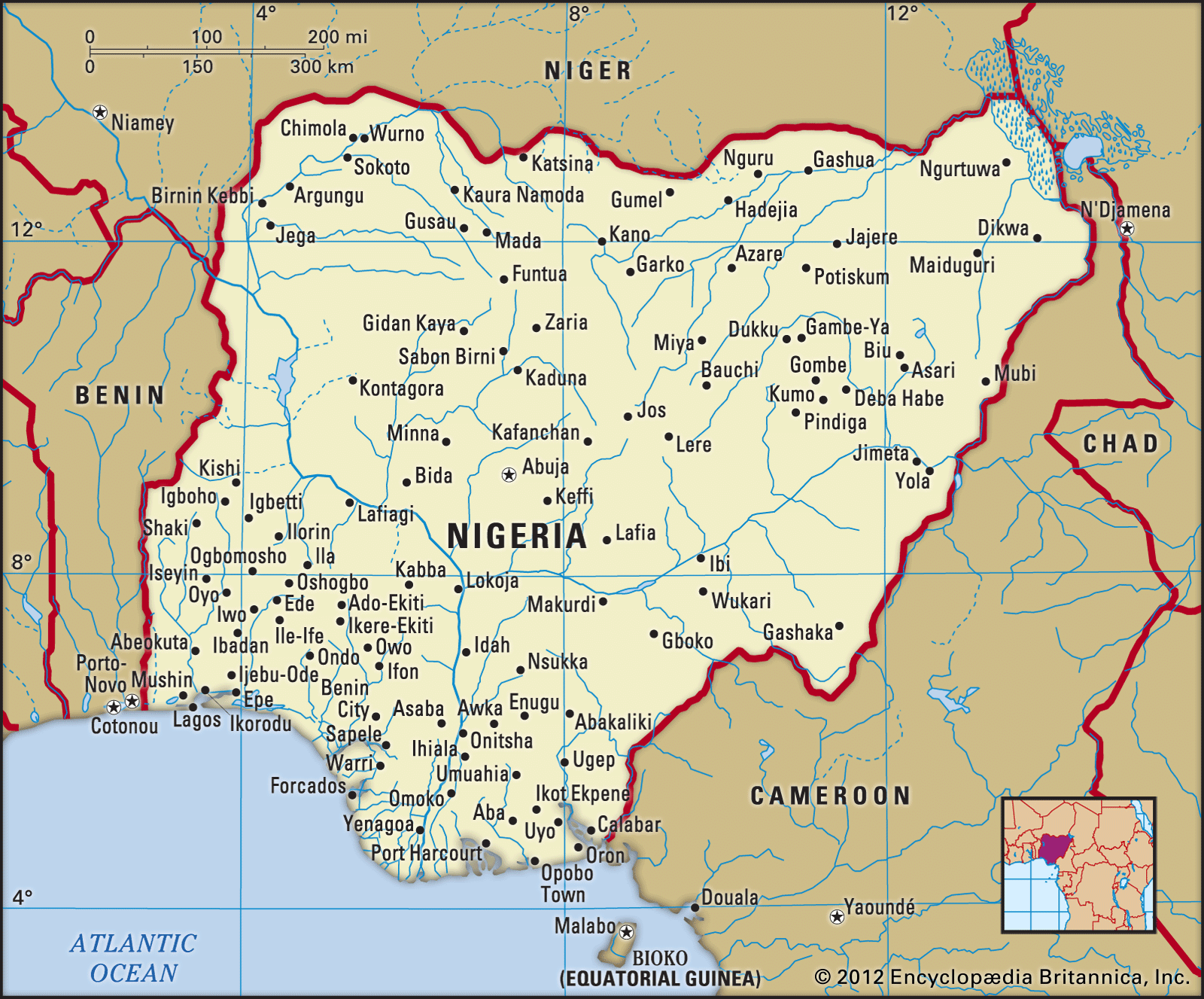
Even before the current crisis, the 2022 Multidimensional Poverty Index by the NBS showed that 63% of Nigerians (133 million people) were poor. The burden of poverty is not evenly distributed: 65% of the poor (86 million people) live in the North, while 35% (47 million) reside in the South. In some states, the picture is devastating; the incidence of poverty ranges from 27% in Ondo to a staggering 91% in Sokoto.
This failure stems from multiple sources: limited industrial expansion, declining entrepreneurship, and a hostile business environment that stifles innovation. With rising emigration and growing informality, Nigeria faces what economists describe as a jobless growth trap, where GDP figures improve but living standards stagnate.
The call by the World Bank for Nigeria to strengthen its public financial management systems and ensure that every naira spent delivers measurable development impact is crucial. For too long, inefficiency, leakages, and outright corruption have undermined the capacity of public spending to lift people out of poverty. Nigeria does not lack resources; it lacks accountability and focus. Without disciplined fiscal management, no amount of reform will yield the desired outcomes.
To its credit, the Tinubu administration has taken difficult but necessary steps to stabilize the economy. The removal of fuel subsidies, unification of exchange rates, and tighter monetary policy have begun to create fiscal space and restore investor confidence. But as the World Bank rightly observed, these gains are only the first phase of recovery. Without complementary structural reforms, especially in agriculture, energy, and transport, inflation will remain high, and growth will remain narrow and exclusionary.
The federal and state governments should expand social protection programs to cushion the poor from the short-term pain of adjustment. Conditional cash transfers, school feeding schemes, and targeted support for smallholder farmers are essential components of a humane reform agenda. Equally important is the need for policy coherence. Too often, Nigeria’s fiscal, monetary, and trade policies move in conflicting directions, canceling out potential benefits. A unified, evidence-based approach—one that prioritizes citizens’ welfare above political expediency—is essential for sustainable progress.
There should be adequate measures towards the reduction of inflation, particularly food inflation. Boosting local food production, investing in mechanization, storage and transport infrastructure, and strengthening the agricultural value chain can help tame prices and improve food security. Concurrently, the Nigerian government must improve public spending efficiency by cutting waste, enforcing fiscal transparency, and redirecting resources toward health, education, and social protection. These are the building blocks of human development—the only true measure of progress.
Job creation at scale is non-negotiable. This means supporting small and medium enterprises, attracting investment into manufacturing and services, and tackling the energy crisis that cripples productivity. Reforms that stabilize the macroeconomy but fail to provide employment are, at best, incomplete. The government must acknowledge these realities rather than play politics with numbers and citizens’ well-being.
Nigeria has the talent, resources, and human capital to lift millions out of poverty within a generation. But this requires political will, institutional discipline, and a moral commitment to inclusive growth. Economic reform is not about numbers; it is about people. Until the policies of the state begin to ease the burden of its citizens, Nigeria’s poverty crisis will remain a scar on the conscience of its leaders and a threat to its stability.


