Political Parties and the Interim Government Navigate Election Challenges
Kathmandu, Oct. 11 — The responsibility of ensuring free and fair elections lies with the government, which should engage political parties and other stakeholders in meaningful dialogue. However, the interim government led by Sushila Karki has opted to delegate this task to the ceremonial President, Ramchandra Paudel, rather than directly reaching out to the political parties represented in the dissolved House of Representatives.
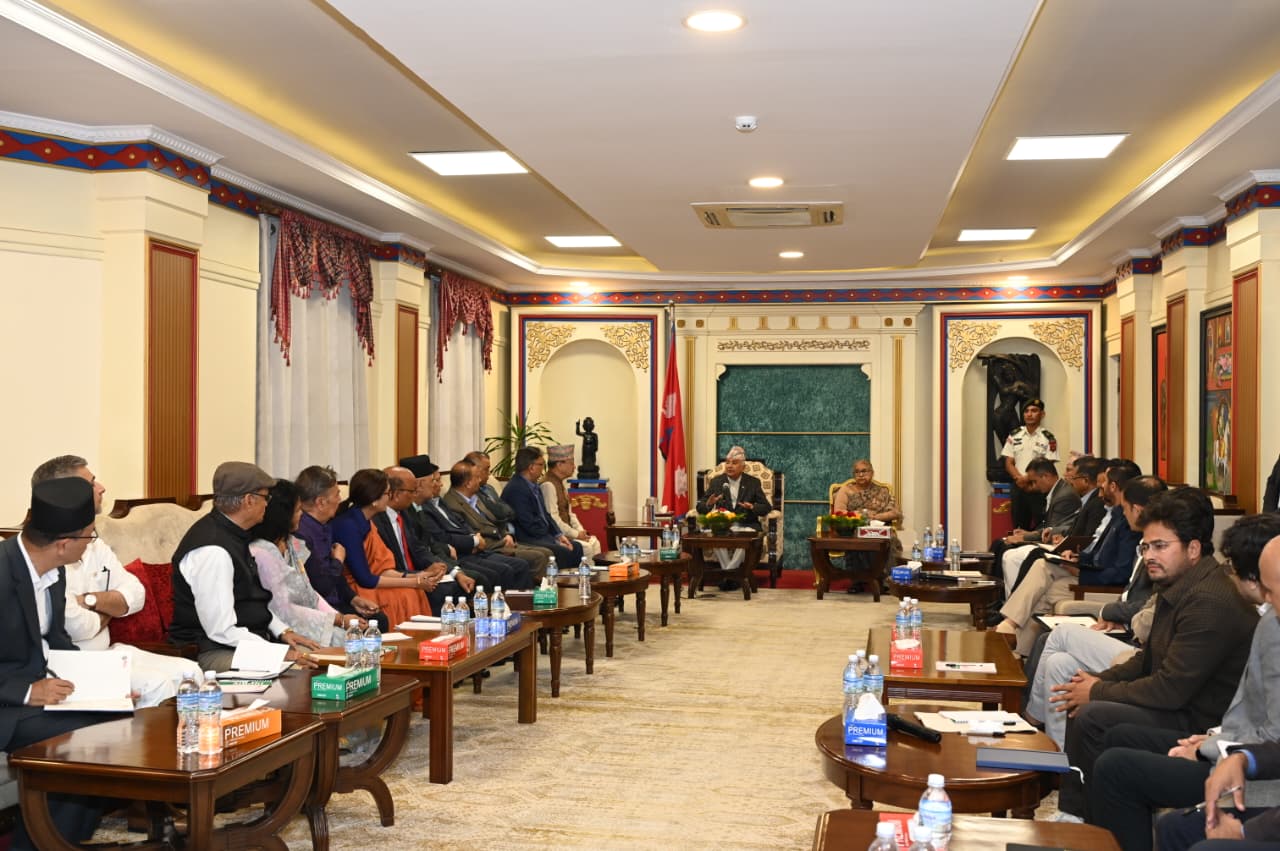
On Friday, President Paudel convened a consultation with political party leaders, following a request from Prime Minister Karki on Thursday for him to take the initiative. During the meeting, Paudel urged the political parties to participate in the elections to protect the country, its constitution, and democracy.
A Nepali Congress leader raised concerns about the government’s reluctance to consult with the parties directly, asking, “The very mandate of this government formed after the Gen Z movement is to hold the elections on March 5, 2026. But why is the government refraining from consulting with the parties?”
Another leader from CPN-UML, the second-largest party in the outgoing parliament, echoed similar questions, wondering why the government hesitates to sit down with them if it knows that elections cannot be held without their involvement.
In the meeting with Prime Minister Karki, ministers, and political party leaders, President Paudel reiterated that elections are the only option to protect the country, the people, democracy, and the constitution. He urged political parties to focus on the House of Representatives election scheduled for March 5.
Notably, top leaders of major parties such as Sher Bahadur Deuba, KP Sharma Oli, and Pushpa Kamal Dahal were absent from the meeting convened by the President. At the all-party meeting, representatives of political parties questioned Prime Minister Karki about the location of the meeting and the public release of electoral programmes without prior consultation.
Karki later clarified that the meeting was held at Sheetal Niwas at her request. A minister present at the meeting stated, “After Friday’s meet created a positive environment for polls, subsequent meetings will now take place in Singha Durbar.”
Karki explained that she had requested the President to convene the first meeting to avoid angering Gen Z groups. “Had I called the first meeting with the political parties, the Gen Z groups might have gotten angry,” she said.
Major political parties with significant representation in the dissolved House are divided on whether to participate in the elections. The Nepali Congress is in a dilemma but has not declared a boycott of the elections, which are scheduled two years earlier than usual. The UML is questioning the government’s intent and lobbying for the reinstatement of the dissolved House. The CPN (Maoist Centre) has not opposed the polls but has asked the government to create a conducive environment first.
According to President Paudel’s press adviser, Kiran Pokharel, the head of state advised the government to make necessary security arrangements for free and fair elections. The President is set to consult Gen Z representatives on Saturday, alongside government representatives.
“President Paudel emphasized the need for everyone to work together to successfully conduct the elections and safeguard democracy. He encouraged the parties to voice any confusion or uncertainty, warning that seeking alternatives to the elections could lead the country down a dangerous path,” said a statement issued by the President’s Office after the meeting.
He also urged political parties to avoid creating confusion and instead assure the people that the concerns raised by the young generation would be addressed. He stressed that the government must immediately respond to the parties’ concerns about security.
Several political leaders expressed that democratic parties are ready for elections but raised doubts about the current security climate guaranteeing free and fair elections. They emphasized the need for the government to ensure a free, fair, and fearless poll atmosphere.
Leaders from the Congress and the UML questioned the viability of elections given the recent looting of police weapons and the presence of hardened criminals. Prime Minister Karki assured that the interim government is fully aware that elections cannot happen without political party participation and promised to make necessary security arrangements.
She urged the parties to consider the discontent of Gen Z-ers and embrace change, saying, “as they are the sons and grandsons of all of us.”
After the meeting, government spokesperson and Minister for Information, Technology, and Communication Jagadish Kharel claimed that the country is now election-bound. “The government is also moving towards elections while addressing the major demands of Gen Z,” he said.
Prime Minister Karki has already held meetings with office bearers of the Elections Commission and urged them to hold talks with political party leaders. “No political party has announced a boycott of elections,” Kharel said.
He stated the Election Commission is proceeding according to its schedule and claimed that security agencies have not reported any loss of morale. He also claimed that the election is now certain thanks to the President’s initiative.
“Now that the government, political parties, and the President himself have created an environment for holding the elections, the security personnel are also ready with a high morale. The country is now clearly moving forward on the path to elections. The phase of silence and lack of dialogue is over,” he said.
Rastriya Prajatantra Party (RPP) spokesperson Gyanendra Shahi, who participated in the meeting, proposed amending the constitution to ensure a directly elected executive prime ministerial system and abolish the provincial structure.
All ministers of the interim government were present in the meeting. Attendees included Vice-president Purna Bahadur Khadka and General Secretary Gagan Thapa from the Nepali Congress; Senior Vice-chair Ishwar Pokharel and General Secretary Shankar Pokharel from the UML; and Senior Vice-chair Narayan Kaji Shrestha and Deputy General Secretary Barshaman Pun.
Acting President DP Aryal and Deputy General Secretary Bipin Kumar Acharya from the Rastriya Swatantra Party; Spokesperson Gyanendra Shahi and Mina Lama from the Rastriya Prajatantra Party; Vice-chair Rajendra Pandey and General Secretary Ghanashyam Bhusal from the CPN (Unified Socialist); Renu Yadav from the Janata Samajbadi Party; CK Raut and Jay Kumar Raut from the Janamat Party; Gyanendra Jha and Sarbendra Nath Shukla from the Loktantrik Samajbadi Party; Resham Chaudhary from the Nagarik Unmukti Party; Sunil Prajapati from the Nepal Majdoor Kisan Party; and Bidyut Bajracharya and Prakash Adhikari from the JSP Nepal.


