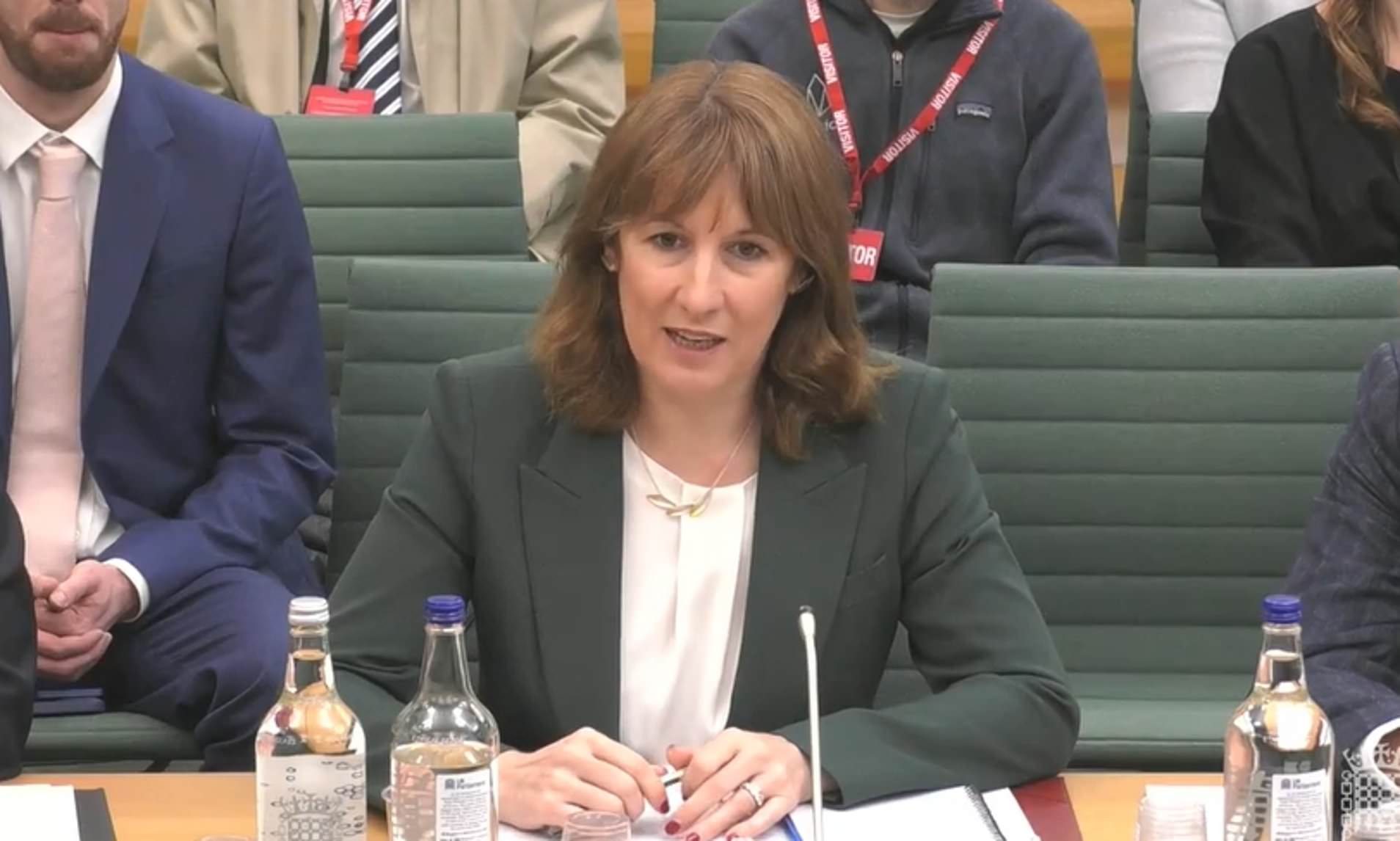
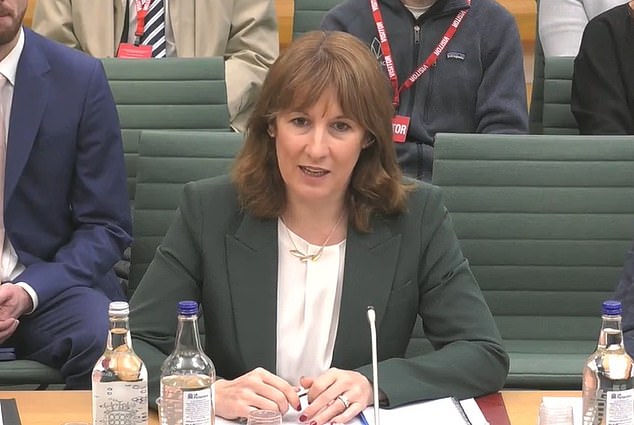
Rachel Reeves admitted there were ‘too many leaks’ about the Budget and they were ‘very damaging’ as she was grilled by MPs today.
The Chancellor insisted she was ‘frustrated’ and is now ‘doing something about it’ by launching an official probe into who was responsible.
She told the Treasury Select Committee that a ‘review’ is also being conducted into the department’s ‘security processes’.
But Ms Reeves herself has been accused of talking up a ‘black hole’ in the public finances that effectively did not exist to justify announcing another massive round of hikes on November 26.
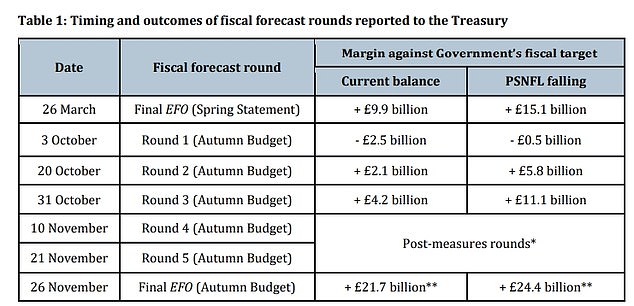
The OBR told the Treasury as long ago as September that a downgrade to long-term productivity estimates had been offset by higher tax revenues and inflation.
By the end of October Ms Reeves had been told the books were in a small surplus, with only Labour’s humiliating U-turns on benefits curbs and axing winter fuel allowance pushing them into the red.
However, Ms Reeves still called a press conference on November 4 stressing the bleak situation, before hammering the country with another £30billion of tax increases at the Budget.
She used some of the money to cave to mutinous Labour MPs by scrapping the two-child benefit cap, as well as increasing the ‘headroom’ in the finances to help calm nervous markets.
In other key moments from the session today:
- The Chancellor again denied that extending the hated tax threshold freeze for a further three years was a breach of the Labour manifesto, despite acknowledging ‘working people’ will pay more;
- She claimed she had the ‘balance about right’ at the Budget last year even though she was forced to mount another huge raid this time;
- Ms Reeves insisted she remains completely focused on ‘growth’ after the OBR refused to score any of her measures as a significant boost to the economy;
- Asked whether she might have to increase taxes again, she said: ‘I reserve the right to take action at any point.’
- The Chancellor ruled out imposing Capital Gains Tax on primary residences or watering down the state pension triple lock in this Parliament.
Treasury officials have been ordered to carry out a leak inquiry into briefings that misrepresented economic forecasts the department was being given privately.
Permanent secretary James Bowler said this morning that it will examine ministers, officials and advisers.
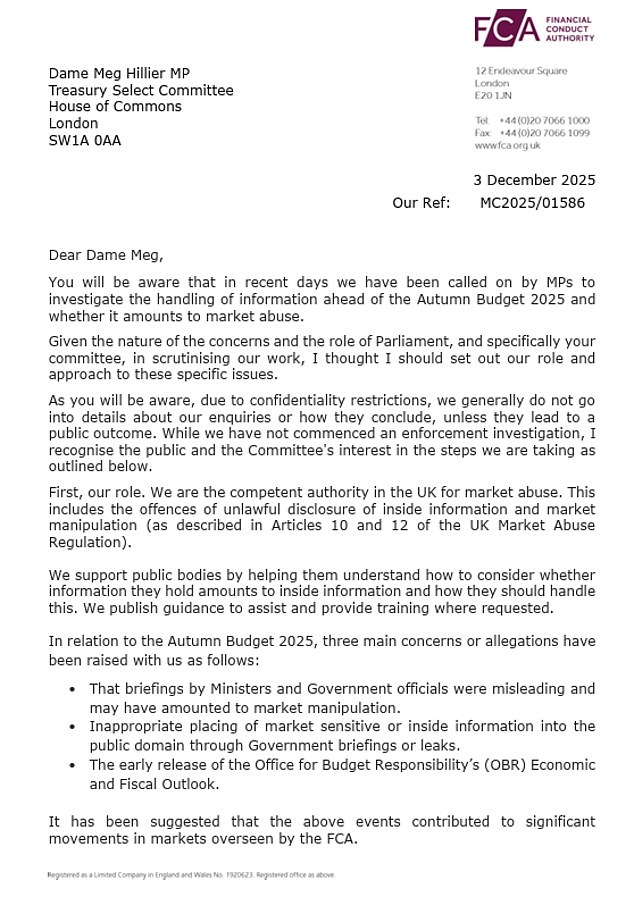
The Financial Conduct Authority has warned it could launch an investigation into the situation if it is not satisfied with the findings.
Ms Reeves confirmed this morning that the leak inquiry will focus on briefings on November 13 that she branded ‘partial and inaccurate’.
On November 13 the Financial Times broke a story saying that the government had abandoned a widely-briefed plan to breach the Labour manifesto by increasing income tax.
That sparked pandemonium on the gilts market, with interest on government debt rising sharply as traders priced in risk that Ms Reeves was not serious about balancing the books.
In order to contain the situation government sources briefed a number of journalists on November 14 that the idea had been dropped because the OBR had recently upgraded tax revenue forecasts.
However, an exact timetable of forecasts released by the OBR later showed that was not the case.
The watchdog has made clear it was infuriated by the suggestion that its forecasts had improved late in the process.
Ms Reeves said this morning of the FT story: ‘It was not an off-the-record briefing, it was a leak. I’m absolutely categorical that that was not an authorised briefing.
‘It was incredibly damaging and frustrating. That is why we have a leak inquiry.
‘It was not briefing that was signed off by me, any of my ministers or officials. It was unacceptable. That is why there is a leak inquiry going on.’
On the probe looking at ministers, officials and adviers, Ms Reeves said: ‘Of course, it is right that it looks at all those people. That is not suggesting that we think any of those people are responsible, but everybody who had access to information should rightly be part of that leak inquiry.’
Under pressure from Tory MP John Glen, Ms Reeves denied there were no meaningful updates from the OBR after October 31.
‘As you’ll know from your time at the Treasury, pre-measures is not the final word from the Office for Budget Responsibility, because then you have post-measures forecasts,’ she said.
‘They take into account the policy decisions that we take as a Government on tax and spend… so there was plenty of additional information being shared between the OBR and the Treasury between October 30 and major measures one and indeed major measures two.’
Pressed on whether there were ‘meaningful data points’ in November, she said: ‘Yes there was and the reason for that is that the OBR do costings of all of the changes that we’re making as well as there being interactions between the tax measures and other economic variables, whether that be GDP, consumption, inflation, and so all of this is changing.
‘It was a big Budget – I think we can all agree that. And every measure has its own impact, as well as a cumulative impact. So there was a lot more information between the sets.’
Ms Reeves kicked off the session by saying she was ‘grateful’ to have the ‘opportunity to… reiterate in the strongest terms that leaks are unacceptable’.
‘The Budget had too much speculation. There were too many leaks, and much of that, those leaks and speculation, were inaccurate, very damaging, as well as the IT security issues… The OBR’s report also noted that the spring statement had been accessed early as well,’ she said.
‘I want to say on the record how frustrated I am and have been by these incidents and the volume of speculation and leaks, and that is why I am doing something about it, because we cannot allow this to happen again.
‘A leak inquiry is under way with my full support, being led by the permanent secretary at the Treasury, and we are also conducting a review of the Treasury security processes to inform future fiscal events.
‘We also clearly need to look explicitly at physical IT security.
‘The Treasury have asked the National Centre for Cyber Security to undertake a forensic examination of recent economic and financial outlooks.
‘The outcome of that review, of course, will be public, and we’ll write to you with the outcomes of that review.’
Even Labour MPs have suggested the leak probe is a sham, observing that such investigations almost never find a culprit.
The Tories have called for the FCA to hold an investigation into whether market abuses took place.
Ms Reeves said that the decision to abandon plans for a manifesto-busting income tax hike had been taken jointly with the PM.
‘In the end, because of the decisions we made on high-value council tax on property and dividends and a number of other measures, we were able to keep the contribution from working people as low as we possibly could,’ she said.
‘The Prime Minister and I met two, three times a week during the Budget process. That is not always the case between chancellors and prime ministers.
‘I recognise that. But there is a very close partnership between myself and the Prime Minister.
‘And so we took him through all of the numbers and all of the options and we decided it together as a team, because that is what the Prime Minister and I am.’
She said extending for a further three years the national insurance and income tax thresholds was ‘not a breach of the manifesto, but it is asking everybody to contribute more’.
In a letter to the Treasury Select Committee, FCA chief executive Nikhil Rathi said the organisation’s ‘purpose is not to make judgments on political discourse, even though that discourse may on occasion have an impact on markets’.
However, he did not rule out holding a probe, noting the government’s ongoing leak inquiry.
‘We have requested details of this work and that the outcome, including of the inquiry into any leak of market sensitive or inside information relating to the Budget, is shared with us so we can consider as appropriate,’ he added.
Brits appear to be running out of patience with Labour according to a poll released yesterday that showed the proportion saying the government taxes and spends too much at a six-year high.
YouGov research found 45 per cent believe the burden of the state is too great, while a fifth thought taxes and spending was too low.
The level of dissatisfaction has not been worse since the firm started tracking it in 2019, while just 11 per cent said the balance was right.
The tax burden is due to reach a new peak as a proportion of GDP in records that go back more than 300 years.
After the ‘stealth’ freeze on thresholds was extended by another three years, a quarter of the working population is set to be paying higher or top rate tax by 2031.
That is up from just 15 per cent when the freeze began in 2021.
 Read more
- Are Labour’s controversial fiscal measures wringing wallets dry as inflation climbs, fueling fears of relentless tax hikes?
- Is Britain bracing for historic tax peaks as Labour’s fiscal tactics trigger staggering economic burdens?
- Could Labour’s controversial tax increases be fueling the UK cost-of-living crisis and pushing 85% of adults to call it today’s top issue?
- Is Britain’s biggest tax raid in history on the horizon with Chancellor Rachel Reeves’ upcoming budget sparking fury?
- Are taxpayers bracing for the biggest tax hike in four decades as Labour tackles a colossal £40 billion funding black hole?