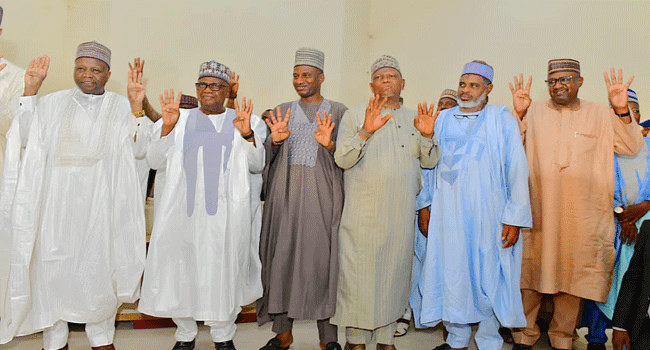
The Political Landscape in Gombe State and the Role of Senator Danjuma Goje
Politics is often a realm of betrayal, but it’s the nature and context of that betrayal that distinguish mature democracies from less developed ones. In advanced democracies, it’s nearly unthinkable for a winning candidate to become a pariah within their own party simply because they command the loyalty of the electorate. However, in Gombe State, we are witnessing a rather primitive attempt to undermine the entire political structure, starting with Distinguished Senator Danjuma Goje, the APC’s golden swan, while the party watches curiously.
What is happening in Gombe State can be likened to an effort to give a dog a bad name just to hang it. The endgame is clearly to accommodate the ambitions of some individuals at the expense of the majority. Hazel Abdelmowla once observed that, “It’s a big red flag when a politician takes decisions based on his personal interest rather than a common one.” This statement perfectly encapsulates the unfolding scenario in Gombe, which could prove even more costly for the APC than it did in 2023 if not addressed promptly.
Senator Danjuma Goje is a household name in Nigerian politics. He is among the few who have consistently placed the collective interest above personal gain. Today, Goje remains the standout political leader of the APC in Gombe State and Nigeria at large, despite the relentless attempts by some people to erase that fact by biting the fingers that fed them.
The recent viewpoint on the floor of the Senate regarding lop-sidedness in funds allocation to the entire North East signified his position as a thinker and leader to reckon with by the party. While many have praised Goje’s courage, elements within his party are painting that intervention as a “face-off” with the powers that be.
But Senator Goje was simply doing what a statesman should—speaking truth to power. It must be noted that Goje didn’t speak as a mere senator from Gombe Central; he spoke as Chairman of the North-East Caucus of the National Assembly. No wonder, his submission earned him widespread applause across the country. In a democracy like Nigeria’s where leaders must return to the people to seek revalidation through votes, it is certainly not rebellion to speak for the majority. It is a sacred duty.
Unfortunately, that act of patriotism is what some elements now wish to weaponize against him. But they have failed to take into account the fact that Goje’s record, including in Gombe, speaks louder than propaganda. It is surprising they are misreading this exemplary leader.
So, in case some of these primitive moves have reached the President, it is important to help the APC understand Goje’s significance. To do this, let us track back to the 2023 elections. While the APC suffered humiliating defeats in Gombe, losing all two other Senate seats and five out of six House of Representatives seats to the PDP, Goje alone stood tall. Without stepping out for a single campaign rally, his constituents overwhelmingly re-elected him.
The only APC candidate to win a House of Representatives seat in Gombe was from Goje’s constituency, riding entirely on his influence. Meanwhile, those leading the anti-Goje crusade lost their polling units and constituencies woefully, contributing to the APC’s presidential poll loss in the state.
So, rather than demonizing Goje for his honest interventions, this is the moment to hold him in higher esteem. With growing disaffection in the North, the very region that delivered President Tinubu’s majority votes, the APC desperately needs men like Goje: politicians whose credibility rests not on propaganda but on authentic grassroots loyalty. It is clear the APC needs him more than he needs the Party, especially as he seems not keen on contesting again unless the pressure mounts on him to re-contest as previously done.
Beyond Gombe, let us not forget that President Bola Tinubu won only one of the six North-East states—Borno. He lost in Gombe, Bauchi, Taraba, Adamawa, and Yobe. Looking at this reality, it then means that Goje’s influence as leader of the National Assembly caucus of the North East should be courted, not disparaged.
APC leaders who Goje nurtured politically should not be quick to forget how he led the party to transform Gombe from fully PDP to APC fully. Goje’s political journey is one of consistency, service, and loyalty. A former minister, two-term governor, and now a fourth-term senator, his trajectory reflects a deep understanding of governance and grassroots politics.
Alongside Bola Ahmed Tinubu, Goje belongs to the class of pioneer governors who shaped Nigeria’s Fourth Republic. His tenure as governor of Gombe State (2003–2011) remains the most productive era in the state’s history. He built a solid infrastructure base, fostered peace, expanded the economy, and laid the foundation for what many still refer to as the “Gombe miracle.”
Crucially, Goje never used his influence for selfish consolidation. Instead, he mentored a generation of leaders, many of whom now occupy key political positions.
Despite his loyalty and proven electoral value, the APC and the Presidency seem reluctant to tap into Goje’s political capital to strengthen the party in Gombe State. President Tinubu’s inner circle appears to favor loud, media-driven politicians, many of whom command little real influence beyond social media.
This miscalculation is dangerous. The APC cannot afford to approach 2027 with optics over substance. Political capital is not built on noise but on numbers, and Goje has both in abundance.
If the party truly wants to consolidate its hold on the North-East and retain national dominance, it must recognize and reintegrate leaders like Goje into its inner political machinery. Ignoring such leaders is not just disrespectful; it is politically suicidal.
The stakes for 2027 are immense. The North’s political landscape is shifting, and many influential figures, both within and outside the APC, are reconfiguring alliances. If the APC fails to value its true leaders, others will, especially as Atiku Abubakar is from the same zone. Goje’s political structure is strong enough to swing outcomes, and no party can afford to underestimate that.
In politics, loyalty must be mutual. Goje has shown it time and again to his people, to his party, and to his country. But loyalty, when consistently taken for granted, often finds a new home.
The APC must now decide whether it values the quiet strength of true leaders or the fleeting noise of opportunists. Goje represents the kind of authentic political leadership the party needs to withstand the coming storms. He remains the North-East’s most credible voice—tested, trusted, and still relevant.
Senator Danjuma Goje is not merely a political figure; he is a stabilizing institution within the APC. His governance legacy, electoral resilience, and deep grassroots connection make him one of the party’s most valuable yet untapped assets.
If the APC genuinely seeks to maintain its grip on power, especially in northern Nigeria, it must stop sidelining men who can deliver when it matters most. The 2027 elections will not be decided on social media or in television studios; they will be won in the streets, villages, and polling units where people like Goje still hold sway.
Failing to harness such strength could cost the APC dearly. The choice before the party is stark and very clear: Value authentic leaders who command respect or keep empowering noise-makers who command nothing. For APC and President Tinubu, the time to choose wisely is now.


