
Changing Dynamics in the Korean Won’s Exchange Rate
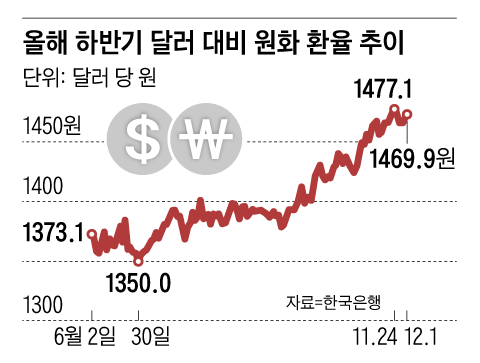
In the past, when the U.S. Federal Reserve lowered the benchmark interest rate, the Korean won’s exchange rate against the dollar would typically decline. However, this traditional relationship is no longer functioning as effectively as it once did. Instead, the exchange rate is now reacting more sensitively to movements in the U.S. stock market than to interest rates.
Baek Seok-hyun, an economist at Shinhan Bank, discussed this shift during a recent interview at the bank’s headquarters dealing room in Jung-gu, Seoul. He noted that it is difficult to definitively attribute the recent high exchange rate to individual investors alone. Baek emphasized that both individuals and larger entities, such as corporations and institutions, are increasingly looking to expand their overseas investments. With a background in engineering and over 15 years of experience analyzing exchange rates at Shinhan Bank since 2011, Baek has observed these changes firsthand. While he admits he initially underestimated the influence of individual investors, he prefers not to use the term “seohak gami” (overseas-investing ants) due to its negative connotations.
Not Just Individuals: Corporations and Institutions Also Expanding Overseas Investments
Although the expansion of individual investors’ U.S. investments has often been cited as a cause of the recent high exchange rate, Baek argues that it is not the sole factor. He explained that while individuals have become a major player in dollar purchases, they are not the only ones driving the market. Foreigners, for instance, can also buy or sell Korean stocks, which affects the exchange rate just as much as domestic investment trends.
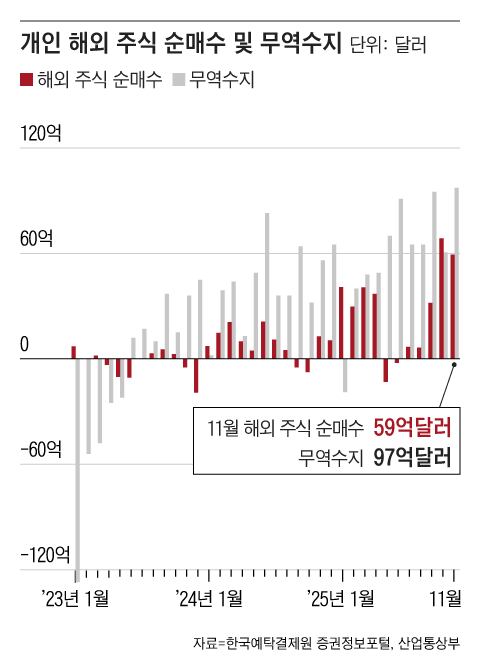
For example, in the second half of last year, some attributed the exchange rate rise to individual investors, but this overlooked the significant impact of foreign capital outflows. At that time, foreigners sold approximately $14.7 billion worth of Korean stocks, compared to individuals’ net purchases of around $2.68 billion. Similarly, in November, foreigners’ net sales of Korean stocks reached $9.7 billion, far exceeding individuals’ net purchases of U.S. stocks, which were $5.9 billion. This shows that the entities influencing the exchange rate vary depending on the timing and context.
Even though individual investors have grown in influence, their role is still not the primary driver of exchange rate fluctuations. October was a case in point, where individuals’ net purchases of U.S. stocks exceeded $6.8 billion, surpassing Korea’s trade surplus of $6 billion. Despite this, foreigners also contributed to the dollar supply by purchasing Korean stocks. However, the momentum from individual investors was strong enough to push the exchange rate upward. From January to mid-April, individual investors consistently bought dollars, but their activity slowed from late April to mid-September due to the shock of Trump’s tariff announcements. Since September 17, however, their buying momentum revived, with daily flows into the U.S. market averaging over $300 million until November.
According to data from the Korea Securities Depository, Korean individuals’ net purchases of overseas stocks in October amounted to about $6.9 billion, surpassing the trade surplus of $6.1 billion. In November, the trade surplus increased to $9.7 billion, outpacing the net purchases of overseas stocks, which were $5.9 billion. This may be linked to the U.S. Thanksgiving holiday, which caused the U.S. stock market to close on the last day of November.
Corporate and Institutional Investment Trends
Baek also pointed out that corporations and institutional investors are playing a growing role in the exchange rate dynamics. Corporations need dollars for investments in the U.S., and institutional investors are diversifying their portfolios by increasing overseas investments. This trend intensified during Trump’s first term, continued under Biden, and has grown even stronger under his second term. The core issue, according to Baek, is a structural imbalance in the supply and demand for dollars, driven by the simultaneous demand from individuals, corporations, and institutions.
Until October, foreigners’ net purchases of Korean stocks acted as a buffer against exchange rate fluctuations. However, when they turned to large-scale selling in November, the exchange rate rose to a burdensome level.
Corporate Preference for Dollar Holdings Resembles Early Pandemic Period
Why has the concentration of individual investors’ U.S. stock investments strengthened now? Baek believes this reflects deeper issues in the Korean market. There is a growing faith in U.S. stocks, similar to the IT bubble of the 1990s, but it also highlights disappointment in the Korean market. As real estate uncertainties grow and the Korean stock market remains stagnant, individual investors are turning to the U.S. market to protect and grow their assets. This, in a way, is a rational choice for survival.
Recent developments, such as Google’s AI advancements, have further attracted funds toward opportunities that are hard to find in Korea. Rather than blaming individual investors, Baek suggests that the Korean market must reflect on its inability to provide attractive investment opportunities.
Government Intervention Faces Challenges
The won’s exchange rate has recently shown synchronization with the yen, which Baek attributes to Japan’s economic policies. Similar to the Abenomics era, Japan’s monetary policy and political leadership changes have influenced the yen, which in turn affects the won.
If the U.S. Federal Reserve lowers the benchmark interest rate in December, it could theoretically weaken the dollar. However, the current market is more sensitive to growth signals than to interest rates. A rate cut is often interpreted as a positive for the U.S. stock market, leading to global capital inflows that increase dollar demand and potentially push the exchange rate higher.
Market experts predict a high probability of a rate cut in December, but the won’s exchange rate against the dollar remains high. Baek notes that the current situation is not due to temporary speculative forces but rather a structural and orderly exchange rate rise based on real demand. In the long term, improving the domestic investment environment is essential to bring capital back and enhance the fundamental attractiveness of the Korean economy.


