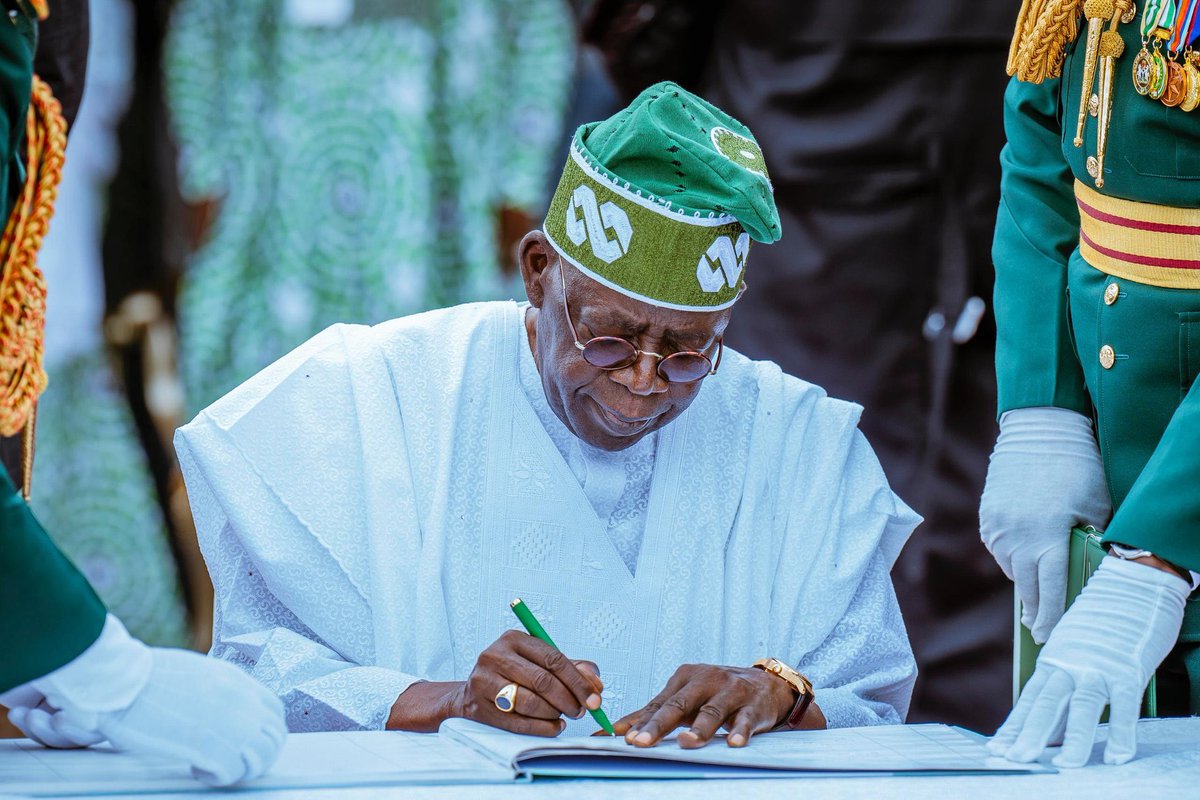
The Socio-Economic Rights and Accountability Project (SERAP) has called on President Bola Ahmed Tinubu to urgently direct the Attorney General of the Federation and Minister of Justice, Mr Lateef Fagbemi, SAN, to publish certified true copies of Nigeria’s recently enacted tax laws and the original versions of the bills received from the National Assembly.
In a Freedom of Information (FOI) request dated December 20, 2025, and signed by SERAP’s Deputy Director, Kolawole Oluwadare, the organisation also urged the President to clarify whether the tax bills transmitted from the National Assembly are identical to the versions signed into law and subsequently gazetted by the Federal Government.
The documents requested by SERAP include the National Revenue Service (Establishment) Act, the Joint Revenue Board of Nigeria (Establishment) Act, the Nigeria Tax Administration Act, and the Nigeria Tax Act.
Beyond disclosure, SERAP requested that President Tinubu establish an independent panel of inquiry to investigate allegations that material differences exist between the tax bills passed by the National Assembly and the laws ultimately gazetted.
According to the group, the panel should be constituted to operate promptly, independently, impartially, transparently, and effectively.
“The panel should have the mandate to establish the facts of what exactly occurred and identify those suspected to be responsible for the alleged alterations,” SERAP said.
It added that the panel should be headed by a retired Justice of the Supreme Court or the Court of Appeal, with its findings made public.
Anyone found responsible for the alleged alterations, SERAP stressed, should face prosecution as appropriate.
SERAP noted that publishing certified true copies of the bills passed by the National Assembly and the laws signed by the President would allow Nigerians to scrutinise the legislation and compare it with the versions gazetted.
Such disclosure, the organisation argued, is critical to transparency, accountability, and public trust in the lawmaking process.
The organisation warned that any unlawful alterations to duly passed legislation would violate the 1999 Constitution of Nigeria (as amended), international human rights obligations, and fundamental principles of the rule of law and separation of powers.
“The law-making processes, including the passing of bills, their signing into law, and their gazetting, must meet the requirements of the Nigerian Constitution, the rule of law, and the separation of powers.
“Any passed bills and signed laws must be accessible, authentic, intelligible, clear, legitimate, and predictable so that people can know and comply with them,” the letter read.
SERAP argued that clarifying whether the versions of the tax bills received from the National Assembly are the same as those signed into law and gazetted would help promote transparency and accountability, while addressing potential threats to Nigerians’ human rights.
The group gave the Federal Government a seven-day ultimatum to comply with its requests, warning that it would initiate legal action in the public interest if no response is received within that period.
According to SERAP, the controversy follows allegations by the National Assembly that the gazetted tax laws contain unlawful alterations and material differences from the bills passed by both chambers.
Specifically, a Sokoto lawmaker, Abdussamad Daisuke, had raised the matter under a point of privilege, drawing attention to discrepancies between the harmonised versions approved by parliament and the copies later gazetted by the Federal Government.
SERAP said the National Assembly established that substantive provisions were allegedly inserted, deleted, or modified after legislative passage.
It further claimed that several oversight, accountability, and reporting mechanisms approved by lawmakers were removed, while new coercive and fiscal powers were inserted without parliamentary approval.
These reportedly include arrest powers, garnishment without court orders, compulsory computation of United States dollars, and appeal security deposits.
The organisation emphasised that Section 39 of the Nigerian Constitution, Article 9 of the African Charter on Human and Peoples’ Rights, and Article 19 of the International Covenant on Civil and Political Rights guarantee the right to seek, receive, and impart information.
It added that these legal instruments impose obligations on the government to ensure transparency and accountability in lawmaking.
“Our requests are brought in the public interest, and in keeping with the requirements of the Nigerian Constitution, the Freedom of Information Act, and the international human rights treaties to which Nigeria is a state party,” SERAP said.
Provided by SyndiGate Media Inc. (Syndigate.info).