The APEC Summit in South Korea: A Crucial Moment for Global Trade
South Korea is set to host a significant gathering of leaders from major Pacific Rim economies, including the United States, China, and Japan, for this year’s Asia-Pacific Economic Cooperation (APEC) summit. This annual event has long been a platform for promoting free trade and economic cooperation among member nations. However, the current geopolitical climate presents a unique challenge for the South Korean hosts.
The summit comes at a time when U.S. President Donald Trump’s policies have disrupted the postwar global trade order. His sweeping tariffs and other measures have caused ripples across the international community, unsettling both allies and adversaries. As a result, the APEC meetings are expected to be overshadowed by a high-profile side event — a face-to-face meeting between Trump and Chinese leader Xi Jinping on Thursday. This encounter will take place against the backdrop of an intensifying trade war that leaves South Korea in a difficult position, trying to balance its relationships with both Washington and Beijing.
APEC’s Structure and Significance
Established in 1989 as a 12-member forum, APEC has grown to include 21 members, such as the United States, South Korea, China, Japan, Australia, and Russia. These countries collectively represent 37% of the world’s population and over half of global trade in goods, according to recent data. Each year, one of the member states hosts the leaders’ meeting, serving as the chair of the forum. While APEC focuses solely on trade and economic issues, it plays a critical role in fostering dialogue and cooperation among nations that might otherwise compete or clash.
This year’s summit will be held from October 31 to November 1 in Gyeongju, a cultural hub known for its UNESCO World Heritage sites. Although APEC lacks a military component, its strength lies in its ability to bring together diverse nations, enabling collaboration on key initiatives without binding agreements. In the lead-up to the summit, various ministerial and working-level meetings are held to discuss practical cooperation on different issues. Economists credit APEC with helping reduce trade barriers in previous years.
However, this year’s atmosphere is markedly different. Kim Tae-hyung, a professor at Seoul’s Soongsil University, noted that while APEC has symbolic significance, the current environment may limit the range of discussions typically held at the forum.
A Changing Trade Landscape
South Korea last hosted APEC in 2005 during a period of postwar globalization. Now, the country faces a far more complex trade landscape under the Trump administration. The forum, once shaped by U.S.-led efforts to promote free trade and multilateralism, now confronts a stark contrast as Trump’s policies challenge the existing rules-based international order.
Park Won Gon, a professor at Seoul’s Ewha Womans University, highlighted the shift, stating that the U.S. initially drove the creation of APEC with the goal of expanding global cooperation. Now, the administration is rejecting those principles. This situation forces pro-American members, particularly South Korea, into a delicate balancing act, navigating diplomatic messages that advocate for free trade without alienating Washington, while also preventing China from positioning itself as the defender of global order.
The Trump-Xi Meeting: A Key Event
The main event of the summit will likely be the bilateral meeting between Trump and Xi Jinping in Busan on Thursday. This will be their first meeting since Trump began his second term. The two leaders have been locked in an escalating trade war, with the U.S. imposing high tariffs and technology restrictions, and China retaliating with curbs on rare earth shipments. It remains unclear whether either side will make major concessions, but some analysts believe the meeting could ease tensions.
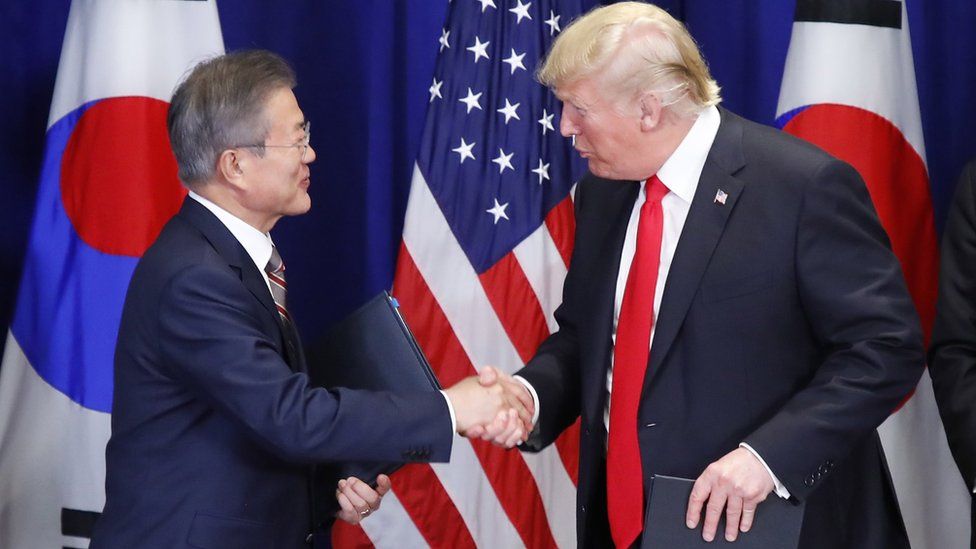
Ban Kil Joo, a professor at South Korea’s National Diplomatic Academy, suggested that the meeting would not happen if there was no expectation of reaching an agreement. This meeting will follow Trump’s talks with South Korean President Lee Jae Myung in Gyeongju on Wednesday. Trump’s trip to South Korea will be preceded by a visit to Japan, where he met with new Prime Minister Sanae Takaichi, who is expected to attend the APEC forum.
Both Seoul and Tokyo have pledged large investments in the U.S., aiming to avoid the highest tariffs that could damage their auto industries and other key exports. However, negotiations between Washington and Seoul have been challenging, with South Korean officials resisting U.S. demands for upfront payments, fearing potential financial crises.
Addressing Free Trade and Emerging Issues
South Korean Foreign Minister Cho Hyun acknowledged that it may be difficult for APEC leaders to issue a joint statement strongly endorsing free trade due to differing positions. Instead, a broader declaration emphasizing peace and prosperity in the Pacific region is anticipated.
Choi Yoon Jung, an analyst at Seoul’s Sejong Institute, suggested that South Korea should use its role as chair to convey a message from “middle power” nations promoting free trade and global cooperation. He emphasized that APEC’s strength lies in bringing together countries engaged in disputes to discuss practical cooperative steps, even if immediate breakthroughs are not achieved.
In addition to trade, this year’s APEC meeting will address the growing role of artificial intelligence and demographic challenges faced by developed economies, such as low birth rates and aging populations. Park, a professor at Seoul’s Ewha Womans University, noted that AI is a crucial global issue, with no existing regulatory norms or standards. For South Korea, a technologically advanced nation, this presents an opportunity to play a leading role in shaping AI governance.


