Early Warnings and Precautionary Measures
Nepal has experienced a series of natural disasters in recent years, with the most devastating being the deadly debris flows at Simaltal and Jhyaple khola last year. These events resulted in nearly a hundred deaths, prompting the government to take stringent precautionary measures in anticipation of heavy rain forecasted for October 3 through 6. Major highways were shut down, and a two-day public holiday was declared to prevent risks to travelers.
A prelude to the potential dangers was witnessed near Muglin, where a landslide at Tuin Khola blocked the highway for 45 hours and then again for another 53 hours within five days (September 19-23). This disruption affected thousands of people traveling home for the Dashain festivities. As predicted, the rain began on the night of October 3 and continued into the evening on the 5, with over 300 mm of rain recorded in the Tarai and about 200 mm in the Valley.
The government’s decision to close highways was a well-measured step that undoubtedly prevented significant loss of lives across the country. However, the devastation in Ilam marked the biggest disaster event the district has seen in recent years. The same rainfall triggered landslides and debris flows, burying houses and killing 37 people, as well as floods that claimed two more lives.
Unprecedented Devastation in Ilam
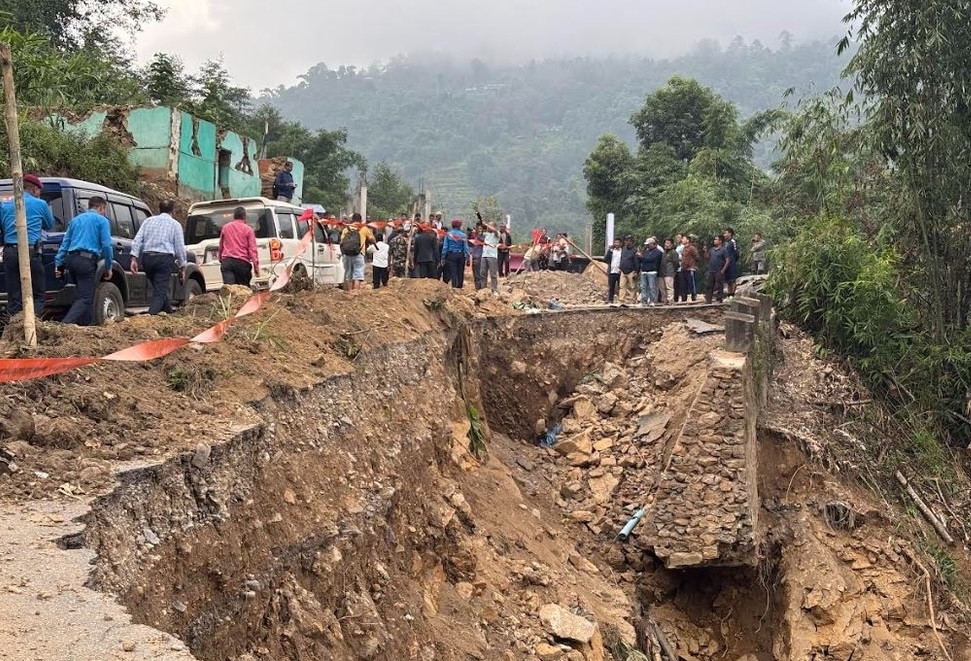
The rainfall was so intense that it caused a significant section of the Mechi Highway to collapse and subside. Cracks appeared in the road, and surrounding slopes continued to widen for days, indicating ongoing landslips and slope deformation. The Ilam District Disaster Management Committee (DDMC), in response to the Department of Hydrology and Meteorology (DHM) forecast, had identified over 20 high-risk locations. However, disturbingly, except for areas around Rajduwali, which suffered particular damage, none of the other rain-battered areas were listed as high-risk. This raises questions about the understanding of risks in Ilam.
Surging Debris Flow
Despite the DDMC adopting timely precautionary measures and putting contingency plans in place, the devastation and loss of lives in Ilam were severe due to widespread debris flow resulting from localized high-intensity rain. This suggests changing rainfall patterns in the mountains. The intense rainfall earlier this month illustrated how diverse these impacts can be. In addition to early warning, several other location-specific measures must be part of the response, especially in the mountains, where orographic elements add to growing complexities.
In recent years, debris flows in the mountains have increased due to localized high-intensity rains, which meteorological stations do not capture. The problem is compounded when micro-channels, conveying runoff along the slopes, are frequently altered by both human and natural factors. Local people generally recognize where risky runoffs are likely to develop and often make diversion channels in and around their houses to mitigate the risk beforehand. Unfortunately, development workers, particularly road builders, predominantly non-locals, do not understand these location-specific realities and unintentionally alter runoff channels during infrastructure development, often without foreseeing the consequences.
A Survivor’s Story
A debris flow survivor in Ilam recalled how debris from the road, resulting from a similar disregard for local understanding of risks, destroyed her property. During road construction above her home some years ago, she urged workers to remove a threatening boulder, but her plea was ignored. On the fatal night of October 4, the boulder rolled down the hill, along with debris from the road, flattening two houses and killing at least four visiting relatives. Such incidents have become pervasive with changing rainfall patterns. In 2018, a similar incident occurred in Jajarkot, where debris from a newly constructed road uphill buried a house and killed eight children inside the home, including the owner.
Increasing Severity of Debris Flows
The year 2020 serves as a baseline to appreciate the increasing severity of debris flow-dominated landslides. That year, more than 400 landslides, several of them quite deadly, killed over 300 people and damaged vital infrastructure across the country. Many were caused by localized high-intensity rain, triggering damaging debris flow in the least expected areas, from Sankhuwasabha in the east to Bajura in the west.
Prolonged Heavy Rain
Understanding the causes for October’s prolonged heavy rain would help recognize the underlying triggers and the likelihood of similar events occurring, possibly worse in severity, in the future and effectively prepare for the eventuality. The October rain was caused by a cyclonic weather system when the monsoon was retreating. The weather system originated as a cyclonic circulation over the Bay of Bengal, rapidly intensifying into a deep depression primarily driven by elevated sea surface temperatures. Meanwhile, the retreating monsoon had left a residual trough of low pressure over southern Nepal. The interaction between the retreating monsoon and the deep depression was further amplified by orographic lift as it reached the Himalayas, unleashing heavy rains in the central Tarai plains and eastern hill districts. With soils already saturated from delayed monsoon withdrawal, the extreme rainfall resulted in widespread damage.
The rainfall, though not a typical monsoon event, behaved like a monsoon, marked by heavy rainfall, intense convective activity and moisture-laden winds. These traits, driven by warm sea surface temperatures and cyclonic circulation, highlight how post-monsoon systems can extend the wet season’s risks, amplified by climate-driven intensification of rainfall extremes—a lesson for the coming years.
Reaching the Vulnerable
Debris flows in hilly regions aren’t anomalies, rather they’re inevitable. They impact rural communities and critical infrastructure like roads, reservoirs, irrigation canals, water intake sites and power plants, vital for both rural and urban populations. Damage to these assets affects a large portion of urban populations, heightening the need for instant mitigation; therefore, the approach often relies in reactive, paramedic-like responses.
The damage assessment, rescue, relief and reconstruction primarily target road corridors. Villages and farms in roadless, remote areas face significant risks, too. Yet, because these areas are mostly unreached, unattended and far from service centres, communities are quite vulnerable to such disasters and consequent neglect. Their capacity to recover and re-establish remains extremely weak. If and when help arrives, it’s often too little, too late.
Addressing Debris Flow Risks
In sum, addressing debris flow risks requires addressing the cyclical water extremes—monsoon-triggered landslides/debris flow followed by water scarcity—by adopting year-round planning, budgeting, programming and monitoring which prioritize not only urban interests but also other vulnerable populations. Planners must foreground the risks facing people to make disaster responses vastly more effective. Without this, we won’t build the required capacity to address the scale and complexities of this omnipresent hazard in a warmer world.


