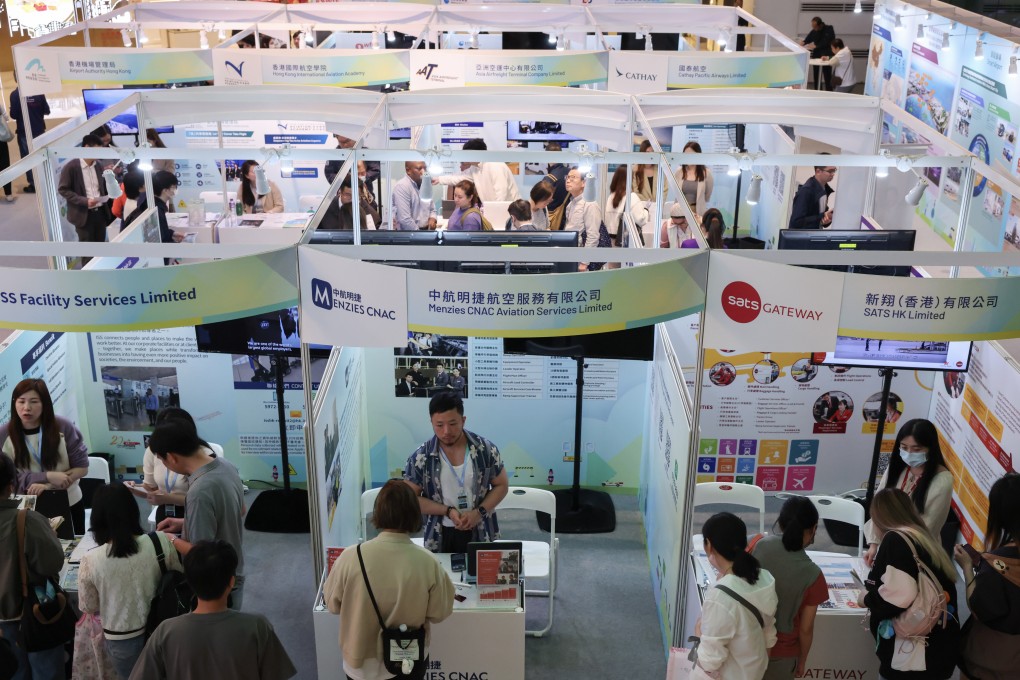
Artificial intelligence could take over junior roles in professional, scientific and technical services, which has net employment outlook of minus 15 per cent
Nearly one-third of Hong Kong companies plan to increase hiring in the next three months, while professional, scientific and technical services are likely to cut staff, especially junior positions, amid the widespread adoption of artificial intelligence, a survey has found.
Human resources solutions company ManpowerGroup Greater China released its findings on Tuesday, after surveying 506 Hong Kong businesses in November.
The survey found that 31 per cent of businesses – particularly in hospitality, health and finance – planned to hire more staff in the first quarter next year. Another 29 per cent anticipated a headcount reduction, while 37 per cent forecast no change. The remaining 3 per cent did not provide an answer.
Do you have questions about the biggest topics and trends from around the world? Get the answers with SCMP Knowledge, our new platform of curated content with explainers, FAQs, analyses and infographics brought to you by our award-winning team.
It also showed that Hong Kong’s professional, scientific and technical services – which include legal, accounting, engineering, IT support, architecture and advertising – had an index of minus 15 per cent for its net employment outlook, the lowest among eight sectors.
The net employment index measures employers’ hiring intentions and is calculated by subtracting the percentage of employers expecting a decrease in hiring activity from the percentage of those anticipating an increase.
“[The sector] is now undergoing accelerated transformation driven by AI and automation … and has widely adopted AI for document drafting, data analysis, content generation, and process integration,” said Lancy Chui Yuk-shan, senior vice-president of ManpowerGroup Greater China.
“[This] would reduce the demand for some entry-level roles and lead companies to moderate short-term hiring intentions. Nevertheless, market demand remains strong for core talent capable of strategic judgment and AI mastery.”
She noted that such professionals included management consultants, legal technologists, engineering advisers, AI engineers, public relations specialists and marketing strategists, with the softening outlook reflecting structural adjustments rather than a sector-wide decline.
The group also projected Hong Kong’s net employment outlook index for the first three months of 2026 at 2 per cent, well below the global level of 24 per cent.
It marked a drop of 1 percentage point from the previous quarter, and was the lowest positive percentage among 41 surveyed countries and regions, according to the group.
Chui also pointed out that the city’s hospitality sector posted the highest net employment outlook of 13 per cent, attributing the positive sentiment to the growth in visitor arrivals.
Hong Kong welcomed 4.2 million visitors in November, a 17 per cent year-on-year rise.
“It contributed to a steady recovery in the catering and retail sectors. Among them, around 2 million were overnight visitors, up 6.8 per cent from a year earlier, prompting hotels to expand … hiring to meet higher occupancy and service demand,” she said.
Chui said she expected demand for accommodation, dining and tourism services to strengthen further with Lunar New Year approaching in February. A peak travel season, the holidays are usually coupled with festive promotions to stimulate consumption, driving additional manpower needs.
The survey also showed that Hong Kong’s talent shortage for 2026 stood at 66 per cent, the lowest level since 2015 when it was 65 per cent, with employers naming AI model and application development and AI literacy as the two most sought-after skills.
Engineering, sales and marketing, as well as manufacturing and production were also among the top areas in demand, with companies tackling the shortage by upskilling and reskilling existing staff.
Hong Kong businesses are also looking at ways such as hiring more contingent or temporary workers, tapping new talent pools, offering more location flexibility, and using automation or AI to reduce total headcount needs to address the shortage.
The survey also found that salaries were expected to rise by 2.7 per cent in 2026, with 38 per cent of surveyed businesses planning pay increases, 2 per cent projecting cuts, and 60 per cent taking a wait-and-see approach.
“[The increase in salary] is similar to last year. We see that some sectors are gradually recovering and in recognising the need to retain talent, they will actually offer appropriate pay rises,” Chui said.
More Articles from SCMP
Philippines weighs using UN anti-corruption treaty for Zaldy Co’s extradition
Why Hong Kong’s first pro female MMA fighter now battles for women’s health
SCMP Best Bets: Sky Song can be the perfect tune at Happy Valley
Hong Kong launches consultation for 2026 budget focusing on economic growth
This article originally appeared on the South China Morning Post (www.scmp.com), the leading news media reporting on China and Asia.
Copyright (c) 2025. South China Morning Post Publishers Ltd. All rights reserved.


