The Board of Audit and Inspection has released an audit report criticizing the Yoon Suk-yeol government for pushing the introduction of “artificial intelligence (AI) digital textbooks” without sufficient preparation, causing confusion in the education sector.
The AI textbook initiative was part of the Yoon Suk-yeol government’s 120 national tasks unveiled in July 2022. At the time, the government stated, “We will foster talent with future core competencies through educational innovation utilizing new technologies like AI,” adding, “We will support customized diagnosis and learning through an AI-based academic diagnostic system and provide close support for foundational academic skills tailored to students’ characteristics.” The government envisioned a system where students’ learning history data would accumulate through digital textbooks, analyzed by AI to provide personalized learning materials.
However, the Board of Audit and Inspection’s report, released on the 17th, noted that the AI textbook project was not mentioned as part of the Yoon government’s national tasks. Instead, it stated, “The Ministry of Education announced a plan in January 2023 to phase in AI digital textbooks starting in 2025 after then-Minister of Education Lee Ju-ho instructed their introduction upon taking office on November 7, 2022.” The report criticized the ministry for deciding to introduce AI textbooks in 2025 after only seven internal meetings without external consultation. It emphasized, “There was no effort to gather opinions from stakeholders—students, parents, and teachers—on whether to introduce AI textbooks, the timeline, or whether their adoption should be mandatory.”
For companies developing AI textbooks, a critical question was whether all schools would be required to adopt them or if adoption would be optional. The market size would vary significantly depending on the answer. According to the Board of Audit and Inspection, companies repeatedly asked the Ministry of Education whether AI textbooks would be mandatory, but the ministry did not provide a clear answer until September 2023.
Ministry of Education officials had initially prepared to allow schools to voluntarily adopt AI textbooks. However, then-Minister Lee Ju-ho ordered clarification of the companies’ concerns, and a ministry official stated at a meeting with companies in October 2023 that “AI textbooks are mandatory for all schools.” The Board of Audit and Inspection pointed out that this marked the shift to mandatory adoption.
With plans to fully introduce AI textbooks in 2025, there was no time for pilot testing. The ministry changed its policy to immediately use AI textbooks in classrooms once they passed inspection and conduct a “field suitability review” for six months after introduction. However, companies requested a three-month extension due to tight deadlines, and AI textbook development and inspection were only completed in November of last year. Consequently, the field suitability review was never conducted, the audit report noted.
The Board of Audit and Inspection also criticized the ministry for failing to provide technical requirements for AI textbooks in a timely manner. According to the report, the ministry allowed companies to begin development without first establishing “technical standards,” which were only released in December 2023. This forced companies to redesign their textbooks, causing delays and quality issues.
AI textbooks were to be subscribed to by schools on a subject-by-subject basis, with regular payments to developers. However, the ministry did not estimate the required subscription budget despite deciding to introduce AI textbooks and unilaterally informed provincial and metropolitan offices of education that they would bear the costs. When local offices requested discussions, the ministry ignored them.
During the audit, the Board of Audit and Inspection asked the ministry to estimate the annual subscription costs if AI textbooks were mandatory starting this year. The results showed costs would rise from 336.1 billion Korean won this year to 542.1 billion next year, 863.4 billion in 2027, and 1.0732 trillion in 2028.
The Board of Audit and Inspection warned the ministry, “When introducing new types of textbooks like AI textbooks, conduct pilot operations to verify effectiveness and identify issues beforehand. If field suitability reviews are to replace pilot operations, ensure teachers thoroughly apply and review them in classrooms before full introduction.” It also advised, “When pursuing projects that burden local education finances, such as the AI textbook initiative, review necessary funding and coordinate sufficiently with provincial and metropolitan offices of education.”
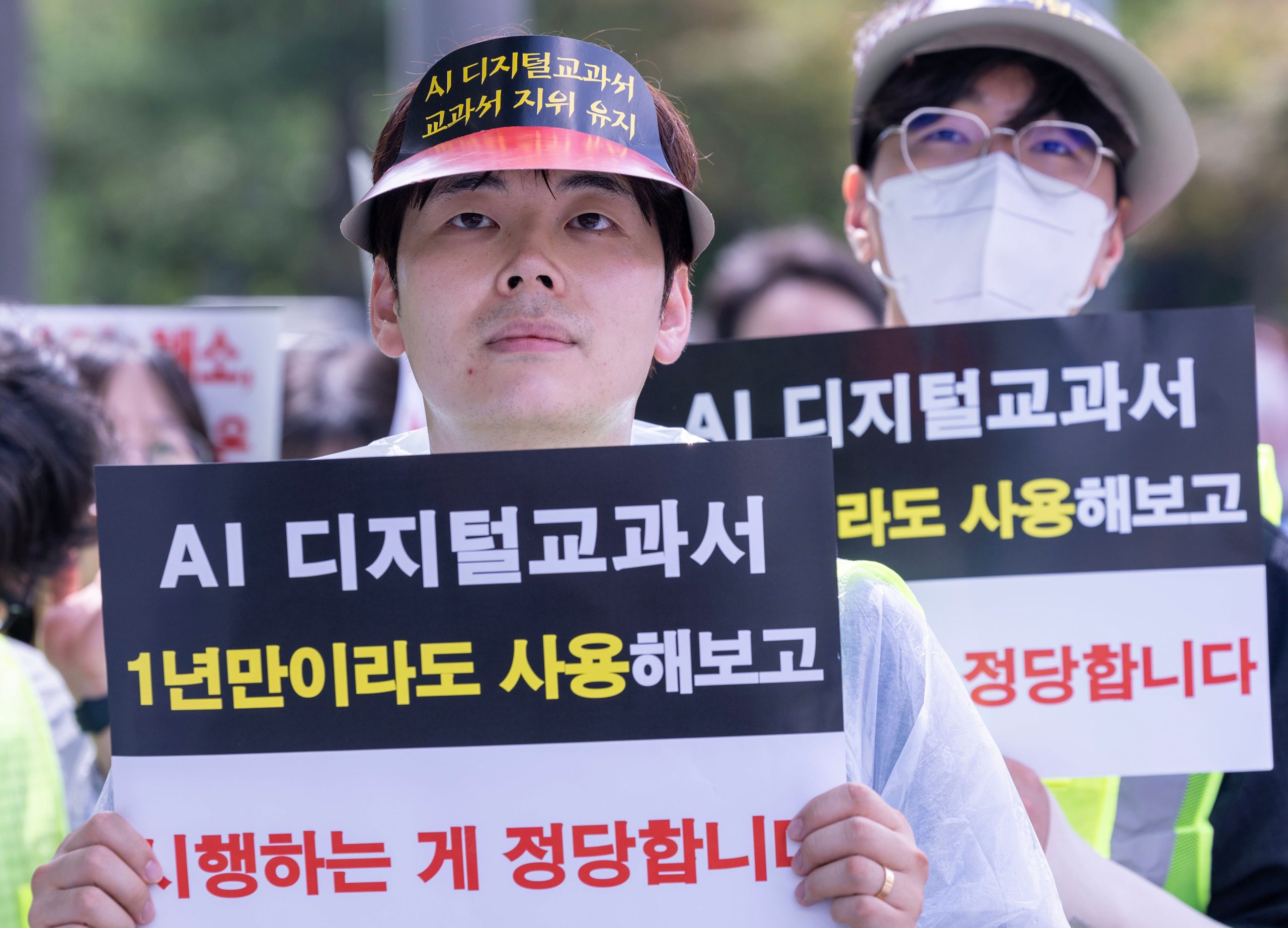
The AI textbook project is effectively scrapped. After the ministry pushed for mandatory adoption in late last year, the Democratic Party of Korea—then the opposition—passed a revision to the Elementary and Secondary Education Act downgrading AI textbooks to “educational materials” and banning their status as official textbooks. Consequently, the ministry allowed schools to voluntarily choose AI textbooks this year. Though the ban was repealed in January by then-acting President Choi Sang-mok, a new bill was passed in August under President Lee Jae-myung’s administration, and the president promulgated it into law. Thus, AI textbooks lost their textbook status. A total of 1.4093 trillion Korean won had been invested in the project by then.
The audit on AI textbook introduction was conducted after the Democratic Party-led National Assembly passed an audit request in February. Under the National Assembly Act, the Board of Audit and Inspection must audit any matter requested by the legislature.