A Gharial’s Return: A Sign of Hope for Devghat
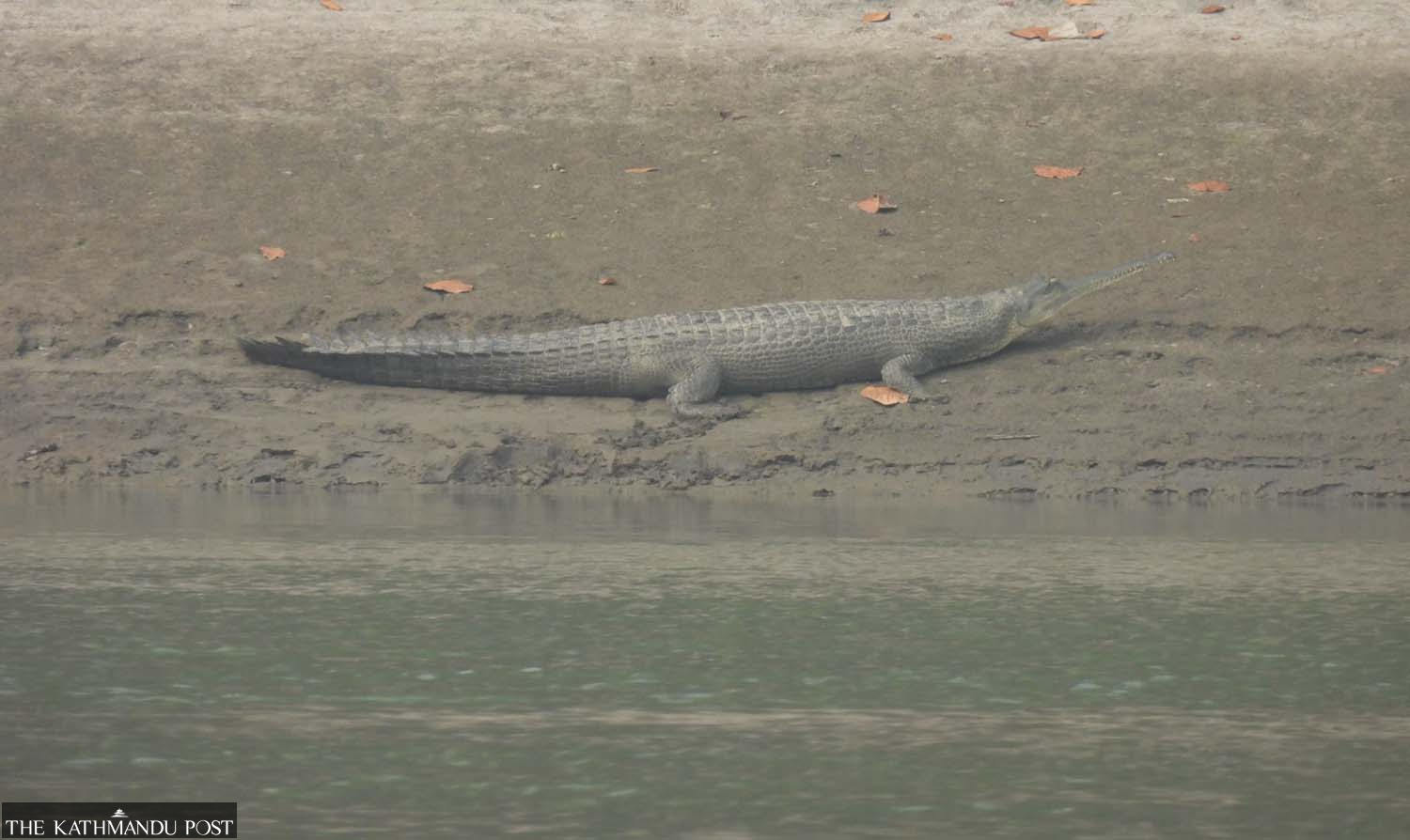
In a small town near the confluence of the Trishuli and Kaligandaki rivers, a rare sighting has sparked excitement among locals and conservationists alike. A gharial, a critically endangered crocodile species, has been spotted in the Narayani River near Devghat after nearly three decades, bringing back memories of a time when these long-snouted reptiles thrived in the area.
The gharial was seen basking on a sandbar on the Nawalparasi side of the river, just downstream from Devghat. This location is significant as it marks the meeting point of two major rivers, with the combined flow becoming known as the Narayani. According to Hiralal Bote, a local resident, the gharial has been appearing for about six or seven days, often coming out to bask in the sun on the sandy mound.
For many elderly residents, this sighting brings back fond memories. Dal Bahadur Bote, 71 years old, recalls that gharials were once common along the Narayani in areas like Khaireni and Chharchhare. “We used to see 20 to 25 gharials at a time,” he said. However, he hasn’t seen one in the past 30 or 35 years.
Gharials are sensitive to their environment, inhabiting clean, fast-flowing rivers and feeding exclusively on fish. Their presence is a strong indicator of river health. Unfortunately, increasing pollution, declining fish stocks, and habitat disturbance continue to threaten their survival.
“The water used to be so clean that we could drink it straight from the river,” said Dal Bahadur. “Now, even bathing makes your skin itch. Fish have sharply declined. How could a gharial survive in such conditions?”
Conservation Efforts and Challenges
Globally listed as critically endangered, the gharial’s survival in Nepal depends largely on conservation efforts led by Chitwan National Park. The park established a gharial breeding center at Kasara in 1978, aiming to conserve the species by hatching eggs and releasing them into rivers when they grow to about two meters in length. While there have been some successes, survival rates in the wild remain low.
Sujita Shrestha, chief of the gharial breeding center, noted that gharials have not been reported in the upper stretches of the Narayani for a long time. She mentioned that if a gharial has appeared in Devghat, it is unclear whether it came naturally or was released after rescue. However, officials at the Division Forest Office in Bharatpur denied any recent release in the area.
Local people believe the reptile arrived naturally in the Devghat area. “It has not been released here. It must have come by itself,” insisted Hiralal.
Census Data and Gender Imbalance
Chitwan National Park conducts annual gharial censuses in the Rapti and Narayani rivers using direct observation methods. According to the latest census published in December last year, a total of 366 gharials—231 in Rapti and 135 in Narayani—were recorded. Of these, only nine were adult males, highlighting a severe gender imbalance. In 2024, the combined figure stood at 352.
Female gharials typically dig nests in sandy banks during March and April. Some conservationists and locals speculate that the newly sighted gharial may be searching for a nesting site, as it has been moving up and down the sandbar.
Threats to Gharial Survival
Conservationists warn that sand and gravel extraction from riverbanks, along with fishing nets in which gharials often become entangled, continue to undermine recovery efforts. Although more than 2,275 gharials have been released from the breeding center over the decades, census data show that survival rates in the wild remain low.
Nepal is home to two crocodilian species—the gharial and the mugger crocodile. Unlike the more aggressive mugger, which tolerates murky waters and preys on larger animals, the gharial rarely strays far from deep river channels and sandy banks.
Gharials are found in several rivers across Nepal, India, Bangladesh, Bhutan, Myanmar, and Pakistan, with the Rapti and Narayani rivers being their major natural habitats. This species, the only surviving member of the Gavialidae family, is also found in smaller numbers in the Kaligandaki, Saptakoshi, Babai, and Karnali rivers.
Human Encroachment and Legal Protections
Human encroachment and the use of fishing nets in rivers and streams have become major threats to gharials in the Chitwan National Park, the country’s first national park. Although the park administration banned the use of such nets in its waters, their use continues unchecked, posing serious risks to gharial conservation.
The gharial (Gavialis gangeticus) is a protected species in Nepal. As per existing legal provisions, anyone found poaching this animal faces jail time between one to 10 years or a fine ranging from Rs 100,000 to Rs 500,000, or both.
For Devghat’s older generation, the solitary reptile is more than a conservation statistic. “Seeing it again after so many years feels like the river is trying to heal,” said Dal Bahadur quietly.