Expansion of ESG Disclosure Requirements for Listed Companies
Starting in 2028, companies listed on the KOSPI with consolidated assets of 10 trillion Korean won or more will be required to disclose sustainability (ESG) information through their business reports. This requirement will gradually expand over the following years. In 2029, companies with 5 trillion Korean won in assets will be included, and by 2030, the scope is expected to cover companies with 2 trillion Korean won in assets. These changes mark a significant shift in how companies must report on environmental, social, and governance (ESG) factors.
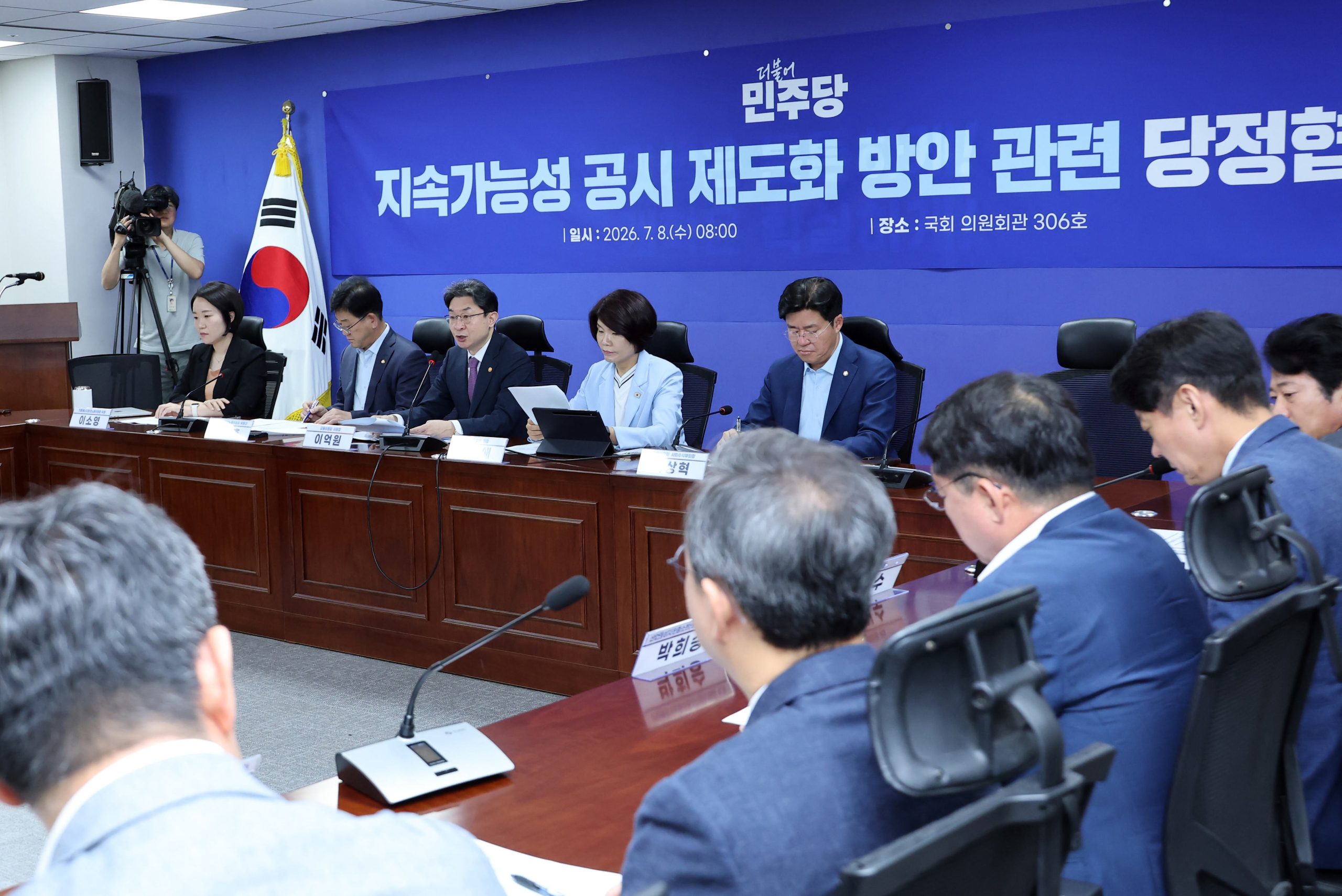
On the 8th, the government and the Democratic Party of Korea held a policy consultation meeting at the National Assembly Members’ Office in Yeouido, Seoul, and finalized the ‘ESG Disclosure Institutionalization Plan.’ This plan outlines the new requirements for ESG disclosure, which involves companies sharing information and risks related to ESG factors with stakeholders such as investors.
Initially, there was consideration of implementing the disclosure through exchange filings before making it a legal requirement. However, the government and the party decided to impose legal obligations immediately. This means that failure to comply could result in compensation claims and criminal penalties. For the first three years, however, damages, administrative sanctions, and criminal penalties will be exempted to encourage companies to actively participate and stabilize the system.
The announcement significantly expands the scope of mandatory disclosure. Previously, the Financial Services Commission had planned to apply the requirement first to companies with consolidated assets of 30 trillion Korean won or more, then expand it to those with 10 trillion Korean won or more starting in 2029. Under this new plan, companies with 10 trillion Korean won or more in assets will face legal obligations starting in 2028.
The government and the party plan to expand the system in 2029 to 157 companies with 5 trillion Korean won or more in assets, and in 2030 to 259 companies with 2 trillion Korean won or more. Including subsidiaries subject to disclosure, the number of companies required to disclose will increase to 291 units in 2028, 3,171 units in 2029, and 3,749 units in 2030. However, subsidiaries with less than 10% of consolidated assets and sales will be exempt from disclosure obligations only in the first year.
A government official stated, “To respond to the information demands of global institutional investors and support the green transition (GX), we have reset our strategy to lead rather than wait for disclosure conditions to mature. We will also establish a comprehensive support system to help companies prepare for smooth disclosure.”
Climate Disclosure to Be Prioritized, Covering Carbon Emissions to Water Usage
Companies subject to mandatory disclosure will fulfill their ESG disclosure obligations through business reports under the Capital Markets Act. The government and the party plan to align the disclosure timing with financial statements reported by the end of March to enhance the usefulness of the information.
Initially, climate disclosure—where international standards are well-established—will be mandated. Other topics (environment beyond climate, social, and governance) can be disclosed voluntarily by companies.
Climate disclosures will include greenhouse gas emissions, the amount and proportion of assets and business activities related to climate risks and opportunities, internal carbon prices per ton, and climate-related goals. Industry-specific indicators, such as water consumption in the semiconductor industry and average fuel efficiency per vehicle in the automotive industry, will also be included.
Starting in 2031, companies’ climate disclosure burdens will increase further. They will need to calculate and disclose not only direct emissions (Scope 1) and indirect emissions from energy consumption (Scope 2) but also emissions across the value chain (Scope 3). Additionally, third-party certification will be mandatory from 2030 to ensure the reliability of disclosed information.
Concerns Over Increased Burden on Companies
Companies have expressed concerns that the mandatory sustainability disclosure could increase their burden. Six major economic organizations—the Federation of Korean Industries, Korea Chamber of Commerce and Industry, Korea Enterprises Federation, Korea International Trade Association, Korea Federation of SMEs, and Federation of Middle Market Enterprises of Korea—issued a joint statement: “Sustainability disclosure is a mid- to long-term task requiring significant time and costs, such as collecting supply chain data, certification, and training specialized personnel. Moreover, since much of the disclosed data consists of forecasts and estimates, immediate legal disclosure could increase corporate burdens due to legal risks from such uncertainties.”
The government plans to support companies by conducting pilot tests for disclosure with representative companies and experts in major industries and developing platforms for climate disclosure risk analysis and evaluation.
Controversy Over Data Collection from Subsidiaries and Partners
Legal experts predict that the mandatory ESG disclosure could spark new debates over how much parent companies can intervene in the management and risk control of subsidiaries. Once disclosure becomes mandatory, parent companies must publicly share information about the entire group, including subsidiaries.
A lawyer from a major law firm said, “Many domestic conglomerates hold less than half the shares of their subsidiaries. Since non-financial information such as greenhouse gas emissions, governance, strategy, and risk management must be managed on a consolidated basis, how to harmonize subsidiaries’ independent management principles and information systems will be a key challenge.”
The issue of data collection from partners is also controversial. ESG disclosure includes Scope 3 emissions from the supply chain, such as partner companies. To obtain this data, companies must request information from partners. However, there are concerns that excessive demands or shifting burdens to partners could violate fair trade laws or the Subcontracting Act. Since few countries have legally specified the right to request data from partners, supplementary measures such as fair trade guidelines from relevant ministries are needed.
월 5900원 멤버십, 신문 독자에게는 2900원, 조선멤버십
55000원 상당의 신문-잡지 8종 마음껏 보기, 조선멤버십
현금처럼 쓸 7000포인트 받아 알뜰한 쇼핑, 조선멤버십