As a longtime newspaper journalist, I have always been drawn to the power and impact of a well-taken photograph. While it may seem like 24-hour video content dominates the era, a single photograph capturing a fleeting moment can often be more powerful than video. Throughout history, such images have highlighted subjects and made complex situations instantly understandable.
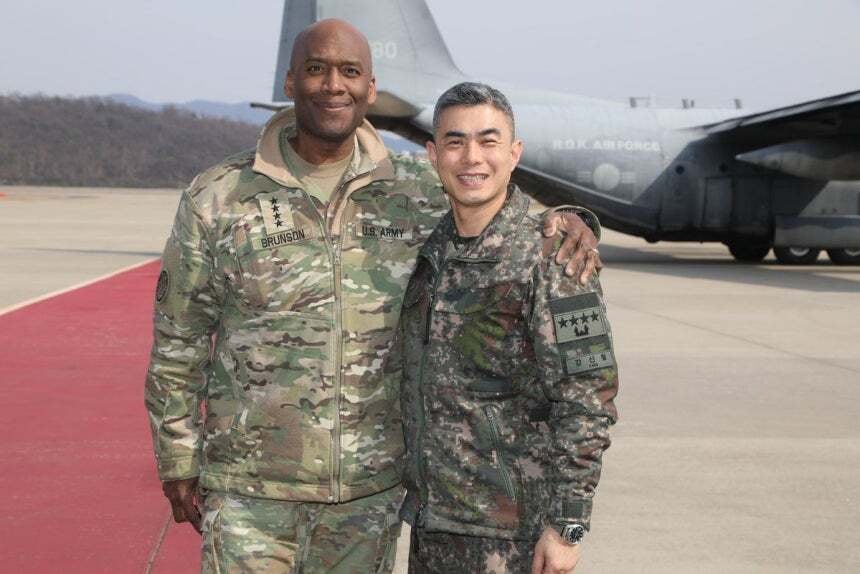
In this context, the main photograph accompanying this article is noteworthy given the current challenges facing the ROK-US alliance. Taken in March of last year, it shows Kang Shin-chul, then Vice Commander of the ROK-US Combined Forces Command and current Defense Minister nominee, and Xavier Brunson, Commander of the US Forces Korea, arm-in-arm and smiling broadly. The image symbolizes their close relationship.
Brunson had previously clashed with Ahn Gyu-back, the outgoing Defense Minister, over key issues such as the transfer of wartime operational control (OPCON), joint exercises, and other matters, creating significant discord. Against this backdrop, Kang—who had served alongside Brunson in the Combined Forces Command until just a year ago—was nominated as the new Defense Minister. Two former comrades-in-arms now face each other as South Korea’s Defense Minister and the US Forces Korea Commander, a rare scenario even in the 70-year history of the alliance.
Commissioned Side by Side in 1990, 34 Years Later as the Two Commanders of the Combined Forces Command
Both men were born in the late 1960s and commissioned as infantry lieutenants in 1990. Kang graduated from the Korea Military Academy, while Brunson completed the ROTC program at the University of Hampton in the US. Over 30 years later, both rose to the rank of four-star general.
Their paths crossed again in the Combined Forces Command on December 20, 2024, when Brunson assumed command at Camp Humphreys, Pyeongtaek, succeeding Paul LaCamera. He concurrently serves as Commander of the UN Command, Commander of the ROK-US Combined Forces Command, and Senior US Military Officer Assigned to Korea (SUSMOAK). The US Forces Korea Commander is often said to wear “four hats,” coordinating with the South Korean Defense Minister on practical matters under the authority of the US Secretary of Defense and Chairman of the Joint Chiefs of Staff.
Kang had already been serving as Vice Commander of the Combined Forces Command since October 2023. With Brunson’s appointment, a new command structure was formed: Brunson as Commander and Kang as Vice Commander. From his inauguration, Brunson emphasized “realistic combat readiness,” stressing that deterrence cannot be achieved through rhetoric alone and underscoring the importance of practical joint exercises.
His timing was significant. South Korea was reeling from the aftermath of the December 3 emergency martial law declaration under former President Yoon Suk-yeol, which triggered political chaos. Concerns arose about the ROK-US joint defense posture as parts of the military leadership became entangled in the martial law controversy. Kang was found to have no involvement in the investigation. Amid this turmoil, Brunson and Kang began coordinating as the top leadership of the Combined Forces Command.
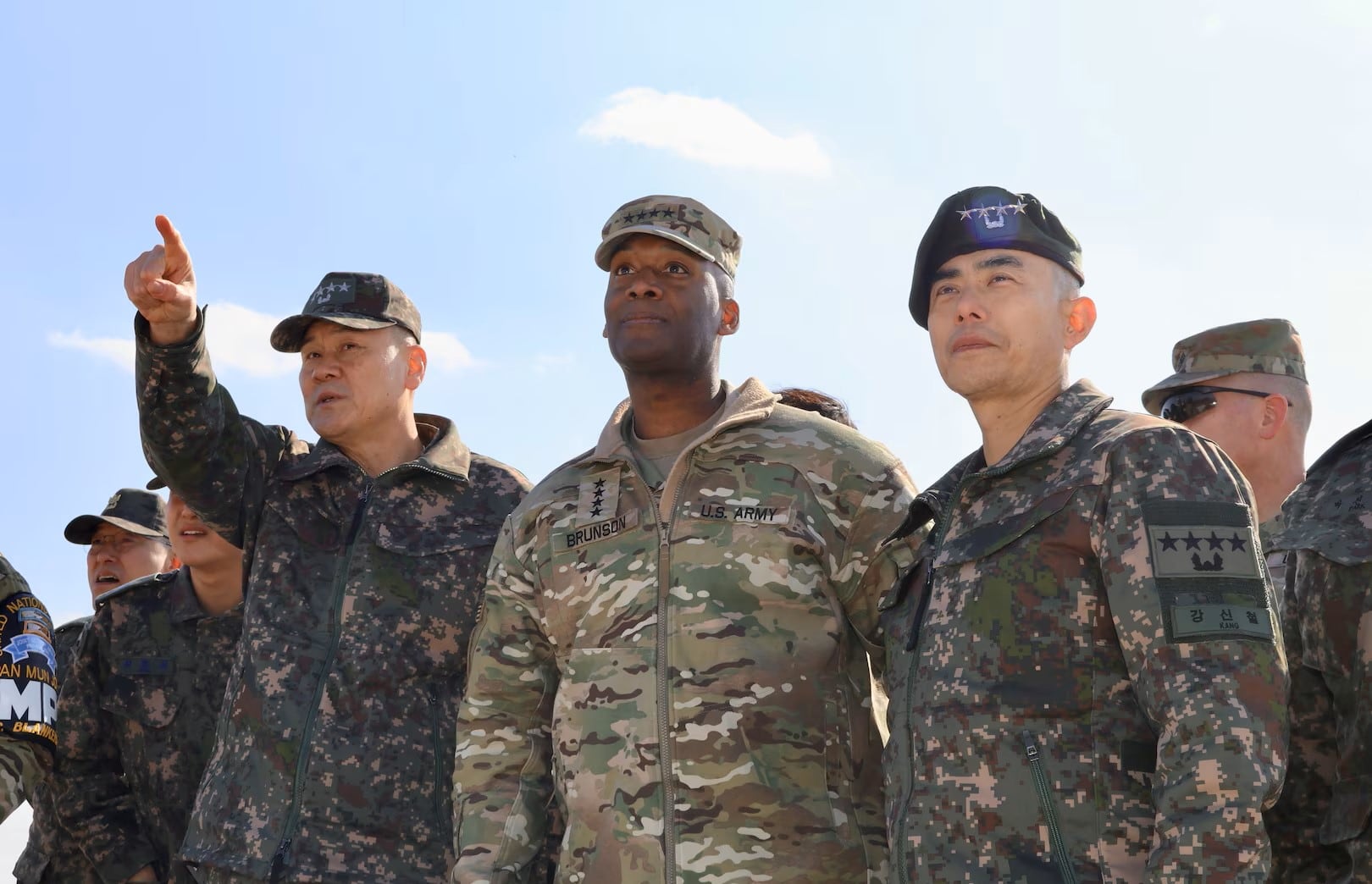
A notable joint public event involving Kang and Brunson occurred on February 21, 2025, at the inter-Korean truce village of Panmunjom. Then-Joint Chiefs of Staff Chairman Kim Myung-su, Brunson, and Kang inspected the readiness of the Military Demarcation Line area in the Joint Security Area (JSA).
An iconic photograph was taken at the Panmunjom outpost. Chairman Kim pointed toward North Korea, with Brunson and Kang gazing in the same direction beside him. It was the first frontline inspection conducted jointly by the ROK-US military leadership since Brunson’s appointment. The two continued to visit sites together. On March 6, they observed a joint live-fire drill at the Pocheon Training Site.
Closer Through ‘Freedom Shield’ Exercises
The two worked most closely together during the ROK-US joint exercise “Freedom Shield 25,” held from March 10 to 20, 2025. The large-scale, multi-domain drill encompassed land, sea, air, cyber, and space operations.
They were also present when Acting President Choi Sang-mok visited Camp Tango (CP TANGO), the wartime command post of the Combined Forces Command, during the exercise. Choi toured the theater operations center under Brunson’s guidance, with Kang in attendance. ROK-US troops on-site chanted, “Let’s go together! We go together!”
After the exercise, Brunson released a message stating that over the past two weeks, he and Vice Commander Kang had toured Freedom Shield sites, reaffirming the strength of the alliance and joint defense posture. He added that the ROK and US were always ready to fight together, from frontline units to strategic discussions.
What drew attention was a “shoulder-to-shoulder” photo Brunson shared. On March 17, at Seoul Air Base in Seongnam, he posted a photo on his SNS showing him and Kang arm-in-arm, smiling broadly.
According to a report by Chosun Ilbo journalist Yang Ji-ho, a military official noted that Brunson had built rapport with Kang during the two-week exercise and that the photo reflected the new commander’s intent to actively promote the alliance and communicate with the South Korean public. This marked a departure from the precedent set by Paul LaCamera, Brunson’s predecessor, who rarely shared such photos with the Vice Commander.
Their joint activities continued. On April 23 of last year, when Acting President Han Duck-soo visited Camp Humphreys, Brunson and Kang together explained the alliance and joint defense posture. Looking back, the two led the Combined Forces Command during a period of severe political turmoil in South Korea. Whenever acting presidents visited the Combined Forces Command or US Forces Korea, they consistently conveyed that the joint defense posture remained unshaken. Through this process, they likely gained deep insights into each other’s military judgments and command styles.
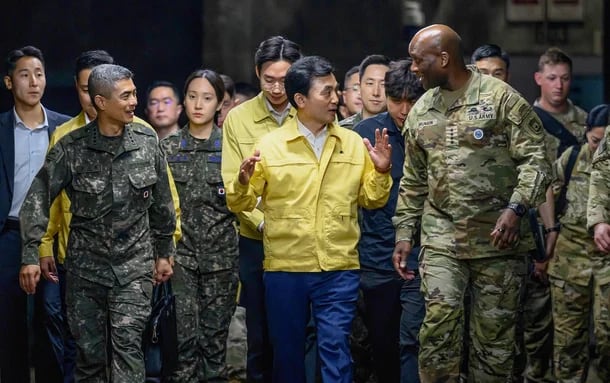
A curious photo was taken at Camp Tango on August 20 of last year during the “Ulchi Freedom Shield (UFS)” exercise. It showed then-Defense Minister Ahn Gyu-back walking and conversing with Brunson and Kang. Few could have predicted that Kang would be nominated as Ahn’s successor roughly a year later. The relationship between the three, once captured in a single frame, has since transformed dramatically.
When Kang retired from the Combined Forces Command in September 2025, Brunson praised him, stating, “General Kang’s leadership, rooted in the belief that the ROK-US alliance was forged in the blood of comrades-in-arms, has strengthened our readiness through realistic and relentless training.” He added, “It was an honor to serve with General Kang.” The remarks, beyond mere courtesy, hinted at significant mutual trust.
Now, They Sit Across the Table Over OPCON
However, the issues they must now address as minister and commander are entirely different from their past collaboration. Central among them is the transfer of wartime operational control. While Brunson supports OPCON transfer in principle, he has consistently emphasized the “conditions-based” approach. In August 2025, during a meeting with South Korean reporters at Camp Humphreys, he warned that taking a “shortcut” without meeting necessary conditions could jeopardize military readiness on the peninsula. In April of this year, he testified before the US Senate Armed Services Committee that “political convenience should not precede conditions.” The following day, he told the House Armed Services Committee that the ROK and US were pursuing a roadmap to meet OPCON transfer conditions by the first quarter of 2029 at the latest.
Amid this, Kang—who had served as Ambassador to Saudi Arabia after retirement—returned to South Korea after just six months and was nominated to replace Ahn. During his first day of preparation for the confirmation hearing on the 3rd, one of the questions he faced was about OPCON transfer. He responded, “The transfer should proceed in a way that strengthens the ROK-US alliance,” adding, “Without the alliance, the concept of OPCON transfer would not even exist.”
Based on their public statements so far, their positions do not appear to be in direct conflict. Brunson insists, “Conditions must not be bypassed,” while Kang emphasizes, “The transfer should strengthen the alliance.” Having led the Combined Forces Command together, Kang understands Brunson’s thinking and the US military’s perspective on OPCON better than anyone, which could be a crucial asset in future negotiations.
The Variable: President Lee Jae Myung’s Push for Early Transfer
The challenge lies in President Lee Jae Myung’s pressure for an early transfer. Viewing OPCON transfer as a matter of sovereignty, the president admonished Ahn in May, stating, “We must be prepared to transfer OPCON tomorrow without any issues.” Finding common ground between the president’s intent and the US stance on “conditions-based” transfer will be a significant burden for Kang.
Until last year, Kang and Brunson operated under a unified command structure, pursuing the same goals. However, as Defense Minister, Kang must now negotiate with Brunson from the South Korean government’s perspective on the timing and conditions of OPCON transfer, the role of US Forces Korea, and the future of the joint defense system. While they will join hands when interests align, they will need to persuade each other when ROK and US judgments diverge.
Will the trust symbolized by their shoulder-to-shoulder photo become an asset in resolving sensitive alliance issues? Or will their deep familiarity lead to fiercer confrontations over the alliance’s future, including OPCON? The bond between the two generals, captured in a photo a year and a half ago, has now reached a new test for the ROK-US alliance.
- 월 5900원 멤버십, 신문 독자에게는 2900원, 조선멤버십
- 55000원 상당의 신문-잡지 8종 마음껏 보기, 조선멤버십
- 현금처럼 쓸 7000포인트 받아 알뜰한 쇼핑, 조선멤버십