Generation Z and Millennials will outnumber Baby Boomers at the polling booths this year, and, despite the Coalition’s current lead in polls, experts say the federal election is anyone’s chance of winning.
The younger cohort make up 7,718,208 votes, while Baby Boomers account for 5,871,342, as per data from the Australian Electoral Commission (AEC).
Gen X, which falls between the two, accounts for 4,350,268 votes.
READ MORE:
Australian politicians brush off Trump’s AUKUS stuff-up
It’s thought to be the first federal election where the younger generation outnumber the Baby Boomers.
The AEC’s national spokesperson, Evan Ekin-Smyth, said almost 700,000 more young Aussies will be casting their first vote this year, with a record 97.8% of people now registered.
Those young voters are likely to vote for the Greens and Labor, says Jim Reed, the founder of research firm Resolve Strategic.
“The major parties are losing their edge, at least becoming less distinct from each other, and voters, especially younger ones, are becoming less loyal to parties,” he told .
It’s not just about age, Reed said, there’s also a gender gap when it comes to voter preferences, with 42 per cent of blokes planning to vote for the Coalition in recent times, compared to 34 per cent of women.
“We notice that gap is also reflected in the younger age group, and there are a range of reasons for that… it can be the policy and the tone of the messages about policy,” he said.
Are you a young voter participating in your first federal election? Can you tell us which issues are most important to you?
yashee.sharma@nine.com.au

The Coalition had 39 per cent of the vote, ahead of Labor, which had 25 per cent.
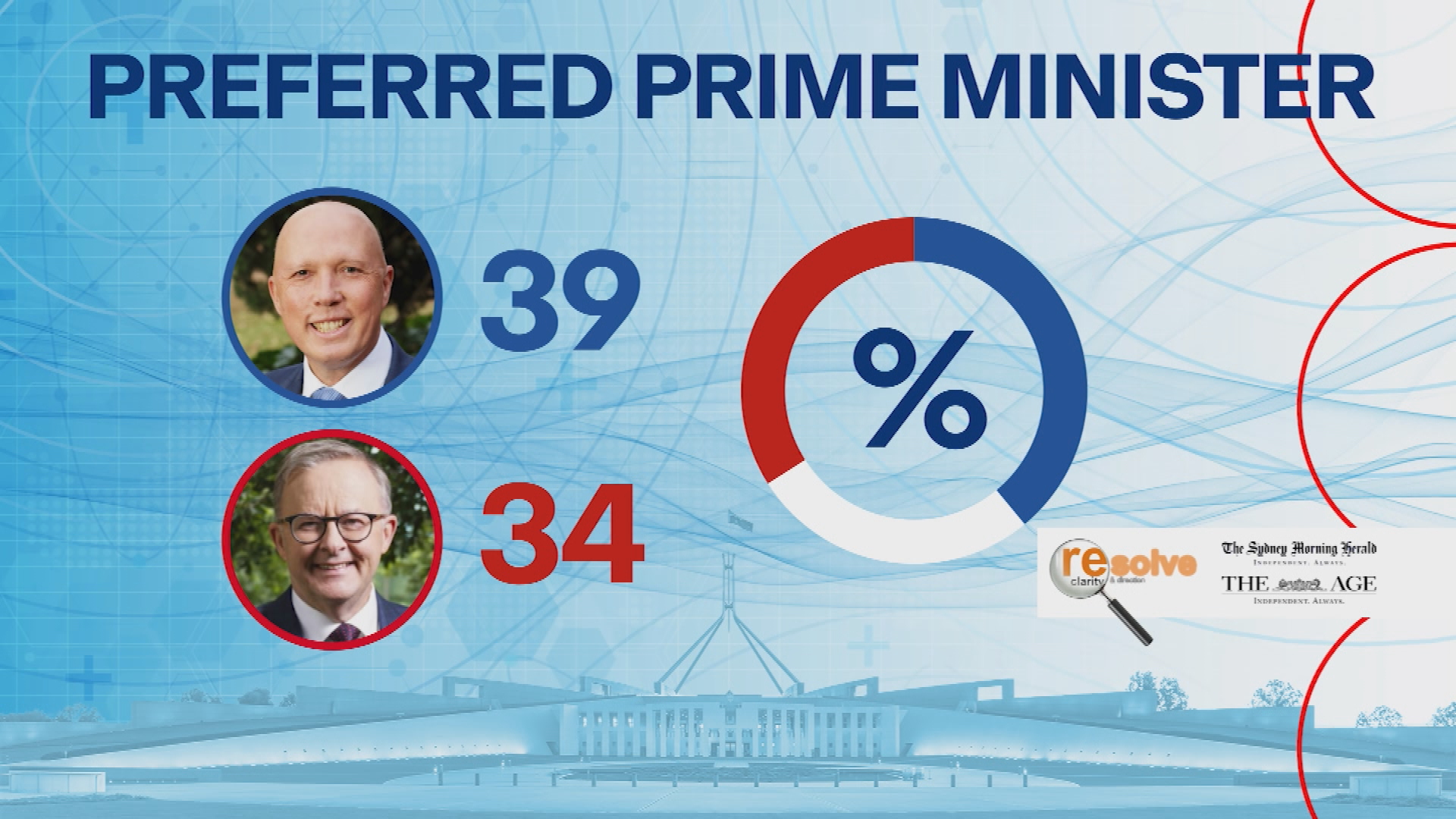
Opposition leader Peter Dutton is also in front as preferred prime minister at 39 per cent with Anthony Albanese at 35 per cent.
“Labour has been caught in the middle, getting it in from both the Greens on the left and the Coalition on the right,” Reed said.
Reed said Labor has been trying to win over young voters but it seems their policies and messaging aren’t quite hitting the mark, with Dutton’s online campaign on social media platforms like TikTok possibly giving him the edge.
The prime minister’s dwindling support can be linked to a combination of factors, including successive interest rate hikes, rising living costs and the controversy surrounding the proposed Voice to parliament referendum, which has led voters to doubt his leadership credentials.
“I reckon Peter Dutton’s been pretty good at laying out a clear position on a few key issues – the Voice referendum, anti-Semitism – that people can get behind,” he said.

Despite the widening gap between the two main parties and their leaders, as well as the large number of young voters at the polling booths this year, Reed said the outcome of the election is still a long way off.
He suggested that the election might finish with a minority government, where neither side gets enough seats to run the show on their own, and they’d need the Greens and independents to get things done.
“I reckon it’d take a real pluck to call it now,” Reed said.
Minority governments are a rare occurrence in Australia – there have only been two in the last 100 years, the most recent being after the 2010 federal election, where Labor and Coalition both secured 72 seats before Julia Gillard negotiated an agreement with the Greens and three independents.
Before 2010, the last time a federal minority government was in power was back in 1940.
The date for the federal election hasn’t been finalised, but it’s due to happen sometime before May 17.
According to Reed, the polls will become more clear-cut as voting day approaches in what’s turning out to be a complicated election.
“We’re moving from people generally deciding whether they like the job the incumbent’s done to taking a more thoughtful approach, considering which party or leader they think will be the best choice for the future,” he said.
That sort of choice influences things, and that can limit options, from my perspective.

