-
READ MORE: Scientists make discovery on Mars that could reveal alien life
It might not be the most obvious place for a holiday.
was once home to sun-soaked, sandy beaches with gentle, lapping waves, according to a new study.
the surface of Mars today.
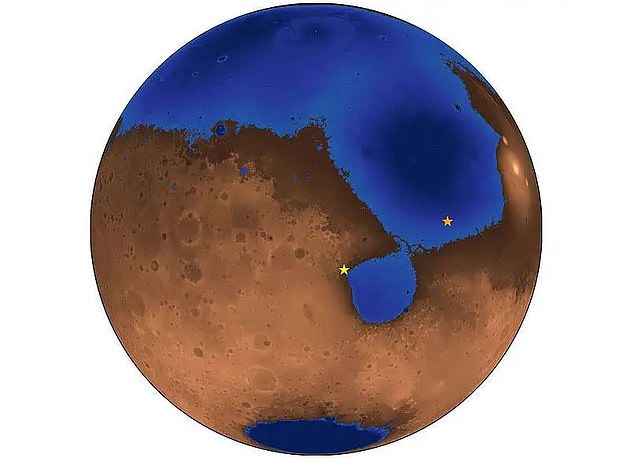
‘s Zhurong Mars rover to unearth hidden layers of rock underneath the planet’s surface that strongly suggest the presence of an ancient northern ocean.
The new research offers the clearest evidence yet that the planet once contained a significant body of water and a more habitable environment for life, the researchers said.
in 2021 in an area known as Utopia Planitia and sent back data on the geology of its surroundings in search of signs of ancient water or ice.
Unlike other rovers it came equipped with ground-penetrating radar which allowed it to explore the planet’s subsurface, using both low and high-frequency radar to penetrate the Martian soil and identify buried rock formations.
By studying the underground sedimentary deposits, scientists are now able to piece together a more complete picture of the planet’s history.
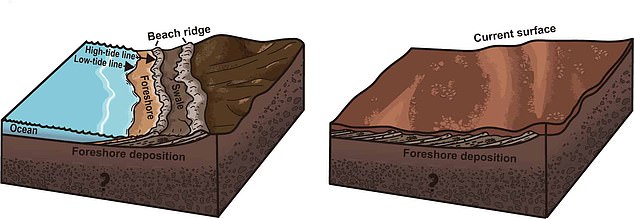
When the team reviewed radar data, it revealed a similar layered structure to beaches on Earth.
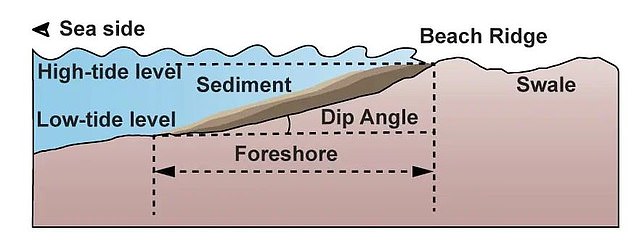
They noticed formations called ‘foreshore’ deposits’ that slope downwards towards oceans and form when sediments are carried by tides and waves into a large body of water.
When the team compared the Martian data with radar images of coastal deposits on Earth, they found striking similarities.
The dip angles observed on Mars fell right within the range of those seen in coastal sedimentary deposits on Earth.
, the researchers said.
The study also provides new information on the evolution of the Martian environment, suggesting that a life-friendly warm and wet period spanned potentially tens of millions of years.
.
‘We found evidence for wind, waves, no shortage of sand — a proper, vacation-style beach.’
Professor Michael Manga, from the University of California, Berkeley, also contributed to the paper.
‘The structures don’t look like sand dunes,’ he said. ‘They don’t look like an impact crater. They don’t look like lava flows. That’s when we started thinking about oceans.
‘The orientation of these features are parallel to what the old shoreline would have been. They have both the right orientation and the right slope to support the idea that there was an ocean for a long period of time to accumulate the sand-like beach.’
The findings were published in the Proceedings of the National Academy of Sciences journal.
Read more


