“Even those who distort history must know what the truth is.”
The voice of Retired Army Major General Park Chul-gyun (62) trembled over the phone. Park is the grandson of the late Colonel Park Jin-kyung (1920–1948), who was tasked with early resolution efforts during the Jeju April 3 Incident in 1948. For two days after President Lee Jae-myung ordered a review of revoking Colonel Park’s designation as a national merit on the 15th, even Park, who spent his life as a soldier, seemed unable to endure. In a phone interview with this newspaper, Park said, “I don’t understand how my grandfather, who was assassinated while trying to protect innocent Jeju residents, could be labeled a ‘perpetrator.’” He added, “As with other modern history, the distortion of history is particularly severe in the April 3 Incident. The failure to correct such historical distortion attempts led to the president’s order to review the revocation of national merit status.” Currently a professor at North Korea Graduate University, Park said, “I hesitated for a long time to give this interview, fearing that my grandfather’s designation as a national merit might actually be revoked,” and declined to be photographed.
◇‘Intentionally Distorting History’
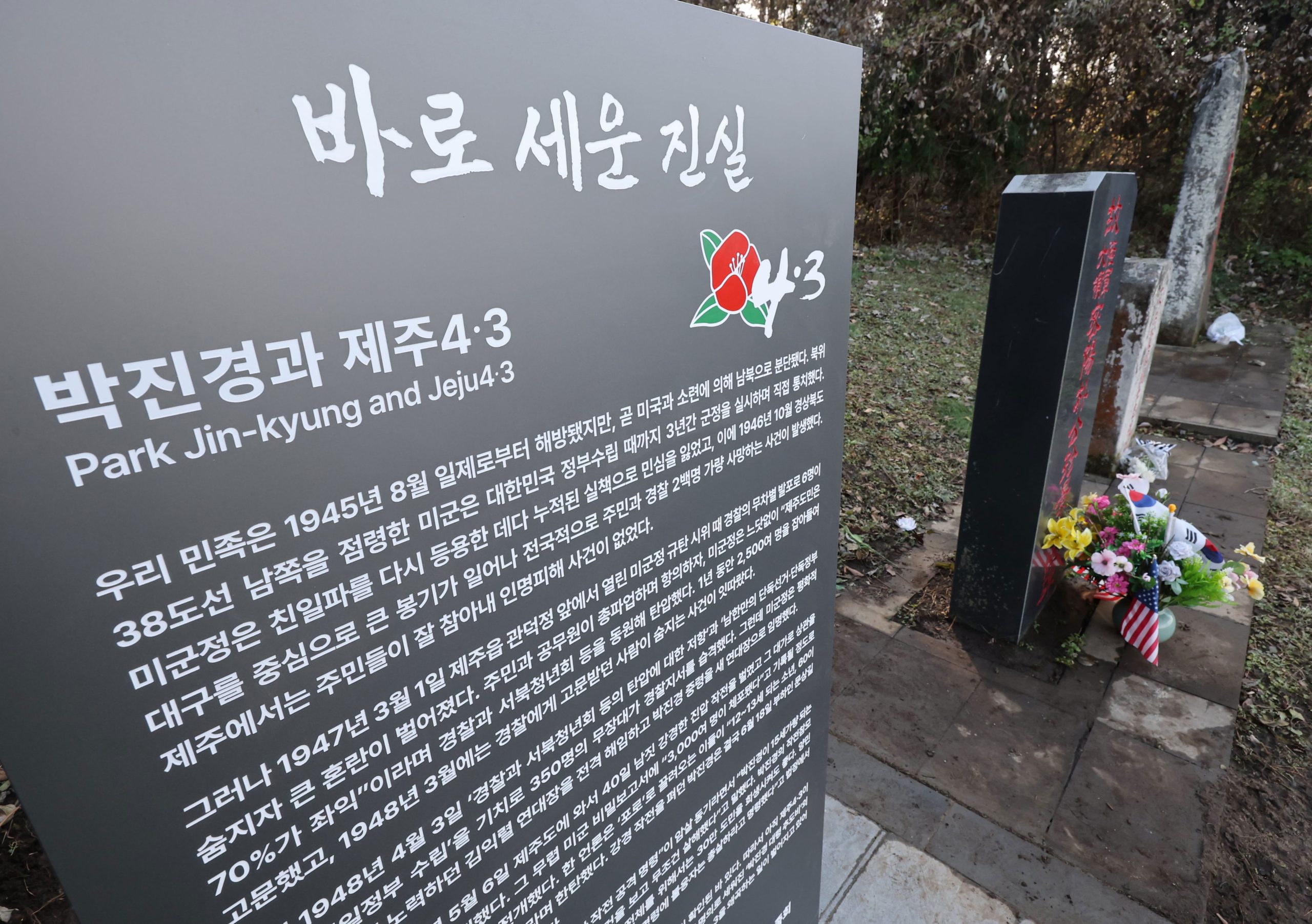
The Ministry of Patriots and Veterans Affairs designated Colonel Park as a national merit on the 10th of last month, based on the Eulji Military Merit Medal he received in 1950. It was 77 years after his assassination. However, the late colonel was once again thrust into the center of an “ideological war.” After backlash from Jeju April 3 groups and the ruling party, President Lee effectively ordered the withdrawal of Colonel Park’s national merit designation. On the same day, Jeju Province erected an informational sign next to Colonel Park’s memorial stone that seemed to justify his assassination.
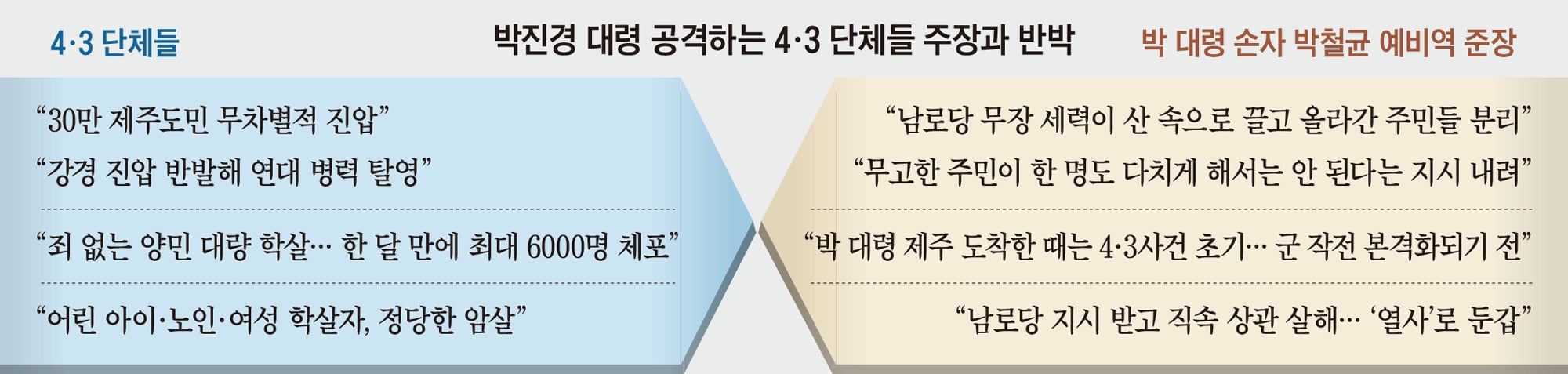
In response, Park said, “It’s absurd to claim that my grandfather carried out indiscriminate suppression operations against civilians,” adding, “Some forces are intentionally distorting history.”
Colonel Park was the commander of the 9th Regiment of the Joseon Constabulary (the predecessor of the South Korean military) tasked with resolving the April 3 Incident. The South Korean Workers’ Party (SKWP) sparked an armed uprising in Jeju in 1948 to disrupt the May 10 elections and the establishment of the Republic of Korea. About a month after the uprising began, on May 6, Colonel Park was dispatched to Jeju. Just over a month after his arrival, on June of the same year, he was assassinated by subordinates while sleeping at his quarters after a promotion celebration.
April 3 groups claim Colonel Park was the mastermind behind the massacre of innocent civilians through harsh suppression. However, according to the “Jeju April 3 Incident Truth-Finding Report (April 3 Report)” released during the Roh Moo-hyun administration, former Lieutenant General Chae Myung-shin (former commander of the South Korean military in Vietnam), who was a platoon leader at the time, testified, “Colonel Park focused his operations on getting residents who had gone into the mountains to come down, rather than conducting punitive operations against insurgents.” This indicates that he prioritized pacification operations to separate residents from SKWP armed forces.
Park, the grandson, said, “When my grandfather arrived in Jeju, SKWP forces were forcing civilians into the mountains to disrupt the May 10 elections.” He added, “Since SKWP partisans were mixed in with the residents in the mountains, it was crucial to get civilians to come down to suppress them. My grandfather even issued a guideline stating, ‘Even if 100 communist insurgents escape, not a single innocent resident should be harmed.’”
◇‘SKWP Assassins Transformed into “Martyrs”’
The period when Colonel Park was in Jeju, May–June 1948, was the early phase of the April 3 Incident. It was before the full-scale “scorched-earth operations” by the military, which began after the rebellion of the 14th Regiment in Yeosu, South Jeolla Province, on October 19 of the same year. During the early phase of the April 3 Incident, the SKWP’s violent behavior was reportedly more severe. According to the April 3 Report, out of over 14,000 victims, 1,764 (12.6%) were killed by SKWP armed forces.
The SKWP-led “Jeju People’s Guerrilla Struggle Report” included in the April 3 Report states, “Four days after Colonel Park’s arrival on May 10, we must purge reactionary figures, including Colonel Park, the head of the 9th Regiment.” Colonel Park was assassinated under the command of SKWP cell member Lieutenant Moon Sang-gil. Park argued, “The SKWP assassins who killed their direct superior under SKWP orders have been transformed into ‘martyrs’ who achieved justice. Such ‘intentional misreading’ has distorted public opinion among Jeju groups.”
Regarding Jeju Province’s erection of an informational sign next to Colonel Park’s memorial stone that seemed to justify his assassination, Park said, “It’s hard to accept that a sign was erected based on testimony far from the truth.” The sign includes a one-sided testimony by Sergeant Son Soon-ho, the assassin, who claimed, “Colonel Park was a figure who killed even a 15-year-old child clinging to his father’s corpse, and the assassination was motivated by his command to carry out merciless attacks against 300,000 residents.” Sergeant Son described the assassination as a justified resistance.
In response, Park said, “Sergeant Son, who assassinated my grandfather, was an SKWP cell member.” He added, “Why is the one-sided testimony of a criminal sentenced to death in a military trial being cited in the informational sign to justify his crime?” He emphasized, “If the local government is to erect an informational sign, it should have included numerous opposing testimonies as well.”
◇‘Third-Generation Soldier: Ready to Sacrifice My Life’
Colonel Park died in the line of duty without direct descendants. His wife, who was in her third trimester when he died, miscarried after hearing the news. After discussions, the family adopted Park Ik-joo, the son of Colonel Park’s older brother, as his adopted son. Park Chul-gyun is the son of Park Ik-joo and became Colonel Park’s grandson. Park Ik-joo was commissioned during the Korean War, retired as a major general, and Park Chul-gyun followed his father’s footsteps, becoming a soldier for three generations.
Park said, “Although my grandfather died tragically, my father and I unhesitatingly wore military uniforms. I have lived with the resolve to sacrifice my life for the country without hesitation if war breaks out.” He pleaded, “I earnestly request that the Ministry of National Defense strictly review whether to revoke the national merit status based on official military records and facts, not claims by specific groups.”
☞Jeju April 3 Incident, Pacification Operations
April 3 Incident: An incident in which innocent Jeju residents were sacrificed during the process of the government deploying military and police to suppress collective unrest sparked by an SKWP armed uprising in Jeju (1948–1954).
Pacification Operations: Psychological warfare and propaganda activities aimed at inducing the surrender of enemy or subversive forces or stabilizing public sentiment during wartime or social chaos.