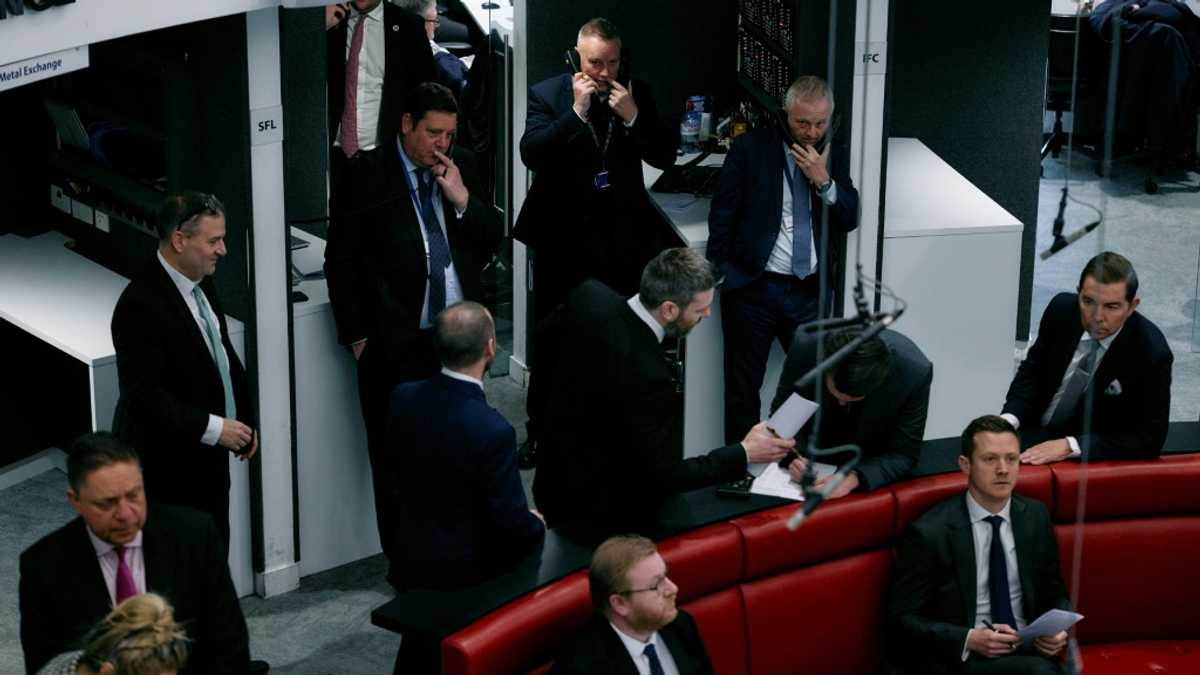

In an age where computer algorithms execute trades at lightning-fast speeds, only a few of London’s metal traders continue to engage in face-to-face transactions by vocally placing orders on what remains Europe’s final known open-outcry trading floor.
The approximately 150-year-old custom occurs within a circular area, known as the “Ring,” featuring red leather seats. Here, representatives gather to determine the day’s worldwide pricing for metals such as copper, nickel, aluminum, and others at the London Metal Exchange (LME).
Just moments before the intense trading starts, a trader bursts in, quickly ties his necktie following the required attire rules, and makes his way to one of the stalls encircling the Trading Floor.
Next, pages with handwritten numbers and stock exchange instructions are distributed.
As soon as the bell sounds, indicating the beginning of trading, nobody is permitted to engage in online transactions or utilize mobile devices. All external communication must be conducted through traditional landlines instead.
Trading each metal for five minutes can be compared to playing poker,” according to Giles Plumb, a trader with over two decades of experience managing the copper portfolio at StoneX, a financial services company.
‘Flurry of activity’
It begins peacefully, with the traders appearing unperturbed as they sit calmly.
As the moments pass, “you avoid checking your watch so as not to seem like you’re waiting for something specific,” Plumb said to AFP.
However, as the last few seconds of the allocated time tick away, the Ring explodes into action.
“There’s a lot of commotion going on,” Plumb remarked, as traders leap from their seats and start yelling.

They rise up and tilt toward the individual—almost always a man—with whom they are negotiating, ensuring that one heel remains in contact with the chair—a key tenet of the Ring protocol.
“Goodness requires being mindful of others’ actions, swiftly processing information, and ensuring clarity and audibility in your communication,” Plumb stated.
So far, I can recognize people’s voices and understand what they’re up to just by listening, without needing to look at them.
Following behind, brokers communicate with their clientele over landlines; some hold a handset to each ear, simultaneously relaying instructions and receiving fresh requests.
In spite of the upheaval, Plumb states that the sessions are “not as aggressive, not as competitive” compared to when he first started his career.
At its height, he mentioned, the “pit would contain 22 traders and around 300 individuals, with an enormous cacophony of sound. It was so loud that one could hardly think clearly.”
‘The battle is lost’
Currently, just eight firms along with a small group of individuals continue to engage in these traditional practices, since online trading has largely extinguished most of the global open-outcry market environments.
The London Metal Exchange and its open outcry system started toward the close of the 19th century, with interruptions occurring solely during World War I and later amid the Covid-19 pandemic.
The LME aimed to transition fully to electronic trading in 2021, yet encountered resistance from its leftover traders who wished to maintain the old practices.
The exchange was modified to retain one of its two daily in-person meetings, provided that more than six members agree to attend.

“Individuals interested in trading the Ring still proceed with their transactions; however, nowadays the majority of the LME’s dealings occur through electronic means,” stated the exchange in an official release.
Thierry Foucaux, a finance professor at HEC Paris business school, stated that there is now no justification for maintaining open-outcry trading.
Electronic trading offers advantages such as being technically advanced and enabling higher market liquidity along with reduced intermediary expenses, he explained to AFP.
He stated that in certain instances, it has endured for valid reasons, particularly within niche sectors such as metals trading, where the pool of skilled professionals is quite small.
Nevertheless, “with time, the struggle is inevitably lost.”


