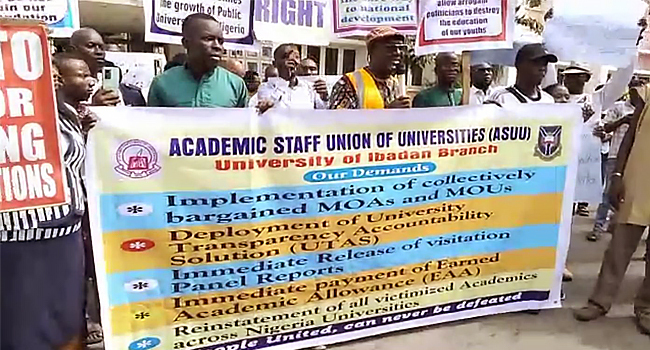
The Ongoing Struggle of ASUU and the Consequences for Nigeria’s Education System
Over the past decade, the Academic Staff Union of Universities (ASUU) has repeatedly taken to the streets in protest, leading to prolonged strikes that have left public universities across Nigeria closed for hundreds of days. These actions have come at a significant cost—impacting students, families, and the broader development of the nation. The latest two-week warning strike is yet another chapter in what many see as a tragic narrative of broken promises and betrayed trust.
The gates of Nigeria’s public universities are once again shut—not because lecturers dislike teaching or students reject learning, but due to a government that has turned deceit into policy. This strike, declared on October 13, 2025, is not an act of rebellion, but a desperate cry for justice. It reflects the frustration of a system built on betrayal, arrogance, and calculated indifference.
For the umpteenth time, the federal government has played with the education sector, signing agreements it never intends to honor, masking its failures with propaganda, and treating dialogue as an inconvenience rather than a duty. This pattern has led to a deepening crisis within the academic community.
The demands of ASUU remain simple, patriotic, and long overdue: revitalization funds for crumbling universities, earned allowances for overworked lecturers, and the genuine implementation of agreements freely entered into years ago. Unfortunately, instead of keeping its word, the government continues to recycle deceit—setting up committees that do nothing and issuing memos that mean even less.
In the last ten years alone, public universities have lost more than 700 academic days to strikes. The 2020 industrial action, which lasted about nine months, had devastating consequences for students whose academic journeys were disrupted and dreams deferred.
At a press conference on October 12, 2025, ASUU President, Professor Chris Piwuna, stated that the union had reached its limit. He described the government’s response as “a paper without substance, a promise without soul.” His words highlight the growing frustration among lecturers who continue to teach in overcrowded classrooms, with obsolete equipment, unpaid salaries, and crumbling facilities.
Rather than engage with sincerity, the government resorted to its habitual threat—the “No Work, No Pay” policy. Vice-Chancellors were directed to take roll calls and withhold the salaries of striking lecturers. This approach exposes the government’s insensitivity and misunderstanding of the issue. The policy assumes ASUU’s struggle is about money, when in reality, it is about integrity, national survival, and the restoration of a decaying university system.
Professor Piwuna responded firmly: “We don’t respond to threats. Nobody can threaten us.” His words echo the frustrations of thousands of lecturers who face daily challenges in their profession. How can you threaten those who already endure deprivation in defense of knowledge?
The Nigeria Labour Congress (NLC) has shown strong solidarity with ASUU. NLC President, Joe Ajaero, condemned the government’s position and described the “No Work, No Pay” order as a distortion of justice. He emphasized that the breach of contract lies with the state, not the scholars. The NLC warned that if the crisis is not resolved after the two-week warning strike, the entire labor movement will join the struggle. Its message is clear: an injury to one is an injury to all.
Every ASUU strike is born out of broken promises. Each dishonored agreement becomes the seed of another shutdown. When classrooms fall silent, it is not a victory for the union but a failure of leadership. For a government that claims to champion reform, it is shameful that it cannot reform itself into honesty.
How can a nation progress when its leaders prefer propaganda to dialogue and intimidation to sincerity? How can a country build a future when those who build minds are treated as adversaries?
ASUU’s struggle is not a fight for privilege but for the soul of education. It is a confrontation with the moral decay that defines governance in Nigeria—a protest against a system that rewards mediocrity and punishes excellence; that starves its teachers while feeding corruption; that sends its leaders’ children abroad to study while neglecting the universities that once shaped them.
The strike is therefore not an act of defiance but of deliverance—a reminder that education is not an expense but an investment in national survival. When government mocks ASUU’s persistence, it mocks the idea of a thinking nation. When it ignores their demands, it declares war on knowledge. And when it threatens “No Work, No Pay,” it reveals its poverty of morality.
Nigeria’s government has lost credibility. It preaches patriotism yet destroys public institutions. It talks of progress but fears enlightenment. It calls for calm but provokes anger through deceit. There is no honor in governance that cannot keep its word, no progress in policies founded on lies.
What ASUU demands is what any responsible government should willingly provide—a functional university system, fair remuneration, and a future that does not drive the youth to flee the country.
It is disheartening that no Nigerian professor earns up to $600 a month, while colleagues in smaller African nations receive between $2,000 and $3,000. Since 1999, the economic cost of ASUU strikes, including lost productivity and damage to infrastructure, is estimated at over ?1.2 trillion. But the greater cost is moral—the erosion of faith in governance and the normalization of deceit.
The current ASUU strike should be seen not as a disruption but as a call to conscience—a desperate reminder that silence in the face of injustice is complicity. ASUU’s action is driven not by hatred but by hope: hope that one day Nigeria will be led by men and women who understand that a nation that starves its universities feeds its own destruction.
When teachers strike, it is not because they hate to teach but because they can no longer endure the insult of a government that refuses to learn. The chalk is crying, classrooms are empty, and the future trembles—waiting for a government that still does not listen.
If the Tinubu administration continues to trade sincerity for propaganda, history will remember that ASUU stood firm when truth became unfashionable.
For when a government breaks its promise to its teachers, it breaks its promise to its people. And a nation that betrays its educators has already begun to fail its children.


