The Role of Art in Understanding Chinese Society and Governance
Martin Powers, a professor emeritus at the University of Michigan, is a renowned art historian and sinologist specializing in the history of social justice in China. He has authored four books, including two that won the Levenson Prize for best book in premodern Chinese studies, and numerous articles. His recent work, China and England: The Preindustrial Struggle for Justice in Word and Image, explores visual and verbal evidence of the English Enlightenment response to imperial China’s institutions.
One of the key questions he addresses is why he examines Chinese society and government through art. Powers explains that while most historians study history using texts, they also make use of visual evidence. When analyzing a historical text, it is not always clear whether the view expressed was normative. However, if we see an image, especially a public one, we can usually assume that the work already had an audience, some community that understood its message. This is valuable for social history.
For example, after the 12th century, references to a story about a Han dynasty prime minister who passed through an area with a riot but did nothing appear in many different media. This story, which shows the concept of jurisdiction and responsibility, was widely understood in China. If we did not have the art, we wouldn’t know that this understanding was so widespread.
Art as a Medium for Political Debate
Powers also discusses how political speech can be reflected through the arts. He argues that works of art do not merely reflect political ideas but participate in political debate. Art is a medium like newspapers for conveying ideas about society and politics. Any time you have a picture that includes members of two or more different groups, like rich and poor, the artist has to determine how that relationship was understood by their audience, so the pictures can tell you a lot about how intergroup relations were imagined.
In aristocracies, one of the most common images of authority is that of a dominant figure standing over a subordinate figure, often with the hand raised in the air about to strike. The subordinate figure is always shown as completely helpless. This situation comes close to what Montesquieu called “honour,” because honor gives you the privilege to do whatever you wish, on nothing more than a whim. This concept is important in any aristocracy, East or West.
In early modern Europe, it was still common to find sculptures or paintings of a hero dominating an enemy who was a member of a different group—Samson vs the Philistines, or Greek gods vs satyrs. Vestiges of this ancient attitude survive even now. The England-based artist Banksy has a mural outside the justice building in London, and the Post reported that the British authorities took the mural down. In the mural, it shows a judge using his hammer to beat a protester cowering on the ground. It’s much the same image we find throughout European history, but I suspect that, for Banksy, it does not signify nobility.
Confucian Ideas in Modern China
Powers’ research has explored how political ideas and values informed Chinese art during the Han and Song dynasties. Recently, the Chinese leadership has looked back to the Confucian tradition for new ideas. He believes that aspects of ancient governance philosophy being emphasized today include the idea that government could succeed only by following the people’s will. This echoes the Confucian thinker Mencius, who argued that just about everyone wants to have a roof over their head, a decent income, and safety for their family.
These were core principles of governance in Song China as well. After scores of Song period policy essays were translated into French and English, Europeans like Francois Quesnay and Adam Smith expressed admiration for what today we would call imperial China’s social policy.
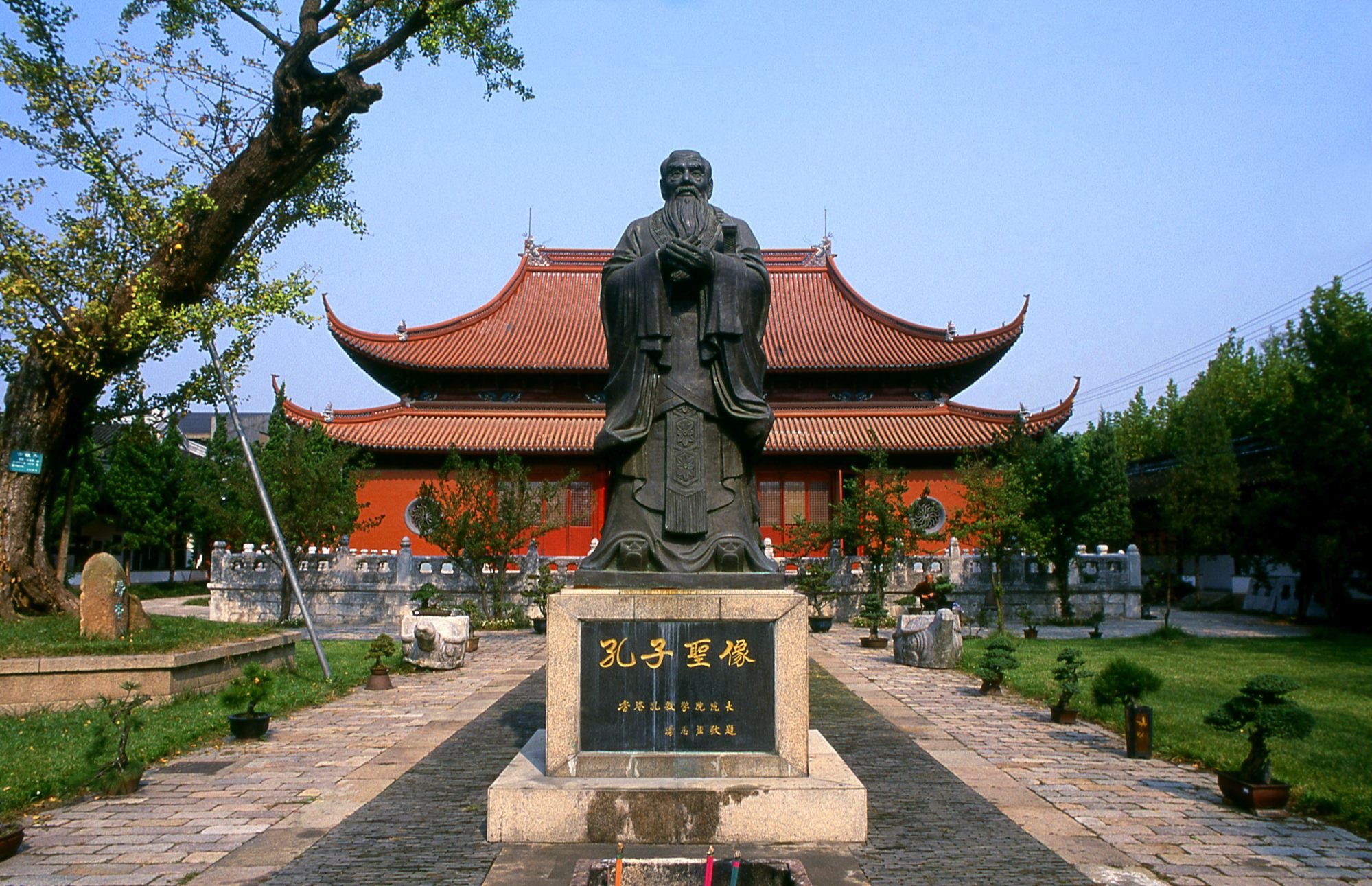
Another progressive policy in imperial China that is echoed in China today is the grievance offices, or deng wen jian yuan. In Song, Ming, or Qing China, all taxpayers—men and women—could blow the whistle on corruption, complain about policy, or make suggestions through these channels. Similar institutions exist in China today, such as the offices for xinfang, or “letters and visits.”
This principle is also rooted in Confucian thought because, for Mencius, a government becomes legitimate only when it wins the hearts and minds of the people. You can’t do that without feedback, so the other term associated with the people’s will was gonglun, or public discourse.
Influence of Imperial Chinese Ideas on Western Thought
One of Powers’ core ideas is that imperial Chinese ideas historically influenced Western Enlightenment thinkers like Rousseau, Thomas Paine, and Thomas Jefferson, who developed the modern understanding of “rights,” “equality,” “free speech,” and “checks on power” in dialogue with Chinese precursors. He explains that in the past 10 or 15 years, there has been a lot of new research on China and the Enlightenment; these studies show that European thinkers were in dialogue with Chinese thought via translated texts from China.
As early as 1588, Gonzales Juan de Mendoza described China’s examination system and rigorous expectations of public officers. This information was reinforced in 1615 by Matteo Ricci’s descriptions of China’s government. Soon thereafter, Robert Burton wrote in The Anatomy of Melancholy that nobility should be assigned to office only if qualified and should be dismissed if they are incompetent. He mentioned the Chinese literati several times as a model for how this could be accomplished.

Many others picked up on this theme. By the 1730s, England’s free thinkers, including Samuel Johnson, were citing translations of Chinese texts to support merit-based reforms, but these were rejected because England’s government, of course, was aristocratic.
The Fear of China in the West
Powers notes that in the 17th and 18th centuries, European intellectuals who promoted Chinese political systems faced exile and book bans, reflecting a “defensive” rather than inquisitive attitude towards China, which was deemed an “external threat.” He suggests that a similar pattern exists today, where Western scholars who speak positively about China are branded as Chinese mouthpieces or marginalized within academic and policy circles.
This fear of China now is not unlike the fear of China in the 17th and 18th centuries. Back then, China’s more egalitarian, post-aristocratic system was a clear threat to European aristocracy, so China was ruthlessly demonized by intellectuals like Fenelon, Montesquieu, and Hegel.
Cross-Cultural Borrowing of Governance Ideas
Powers emphasizes the importance of cross-cultural borrowing of governance ideas today. He points out that historically, in the late Qing dynasty, during the May Fourth Movement, and in the 1980s, Chinese intellectuals overlooked and criticized Chinese tradition in favor of Western notions of modernity. However, there has been a recent shift towards greater confidence in China’s traditional culture and governance models.
He highlights that the younger generation appears to be acquiring some confidence, in part because they are proud of China’s accomplishments. According to Harvard studies, most people in China approve of the government because they’re so much better off now than they were before.
The Global Civilisation Initiative
In recent years, China has brought up several proposals, such as the Global Civilisation Initiative. Powers believes these theories and models can be applied to other countries. He suggests that if people were to learn more about China’s core policies, both foreign and domestic, at least some open-minded persons would realize that much of it makes sense.
He adds that the themes repeated in official statements from Beijing are very much in line with late imperial attitudes towards international relations. China’s Foreign Minister Wang Yi repeatedly insists that state-to-state relations must proceed on the basis of equality and mutual respect, with the understanding that both sides should benefit from the relationship.
The Importance of Cultural Projects
China has been investing heavily in hundreds of museums and civilisation-tracing projects. These efforts contribute to enhancing China’s cultural influence and soft power. Powers notes that these projects provide wholesome, inexpensive entertainment for millions of families. When he visits such sites in China, he sees families with young children everywhere, learning about history through artefacts.
He also emphasizes the importance of full-blown print culture. In the West, not a few historians prefer not to mention that printing was practised widely in China, Korea, and Japan long before Gutenberg. Promulgating a false narrative is not only unfair to Asian peoples; it hinders our ability to understand the circumstances under which printing can develop, as well as its effects on social and political practice.
Conclusion
Powers concludes that whether you look at China’s classical philosophers or today’s top officials, authority isn’t imagined as a substance that you’re born with, as Aristotle claimed. It is a consequence of intelligent policy, rational discourse, and careful attention to the needs of others.


