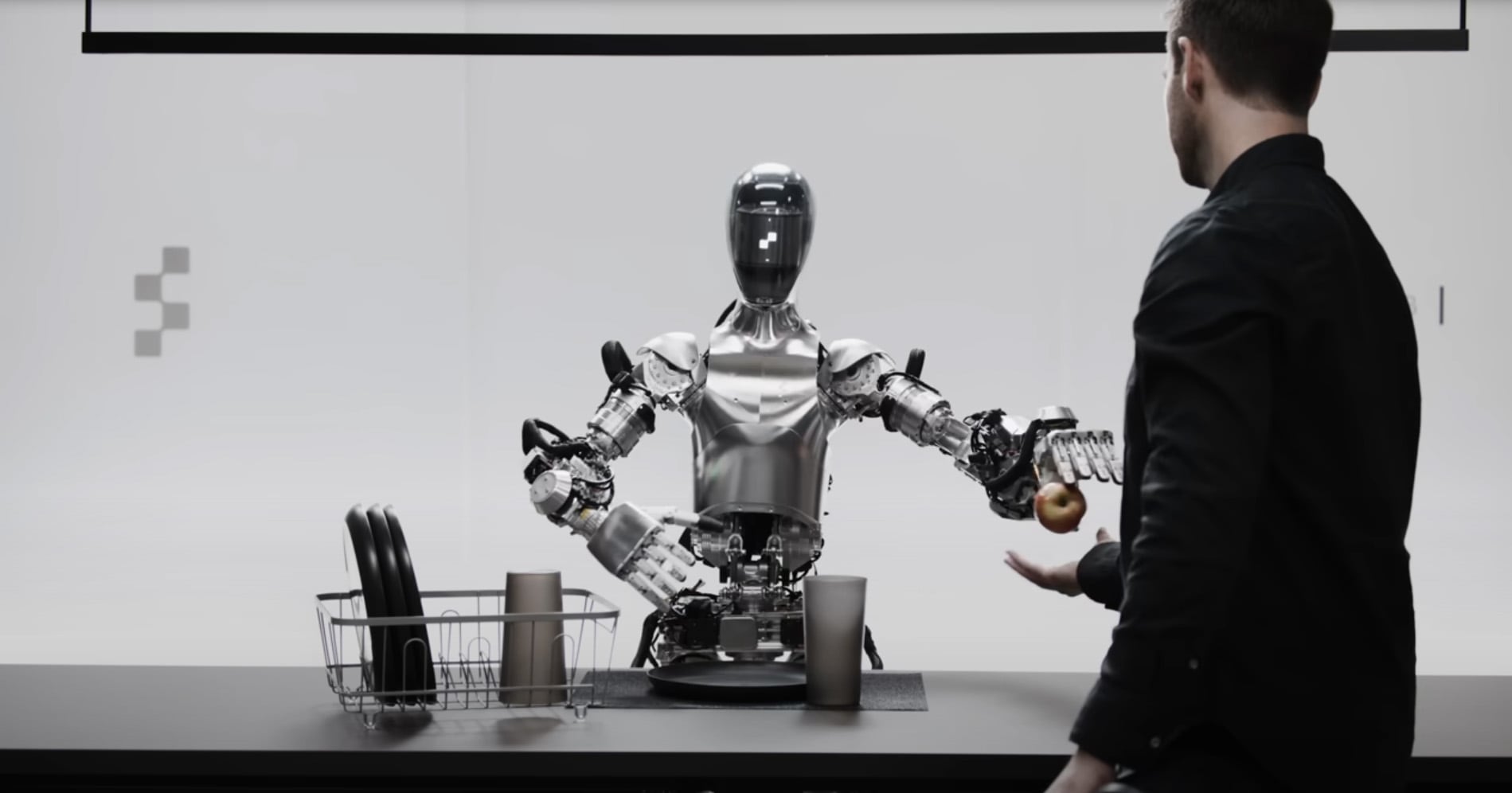
In 2000, Honda of Japan developed the world’s first humanoid robot, known as ‘ASIMO.’ This innovation captured global attention but faced criticism for its instability and limited functionality. It was often seen as a flashy technology rather than a practical solution. However, over the past 25 years, humanoid robots have evolved significantly. Once confined to the realm of science fiction, these robots now walk on two legs, manipulate objects with their fingers, and perform complex tasks. They can engage in conversations, express emotions, and carry out a wide range of activities that humans typically do.
Humanoid robots are no longer just laboratory experiments; they are becoming part of daily life. As they begin to integrate into factories, commercial spaces, and homes, 2025 is considered the year when mass production of humanoid robots will start. Wang Xingsheng, CEO of Chinese robot company Unitree, predicts that within two to three years, the robot industry will experience a breakthrough similar to the ‘ChatGPT’ moment that propelled AI into mainstream use.
Humanoid Robots Deployed in BMW and BYD Factories
On the afternoon of the 1st, an exhibition hall in COEX, Gangnam-gu, Seoul, hosted a unique event. A humanoid robot, approximately 1 meter tall, demonstrated its capabilities by aiming at a 30 cm diameter target moving in a circular motion while holding a bow with an arrow. As the target moved, the robot adjusted its head and arm movements to track it. Using its AI “brain,” the robot calculated the target’s speed and position, then determined the direction and strength needed to shoot the arrow. When the arrow hit the center of the target, the audience erupted in applause. This was part of the “Humanoid Robot Sports Competition,” where 22 teams participated in various events such as archery, weightlifting, running, and a stone-seeing game.
Kim Jin-wook, director of the Korea Robot Sports Association, noted that while humanoid robots may not excel in all areas, they showcase remarkable precision and technical skills in specialized tasks. The event took place during the globally renowned humanoid robot academic conference ‘Humanoid 2025,’ along with the Robot Learning Conference (CoRL) and the Seoul AI Robot Show. Throughout the venue, humanoid robots greeted visitors, and quadruped robots resembling dogs roamed freely. Airobot’s ‘Alice’ engaged visitors in a dice game, demonstrating her ability to recognize visual information, calculate sums, and communicate results.
Rapid Deployment in Industrial Settings
Humanoid robots have advanced to the point where they can perform most tasks that humans can. They now exhibit natural walking and movement, improved hand manipulation, and the ability to communicate with humans and adapt to their surroundings. This progress has been driven by the synergy between robotics and artificial intelligence (AI). Once limited to basic technology development, humanoid robots now feature artificial brains comparable to human intelligence and are being used in specific fields.
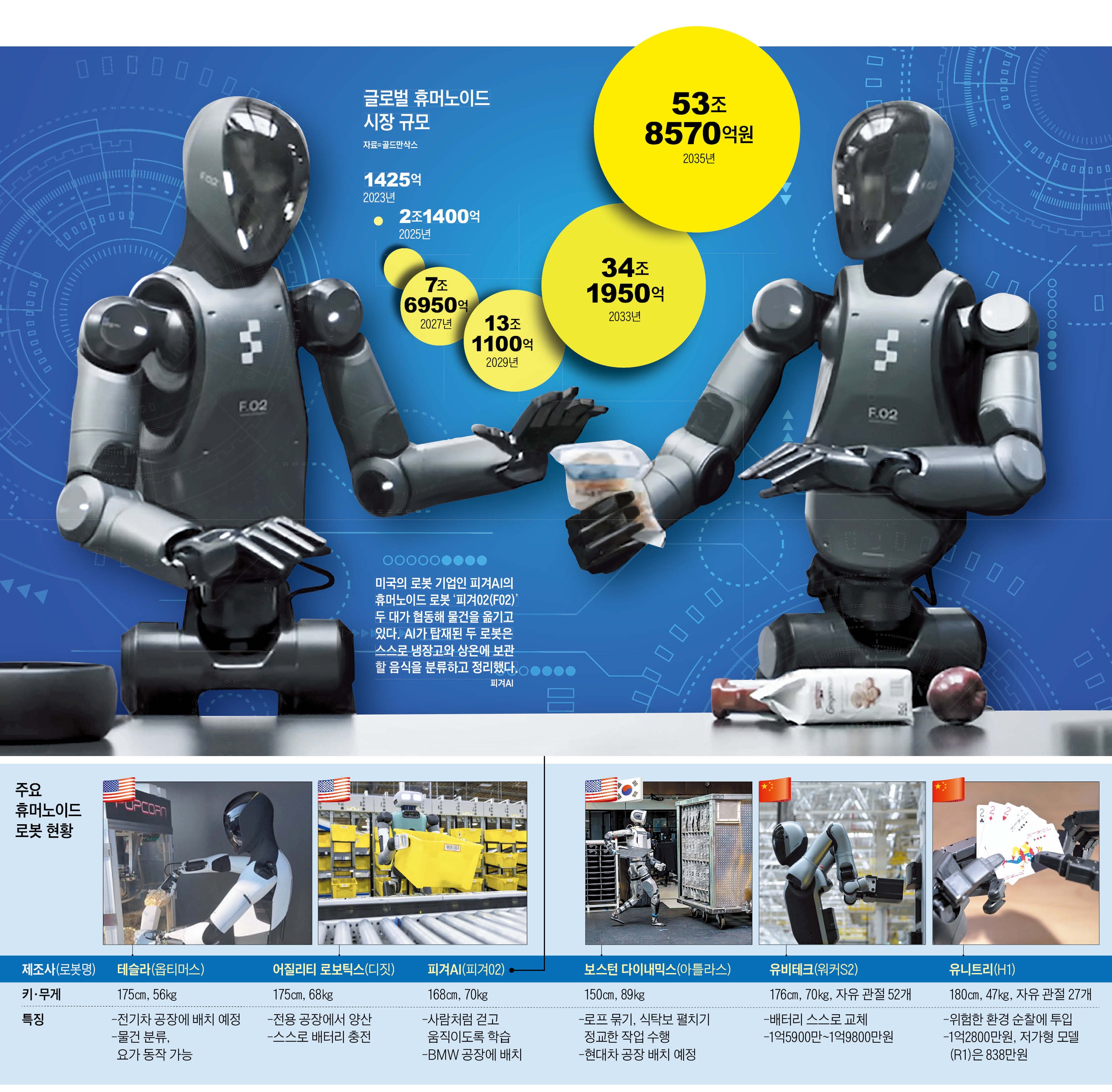
Goldman Sachs estimates that the global humanoid robot market, valued at $1.5 billion this year, will grow to $37.8 billion by 2035—a 25-fold increase in a decade. The industrial sector is the first to see changes due to humanoid robot development. Tesla has been continuously improving the performance of its humanoid robot, ‘Optimus,’ since unveiling the prototype in 2022. The company aims to deploy the robots in Tesla factories by the end of this year and produce 1 million units annually by 2030.
Agility Robotics’ RoboFab, located in Oregon, USA, is the world’s first factory dedicated to mass-producing humanoid robots. The facility, covering approximately 7,600 square meters, can produce 10,000 humanoid robots annually. ‘Digit,’ Agility Robotics’ humanoid robot, is deployed in Amazon logistics warehouses, where it carries boxes weighing up to 16 kg, navigates narrow passages, and loads/unloads them onto conveyor belts. Figure AI has deployed humanoid robots in BMW factories, where they perform tasks autonomously, precisely recognizing and adjusting component positions down to the millimeter. The work speed has reportedly quadrupled.
Hyundai Motor Group is planning to deploy the ‘Atlas’ robot at its Georgia, USA factory. Atlas, developed by Boston Dynamics, is now part of Hyundai’s operations. Chinese robot company Unitree has integrated its robots into the production lines of Chinese electric vehicle manufacturers like BYD. Aezibot, a Chinese robot startup, plans to supply humanoid robots to Furun Jinggong, an automotive parts manufacturing company.
Falling Prices Accelerate Commercialization
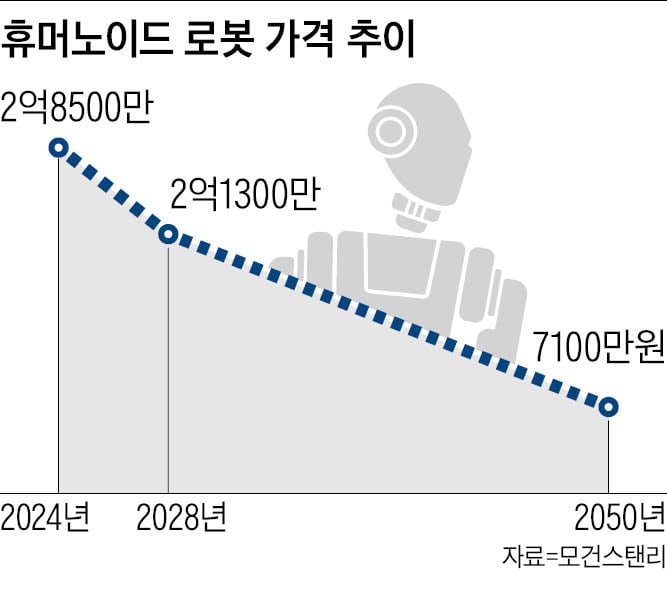
The tech industry anticipates that humanoid robots will soon enter homes beyond factories. The era of “one robot per household” is expected to arrive. For this to happen, robot prices must decrease, and mass production systems must be established. Robots require many expensive high-precision components. According to Morgan Stanley, the price of a humanoid robot was $200,000 (approximately 280 million Korean won) as of 2024. However, prices are rapidly decreasing due to technological advancements and diversified supply chains.
Morgan Stanley estimates that the price of advanced humanoid robots will drop to $150,000 by 2028 and as low as $50,000 by 2050. Chinese companies have already released low-cost models under 8 million Korean won. Unitree unveiled the ‘R1,’ a humanoid robot priced under 8 million Korean won. This significantly lowers the cost compared to the high-end model H1, which costs 128 million Korean won. Morgan Stanley stated, “Developing a general-purpose humanoid robot for household chores requires technological advancements in both hardware and AI models.”


