Growing Concerns Over the Karki Administration’s Priorities
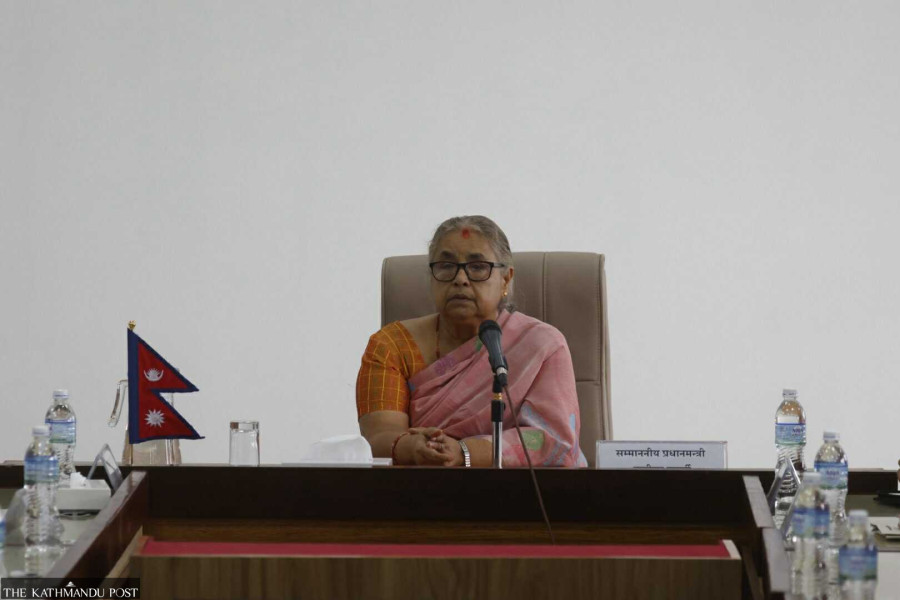
Kathmandu, Oct. 19 — A month after the formation of the interim government led by Sushila Karki, public discourse has begun to shift towards questioning whether the administration is staying true to its primary objective: conducting parliamentary elections on March 5. Various groups and individuals have raised concerns about the government’s focus, suggesting that some decisions might be diverting attention from this critical task.
The Election Environment
During a consultation meeting held by the Election Commission on October 16, representatives from different political parties voiced their dissatisfaction. They claimed that the Karki administration has not created an environment conducive for holding the polls. Despite repeated assurances from both the government and the Election Commission, skepticism remains among political leaders regarding the prospects of free and fair elections.
Multiple experts interviewed by the Post have expressed similar concerns. They highlighted that while the government has yet to engage in serious dialogue with major political parties, it has taken actions such as terminating appointments made by the previous administration. These steps have fueled suspicions that the government is not fully committed to its core mission.
Controversial Decisions
One of the most notable decisions was made by Kulman Ghising, the minister for energy, water resources, and irrigation. Shortly after being appointed, he transferred Hitendra Dev Shakya, who had been appointed head of the Nepal Electricity Authority (NEA) by the former government. This move was perceived as a retaliatory action against the previous administration.
Similarly, a Cabinet meeting on October 16 decided to recall 11 Nepali ambassadors appointed by the previous administration. A former diplomat noted that the government showed interest in recalling ambassadors even from significant destinations like the United States, the United Kingdom, and China.
Political Criticism
Nepali Congress spokesperson Prakash Sharan Mahat questioned the rationale behind recalling the ambassadors, accusing the government of shying away from its main responsibility. He stated that the government should have focused on holding the elections on time instead of taking decisions like recalling ambassadors.
Experts argue that weakening an important administration like the foreign affairs department during such a sensitive period raises doubts about the government’s priorities. Geja Sharma Wagle, a political analyst, said it was not the right decision for the interim government to recall ambassadors at such a critical time. He emphasized that the government must focus on its prime objective, which is to hold the elections on time.
Differing Perspectives
Political analyst Uddhab Pyakurel offered a slightly different perspective. He argued that the current situation cannot be viewed through the normal lens. The Karki government, he said, emerged from the Gen Z movement, which had delegitimised traditional parties and some acts done by their governments. Therefore, for Pyakurel, it is unsurprising that those parties are reluctant to recognize the interim government.
While Pyakurel agreed that recalling ambassadors at this time can be questioned, he suggested the government might have lacked confidence in its ability to present itself internationally through representatives closely tied to political parties.
Government Response
An official at the Prime Minister’s Office also holds similar views to Pyakurel on the issue of recalling some politically appointed ambassadors. Claiming that the government has not deviated from its original agenda, the official said that even among the political appointees there are some exceptions.
Ambassador Shankar Sharma (India), Chitra Lekha Yadav (Australia) and Shivamaya Thumbahangphe (South Korea) have not been recalled. Those ambassadors who cannot represent the government formed after the Gen Z movement were called back, the official added.
“Ambassadors appointed for undue gains were recalled,” the official said, who spoke to the Post on the condition of anonymity as he was not authorised to talk about the issue publicly. “In the embassies where officials from the foreign ministry are more effective than the ambassadors themselves were recalled too. The decision to recall ambassadors was made on the basis of merit, with the aim to cut costs.”
Lack of Urgency
The government’s own sense of urgency appears to be lacking. Leaders from the CPN-UML said that the administration has not even initiated formal dialogue with the political parties. When President Ramchandra Paudel is active in facilitating election preparedness, the government, whose role should be more proactive, is not even engaging major political actors, leaders said.
“The President is ceremonial; the institution acts only as a custodian. But it is the government’s responsibility to create the environment for elections, and it has not done so,” said UML leader Mahesh Bartaula.
“The police force is still traumatised after the Gen Z protests. It was the government’s duty to take all the major players-especially the political parties-into confidence,” Bartaula added. “But it has failed to do so.”
Government Commitment
In response, Ram Bahadur Rawal, press coordinator to Prime Minister Karki, insisted that the government remains committed to its original objective. He said that apart from conducting the elections, the government has to address the aspirations of the Gen Z movement as well.
“The government has already made significant groundwork to ensure that the election is held in a free, fair and timely manner,” Rawal said. “Much of this work is happening at multiple levels. As far as dialogue with the political parties is concerned, the government is indeed communicating with them, though not all discussions have been made public.”
On Friday, CPN (Maoist Centre) leaders Narayan Kaji Shrestha and Barshaman Pun met with Prime Minister Karki to discuss election-related matters.
Former chief election commissioner Ayodhee Prasad Yadav said that five months is enough time to prepare for the polls, provided that a conducive environment exists.