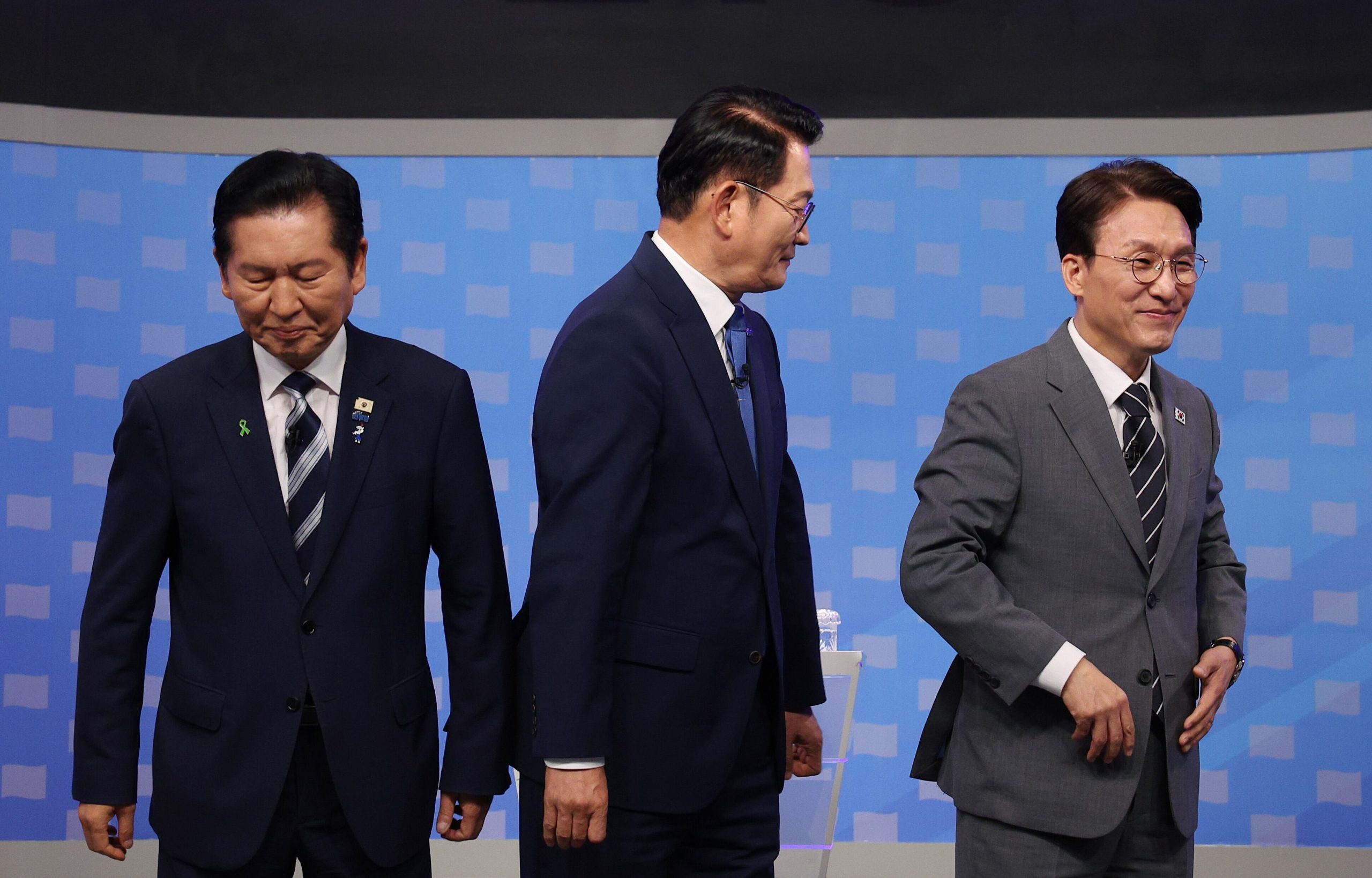
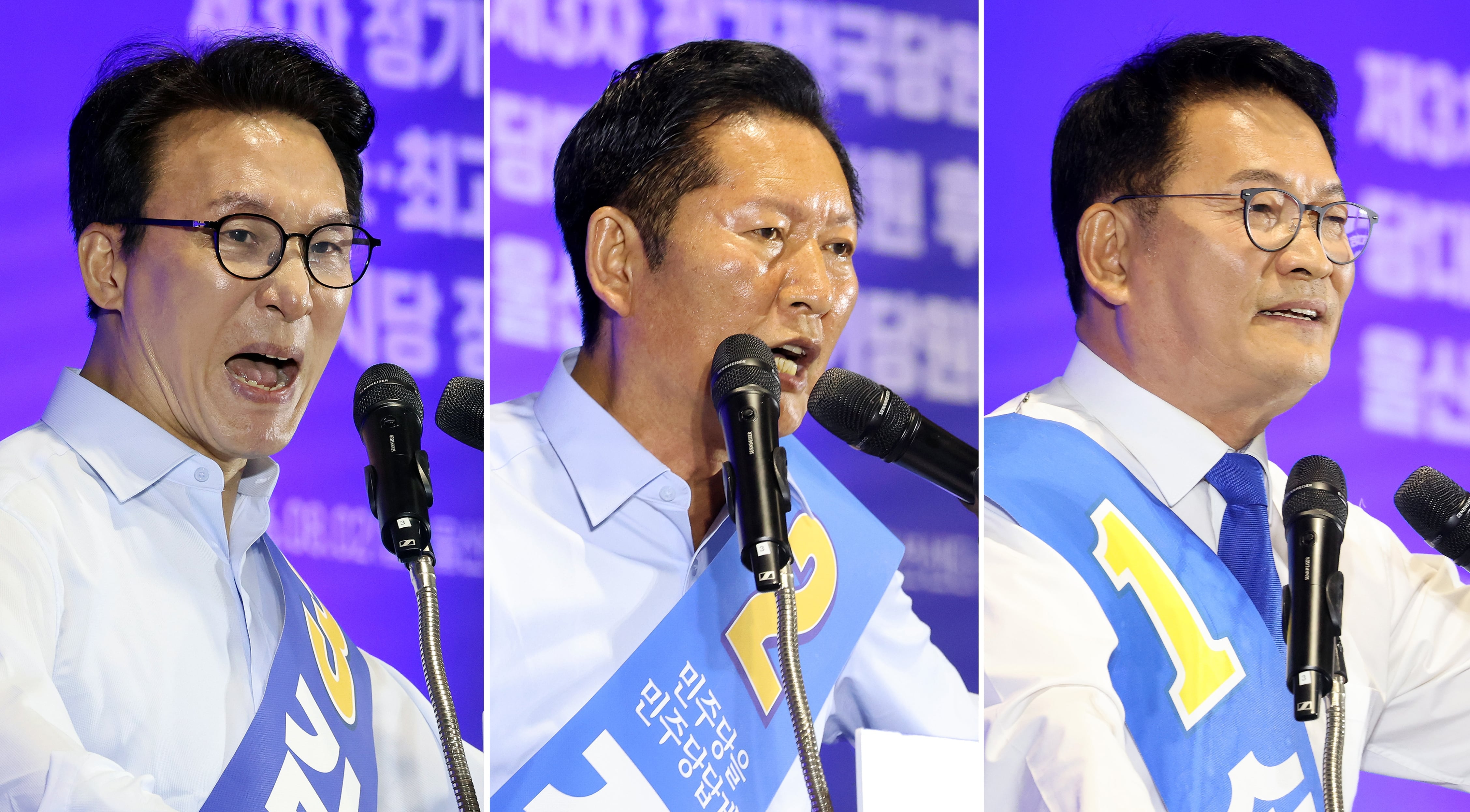
“Why lie blatantly when the video is preserved? It’s not like a goldfish’s IQ.”
Four days before the Democratic Party of Korea’s August 17 convention, on the 13th, Song Young-gil, a candidate for party leader, directed these remarks at his rival, Jung Chung-rae. On CBS Radio that day, Song claimed that Jung had initially stated that the party, government, and presidential office had coordinated to assess the June 3 local election results as a victory but later changed his explanation to “coordination between the party and the presidential office.” Song then attacked Jung, saying, “If you’re going to lie, you need to be smart,” implying that Jung could not even remember his past statements.
Critics note that the competition among the party’s leadership contenders, who concluded their final TV debate the previous day, has shifted from policy and vision to short, provocative “short-hitter negative attacks” targeting opponents’ verbal slips, past records, and relationships with President Lee Jae Myung. The exchanges that began during the TV debates continued on social media and radio after the debates ended. Jung shared a video of his heated argument with Song on Facebook the previous night, writing, “A big man…,” and continued to challenge Kim Min-seok over specific phrases.
◆
“Goldfish IQ” vs. “A big man”…Arguments persist after debates end
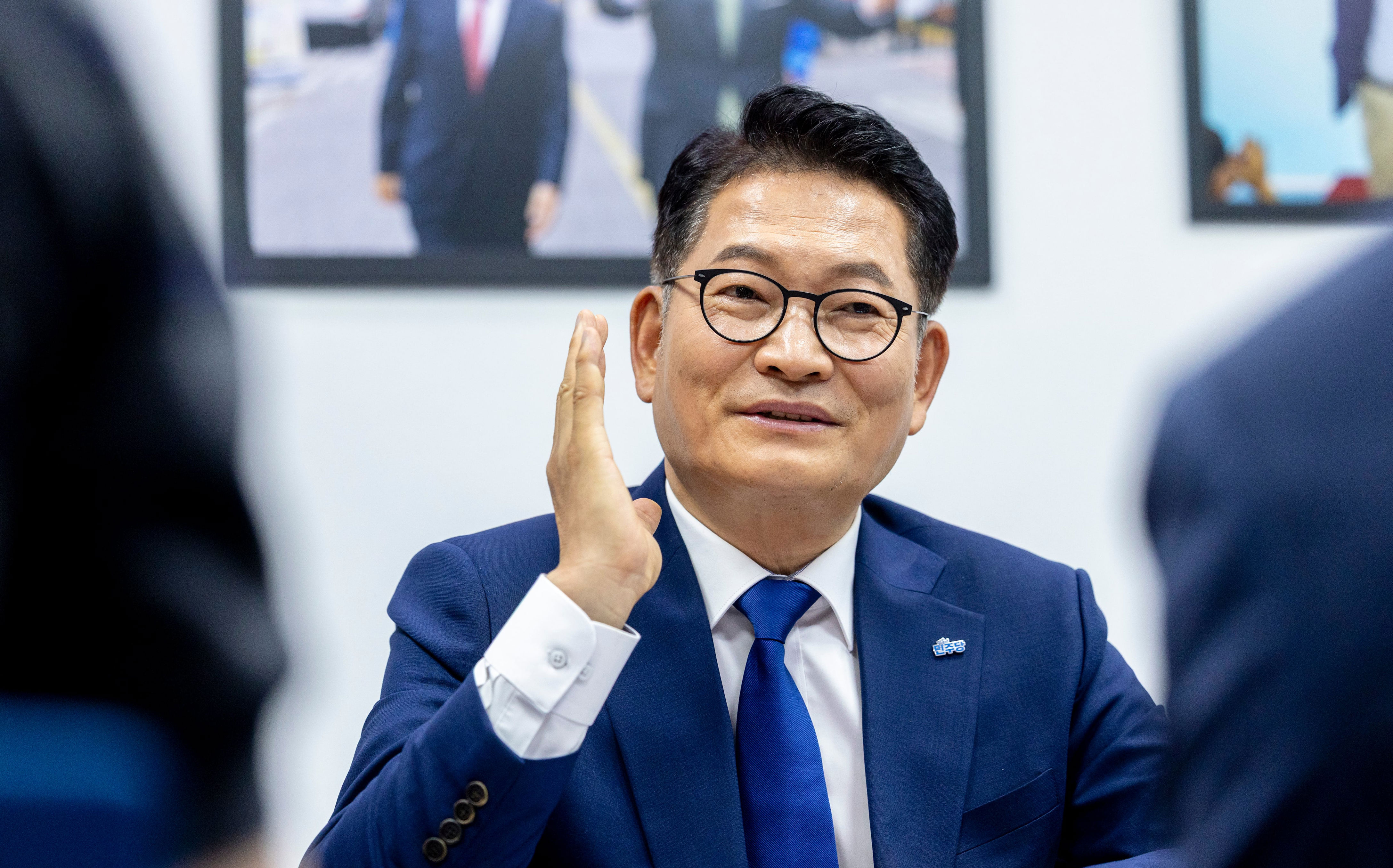
Song escalated his attacks on Jung that day. He criticized Jung’s responses as “slipping away like a loach” and added, “He doesn’t even have the ability to lie.” Last month, Song attacked Jung for repeatedly emphasizing his relationship with President Lee, calling it “stalker-level behavior toward President Lee Jae Myung.” On this day, Song also criticized Jung for failing to properly answer about President Lee’s top state affairs task, calling it “a serious issue and a shameful matter.”
Jung did not back down. During the SBS TV debate on the 12th, when Song mentioned a conversation between President Lee and himself, Jung countered that discussing private talks with the president publicly was inappropriate. After Song explained himself, Jung retorted, “A big man shouldn’t speak so lightly.” After the debate, Jung shared a video titled “Young-gil Hyung Getting Scolded for Acting Arrogant” on his Facebook.
Tensions between Jung and Kim flared over a single word. When Kim praised Jung’s year-long tenure as party leader with the term “치하” (congratulations), Jung criticized it as “a phrase used by superiors to inferiors,” calling it “disrespectful.” Kim countered, “You must have read a Japanese dictionary,” arguing that the term can be used among equals in Korean. Jung later posted a dictionary search on Facebook targeting Kim.
The candidates also engaged in “quiz-style” questions to test each other’s policy capabilities. After Song asked Jung about President Lee’s top state affairs task during an earlier debate, Jung countered by asking Song about task number 50 in the final debate. Jung questioned Kim about the housing supply pledge’s portion assigned to LH, and Kim protested, “The debate among the three shouldn’t devolve into a quiz level.”
◆
“Ruined the presidential election” “Betrayal trauma”…Even 20-year-old issues resurface
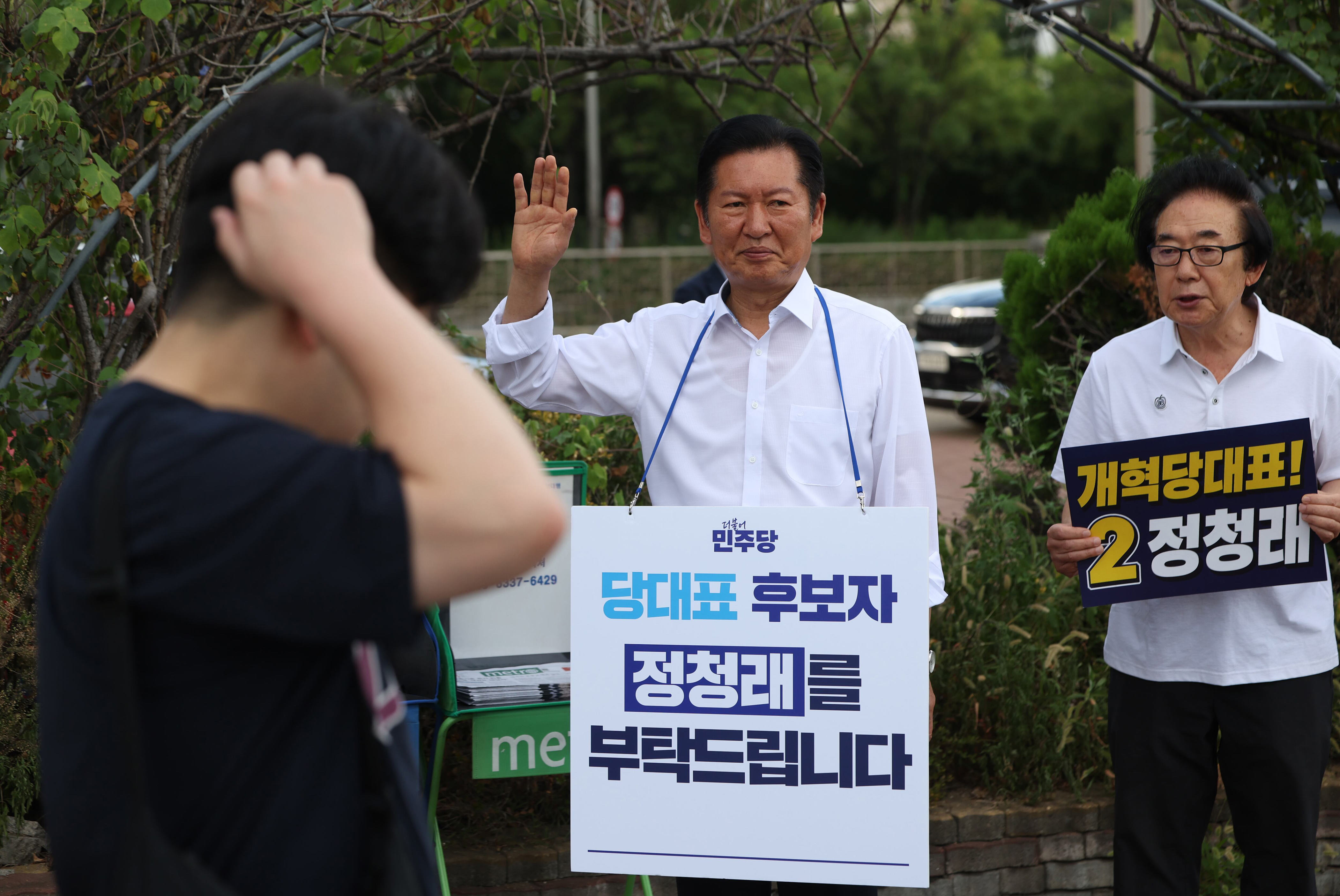
In the final stretch of the convention, not only current issues but also political choices from over 20 years ago and responsibility for past presidential election defeats have become attack material.
During the final TV debate, Kim brought up Jung’s 2021 clash with the Buddhist community over his comparison of temple entrance fees to a “toll” and temples to “Bongi Kim Sun-dal.” Kim argued this harmed the 2022 presidential election and asked why Jung did not apologize actively at the time.
Jung immediately countered by referencing Kim’s 2002 departure from the Democratic Party to support Chung Mong-joon. Jung told Kim, “You seem to have betrayal trauma,” and Kim retorted by citing Jung’s past Buddhist conflict, saying, “You ruined the presidential election.” Thus, a policy debate turned into a clash over a 24-year-old party switch and a four-year-old election responsibility.
Throughout the convention, Jung’s key attack phrase against Kim has been “betrayal.” Jung cited Kim’s 2002 departure, saying, “Once a betrayer, always a betrayer,” while Kim’s camp called this excessive stigmatization. Jung even compared Kim to “someone who left home 18 years ago and demands the house deed.”
The conflict over the “Shincheonji election interference allegations” has extended to post-convention disciplinary issues. When Kim raised the possibility of a religious group’s involvement in the party’s primaries, Jung labeled it a “relevant act” and vowed to order an ethics investigation if elected leader. Kim countered, “Is warning about election interference a relevant act?” and asked, “Are you trying to run the party fearfully?” Jung has maintained his stance that this issue must be resolved after the convention.
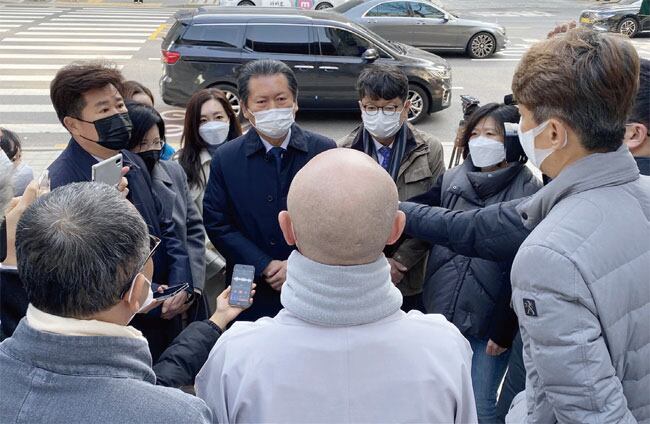
In disputes over election rules, terms like “coup” and “riot” emerged. When some supreme council candidates demanded additional voting opportunities for members who missed voting, Jung called it a “voting coup” and warned that changing rules would cause “riots.” Even in the supreme council race, expressions like “ilbe” (a far-right online community) and “bat” (a derogatory term for opportunists) appeared, spreading the emotional conflict from the leadership race to the entire leadership election.
◆
“Unity” in words…The party closed even public supreme council meetings
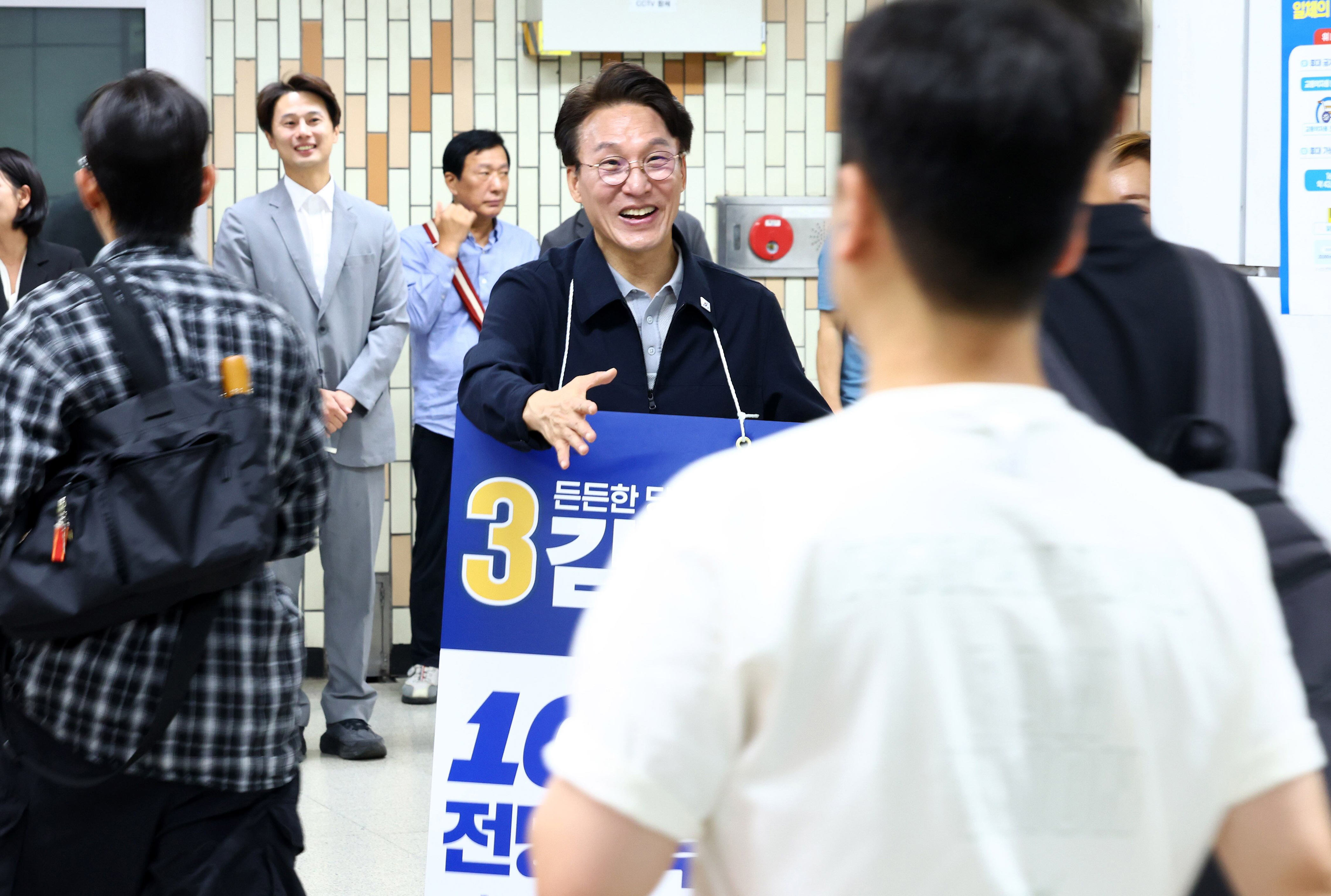
In their closing remarks at the final TV debate, all three candidates emphasized “unity.” Jung appealed for “loyalty” to the party, Song said the three candidates shared “the same roots” and urged cooperation after the convention, and Kim pledged to unify the party post-convention.
However, critics argue the actual party atmosphere is far from unified. While Jung stresses unity, he has not withdrawn his plan to investigate Kim over the Shincheonji issue. When asked about post-convention factional splits, Jung said on the 10th, “Don’t say that. I’ve never even considered it.”
The Democratic Party’s leadership halted public supreme council meetings this week, just before the convention. Though the party claims there were no public agenda items, insiders interpret this as an attempt to prevent further exposure of conflicts between pro-Lee and pro-government factions.
Concerns about post-convention aftereffects persist within the party. Rep. Youn Kun-young recently described the convention as “not just heated but on the verge of exploding,” warning against “pulling up the pillars of the family house to win an election.” Rep. Kim Young-jin also referenced the party’s past splits, stressing the convention must not reach that level.
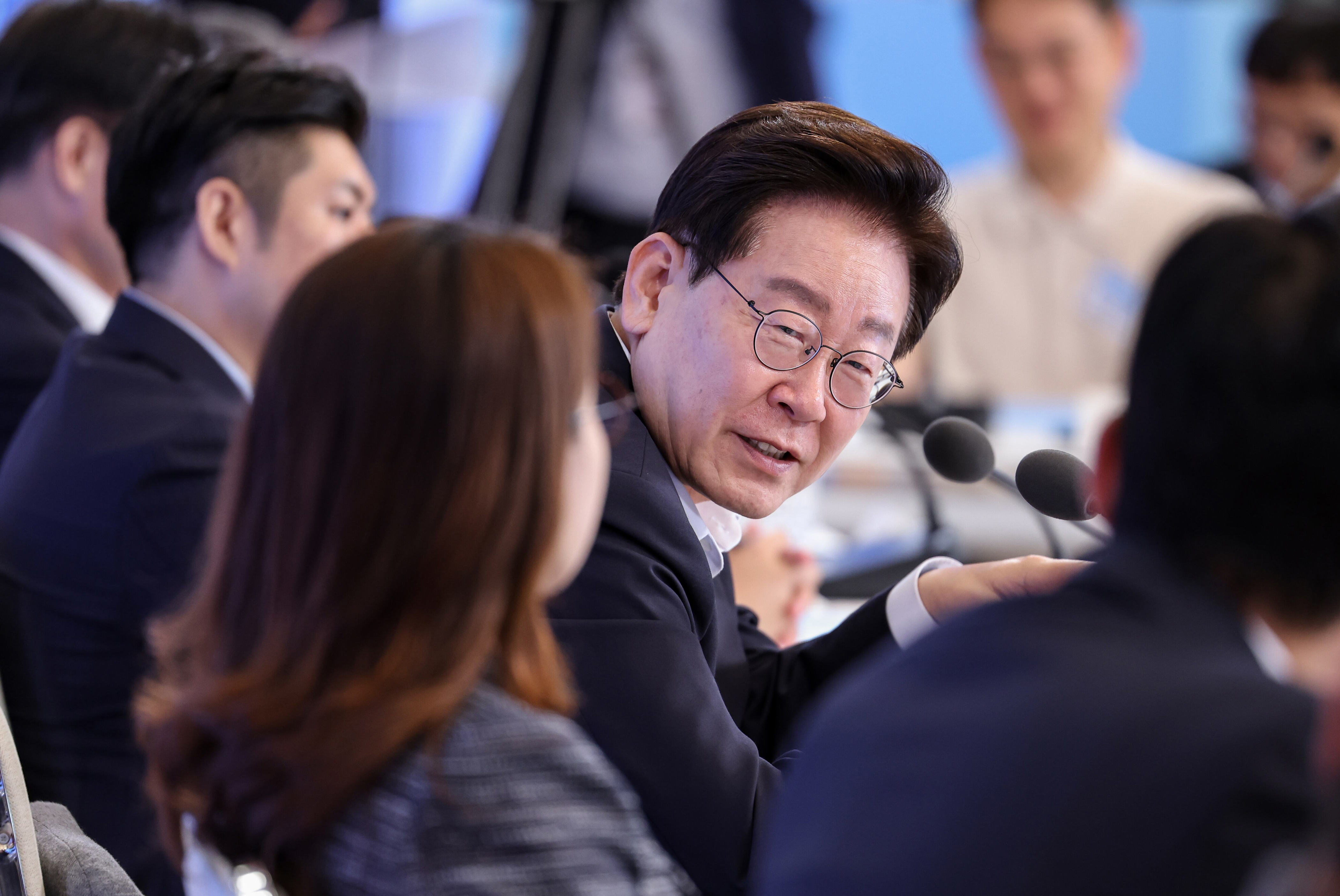
The Democratic Party’s convention preparation committee had announced in early July, before the convention began, that it would strictly address excessive negativity, including derogatory terms. However, as the voting day approached, the candidates’ attacks grew harsher, focusing on short phrases that imprint “lies,” “betrayal,” and “incompetence” rather than policies. A political insider said, “The emotional conflict has escalated to the point where it’s hard to see them as candidates from the same party. If the losing camp isn’t embraced after the 17th, the post-convention aftermath could linger for a long time. The new leader’s first task won’t be winning elections but mending the party.”
월 5900원 멤버십, 신문 독자에게는 2900원, 조선멤버십
55000원 상당의 신문-잡지 8종 마음껏 보기, 조선멤버십
현금처럼 쓸 7000포인트 받아 알뜰한 쇼핑, 조선멤버십