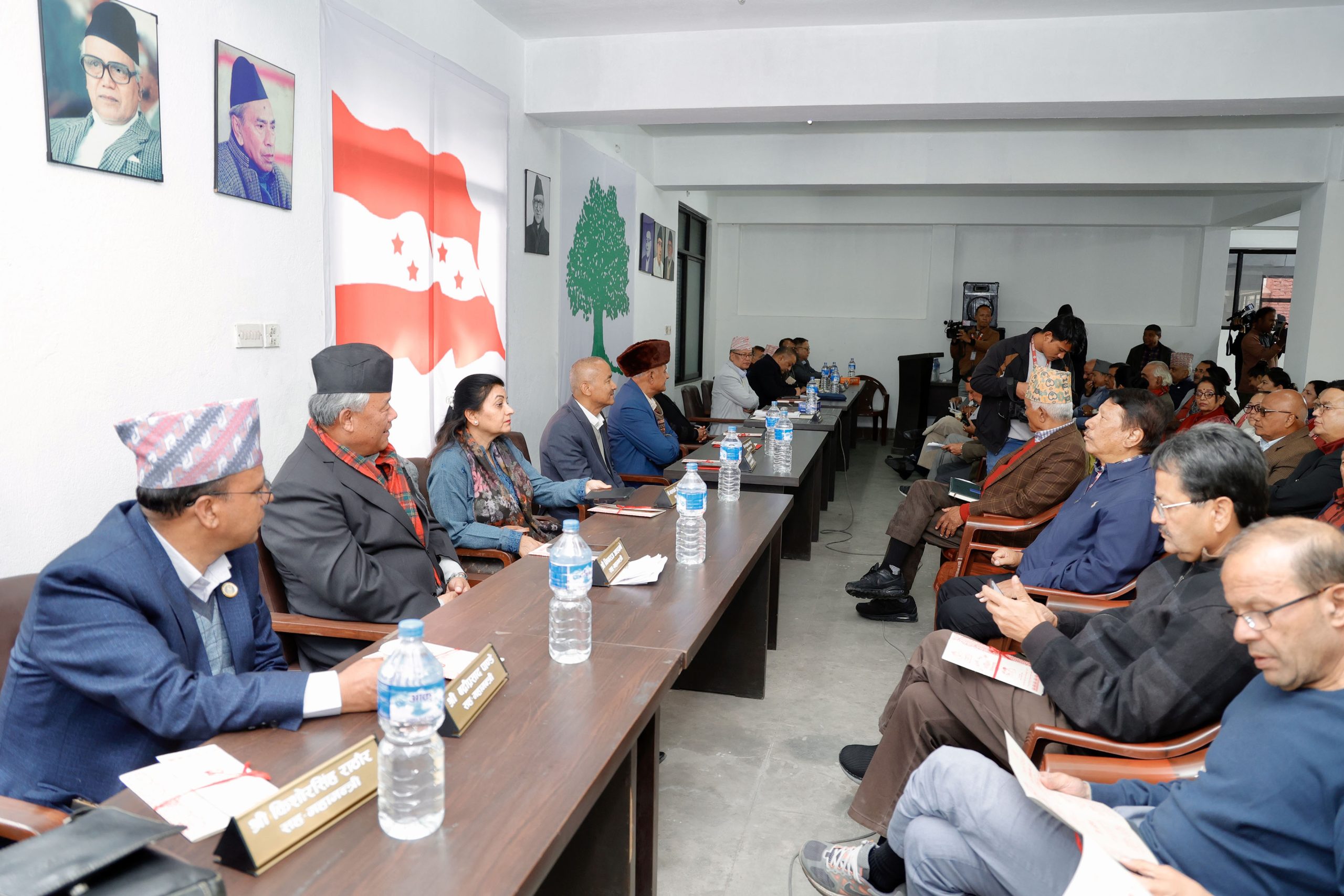
Nepali Congress Decides to Participate in Upcoming Elections
Kathmandu, Nov. 23 — The Nepali Congress has officially decided to participate in the elections scheduled for March 5. This decision stands in stark contrast to its coalition partner, the CPN-UML, which is advocating for the restoration of the dissolved House of Representatives. The UML, the second-largest party in the dissolved House, remains opposed to participating in the upcoming elections.
The country’s largest and oldest political party, however, faces internal divisions regarding whether to hold a regular general convention or a special one. This decision comes in the wake of significant political changes following the September Gen Z revolt.
After a month-long central working committee meeting, the Congress took an official decision to participate in the elections. The party stated, “We firmly believe that only through elections can we safeguard the Constitution, institutionalise the voices for change raised during the Gen-Z movement and move the country forward.”
Despite some Congress lawmakers gathering signatures to call for the restoration of the House dissolved by President Ramchandra Paudel on interim Prime Minister Suhsila Karki’s recommendation on September 12, the party’s decision is expected to pressure the UML to take part in the March elections.
As of Saturday, the UML has clearly distanced itself from participating in the elections and continues to assert that its protests will continue until the House is restored.
“We will continue to show our strength until the House is reinstated,” said UML Chairman KP Sharma Oli at a mass meeting in Kathmandu. “We will hold even larger and more powerful gatherings in the days to come until the House of Representatives is reinstated. This demand is not just for the sake of making a demand; it is a demand that must be fulfilled.”
Registration with Election Commission
In addition to its decision to participate in the elections, the Congress has also decided to register itself with the Election Commission for the National Assembly election scheduled for January 25 next year, as well as the subsequent House elections.
For this purpose, Chief Secretary Krishna Prasad Paudel of the Congress Central Office is entrusted with completing all legal processes, including party registration at the Election Commission, according to the Congress statement.
The party has also outlined several conditions for ensuring free, fair, and safe elections. An environment free of fear is essential for the elections, but the current situation, where thousands of prisoners who fled jails in September remain at large, hundreds of weapons are missing, and political parties cannot campaign freely, is extremely concerning.
The Congress strongly urges the government to immediately improve peace and security, boost the morale of security personnel, and ensure a peaceful atmosphere for the general public.
Political Context and Concerns
Over the past month, the Congress central committee meeting discussed various aspects of Nepali politics in the wake of the September 8-9 Gen Z uprising. The party’s decision highlighted the chaos and anarchy that occurred during the crisis, emphasizing the need to rescue the nation and protect the constitution.
The party also recalled its September 19 decision that the dissolution of Parliament was against the spirit of the constitution and contrary to the court’s view. “The dissolution of Parliament is unconstitutional. This step has put democratic achievements at risk. The Congress firmly believes that a solution is possible within the constitutional framework.”
The party expressed concerns over recent anarchic activities across the country in the name of different groups. It called for restraint, dialogue, and trust among all concerned parties, urging them to avoid violence or provocation and seek solutions through dialogue.
Call for Multi-Party National Dialogue
The Congress emphasized the importance of a multi-party national dialogue to address the voices raised by the Gen Z movement for change. The party called on parties represented in the dissolved House, emerging parties after the demonstrations, Gen Z activists, civil society, intellectuals, business community, media persons, and other stakeholders to engage in dialogue and build a shared national understanding.
Internal Divisions Over Convention
The ongoing central working committee meeting of the party has failed to decide whether the Congress will hold its 15th general convention or a special one due to differences between the two factions.
Fifty percent of the elected representatives have demanded a special convention as the term and mandate of all elected bodies expire in mid-December. A group of leaders close to party chief Sher Bahadur Deuba favors holding the convention after the elections, possibly by April, while the rival faction led by general secretaries Gagan Thapa and Bishwa Prakash Sharma and Shekhar Koirala wants a special or regular convention by the end of December.
General Secretary Thapa, who has been vocal about a leadership change in the party, stated that a special convention has become inevitable. He mentioned that although he proposed a timetable for a regular general convention, central leaders found it impractical, making a special convention the only viable option.
The party is currently trying to reach a unanimous decision on the convention, with the next meeting on November 27 set to discuss and settle the issue of a general convention or a special one. Congress President Deuba has expedited talks with different party groups to find common ground on the convention.


