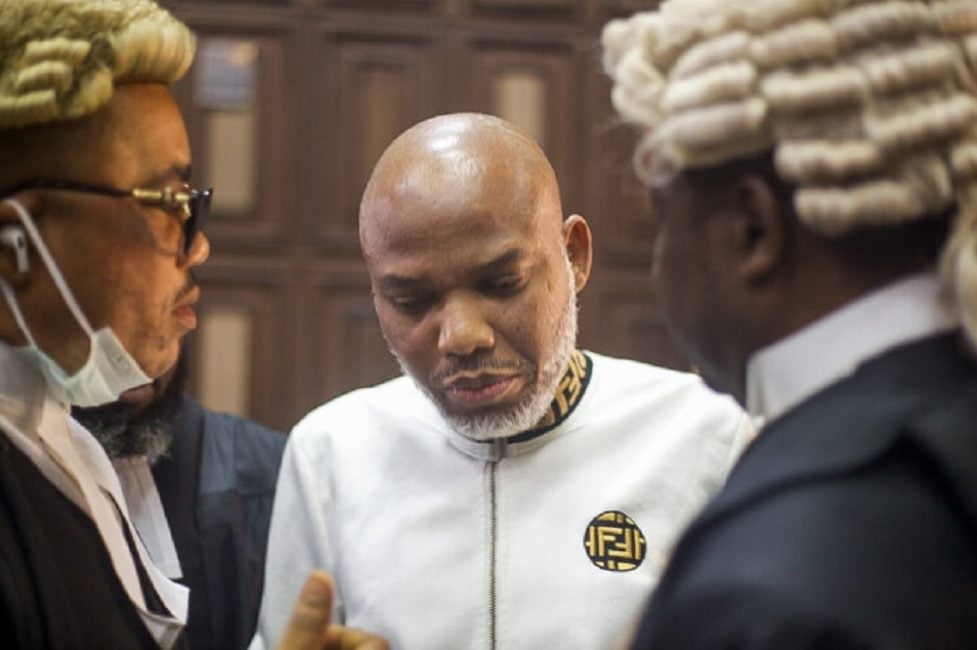
Health Assessments Conducted on Nnamdi Kanu as Per Court Order
The Nigerian Medical Association (NMA) has completed the health evaluations of Nnamdi Kanu, the detained leader of the Indigenous People of Biafra, as mandated by a court order. This development was confirmed by Dr. Ben Egbo, the Secretary-General of the NMA, during an interview with our correspondent.
The Federal High Court in Abuja had previously issued a ruling on September 26, directing the NMA to form a panel of medical experts within eight days to assess Kanu’s health condition. In his judgment, Justice James Omotosho instructed the NMA President to submit the committee’s report for consideration on whether Kanu should be transferred to the National Hospital for treatment.
The Process of Evaluation
Egbo stated that the evaluation was conducted as ordered by the court and that the report had been submitted to the Attorney General of the Federation. He explained that the NMA immediately responded to the Department of State Services’ request, assembling a committee of seven doctors, each representing different geopolitical zones of Nigeria. These specialists came from various fields, including Ophthalmology, Neurology, Urology, and Gastroenterology.
The team examined Kanu and compiled their findings into a comprehensive report, which was then sent to the Attorney General’s office. Egbo emphasized that any further inquiries should be directed to the Ministry of Justice, as the NMA has fulfilled its obligations under the court’s directive.
Legal and Medical Concerns Raised by Kanu
Kanu’s legal team has raised concerns about his deteriorating health while in custody. They have petitioned the World Medical Association (WMA) over what they describe as serious health challenges and inadequate medical care. In a letter dated October 3, 2025, signed by Kanu’s international counsel, Bruce Fein, he claimed that his health had worsened due to insufficient medical attention in detention.
The letter, addressed to the WMA President, Dr. Jacqueline Kitulu, detailed Kanu’s four-year detention in solitary confinement without trial. It described his arrest in Nairobi, Kenya, in June 2021, and alleged that he was denied food, water, and prescribed medications for the first five days of his detention, leading to breathing difficulties and weakness.
Medical Challenges and Allegations
According to the letter, Kanu’s health issues reportedly began after his detention in Nairobi. He claimed that upon arrival at Jomo Kenyatta International Airport, he was taken into custody by masked operatives and held for eight days in a confined room. During this time, he was allegedly denied essential medical care.
Upon transfer to Nigeria, blood analysis revealed a critical potassium deficiency, prompting a series of medical prescriptions that failed to stabilize his condition. Kanu also alleged inconsistencies in his medical test results under one of the physicians assigned to him in custody, stating that the doctor recorded normal potassium levels when in reality they were low.
Additional Health Concerns
The letter highlighted a range of health issues affecting Kanu, including nosebleeds, fainting spells, chest pains, headaches, and swelling of the feet. Over 50 blood samples were taken during his time in DSS custody, but these yielded no improvement in his health under the management of the assigned doctors.
Emeritus Professor Martin Aghaji, a respected surgeon, was mentioned as having stabilized Kanu’s condition when allowed to intervene. The letter praised his efforts, stating that without his intervention, Kanu’s health would have deteriorated beyond recovery. Aghaji reportedly confirmed several health concerns, including issues with Kanu’s liver, kidneys, bladder, prostate, white matter, sleep apnea, and severe tinnitus.
Urgent Calls for Action
The letter urged the WMA to ensure the release of the NMA report, protect Professor Aghaji’s role as Kanu’s physician, review the treatment he has received, and recognize tinnitus and sleep deprivation as urgent medical issues. It warned that without immediate decisive action, the medical neglect of Kanu may prove fatal.
As of the time of filing this report, the Department of State Services could not be reached for comment, as the agency currently has no official spokesperson.


