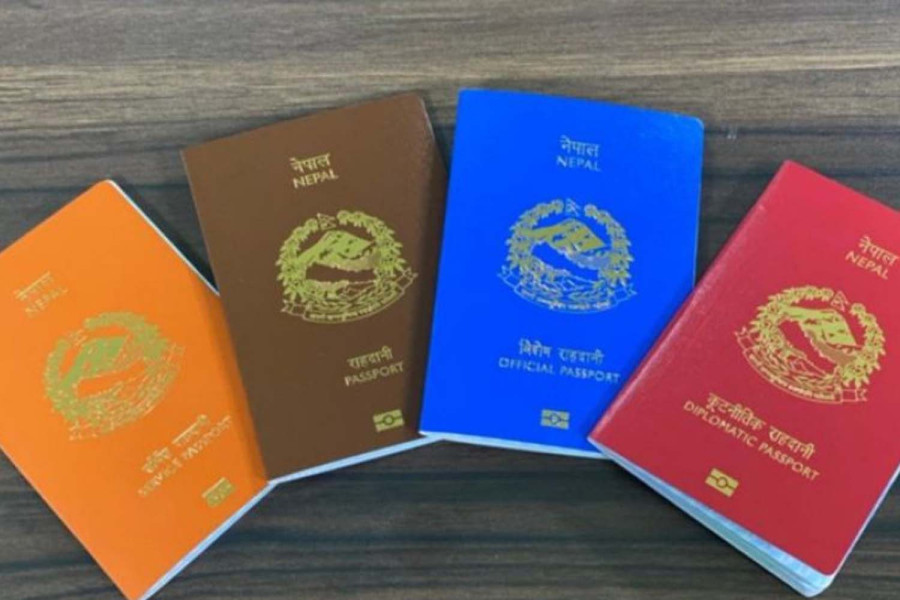
Nepal Faces Passport Shortage Crisis
Nepal is currently facing a critical shortage of passports, with the Department of Passports (DoP) under the Ministry of Foreign Affairs warning that current stock will only last until December. This situation has raised concerns about the potential disruption in passport distribution, especially given the high demand from citizens seeking to travel for jobs, higher education, and renewals.
The DoP is expected to face an acute shortage after December, as two German firms, Veridos GmbH and Muehlbauer ID Service Gmb, are scheduled to deliver passports only after mid-March 2026. This delay has prompted urgent discussions between the Nepali government and the German companies to find a temporary solution.
Prime Minister Steps In
Prime Minister Sushila Karki has taken a direct interest in resolving the crisis. She has initiated talks with the German ambassador, Udo Volz, urging him to support the supply of passports until March 2026. The prime minister has also instructed officials at the Ministry of Foreign Affairs to expedite negotiations with the German firms.
During the meeting, the prime minister requested the German ambassador to take necessary initiatives for passport printing. Ambassador Volz assured that he would make every effort to expedite the process, according to a statement issued by Karki’s private secretariat.
Challenges with Previous Supplier
The new e-passport contract was awarded to the German firms after a long-standing dominance by the French firm IDEMIA Identity and Security France SAS. The final agreement with the German firms was signed in mid-August, following legal challenges from IDEMIA.
Attempts to procure additional 300,000 e-passports from IDEMIA failed, leading officials to negotiate with the German firms for early delivery or the supply of Machine Readable Passports (MRPs) to cover the temporary shortage.
Financial Concerns and Risk of Corruption
Officials have expressed concerns about the financial implications of procuring goods through variation orders or direct purchases, as these methods carry a high risk of corruption and financial irregularities.
Currently, the DoP has only 180,000 passport copies in stock, which will meet the demand until December. These were supplied by IDEMIA as its last batch. Since the new contract was signed with the German firms, the DoP’s working relationship with IDEMIA has now ended.
High Daily Demand and Limitations
The daily demand for passports can reach up to 6,000. Besides the DoP, people can submit their passport applications at all district administration offices, area administration offices, and Nepali Embassy and Consul General Offices abroad.
After stocks started depleting fast, the DoP began limiting daily passport applications. “We have significantly cut down on the number of passport applications we accept,” said Keshav Raj Panthi, information officer at DoP. “We now accept just around 500-800 applications daily.”
Impact of Festivals and Protests
Following Dashain and Tihar, Nepal’s biggest festivals, the DoP has been swamped with passport applications, especially after many district administration offices, among other public offices, were burnt down during the anti-corruption protests in early September.
As many offices cannot provide passport personalisation services, the DoP in Kathmandu is facing long queues, said officials.
Exploring Alternative Solutions
With the German firms not delivering passports until mid-March, the department is looking for stopgap solutions. Initially, the DoP approached IDEMIA to provide 300,000 passports to meet the present requirement, but the company quoted a very high price.
IDEMIA had provided passports for 15 years at $10.31 per copy, so officials did not agree to pay the new price of $15.51 per copy. “Since IDEMIA supplied passports for 15 years, it should have shown some goodwill towards Nepal,” said a foreign ministry official. “But it has instead quoted a high price of $15.51 for a copy. So we are exploring other options.”
Ongoing Negotiations
Khanal, the prime minister’s advisor, blamed the former government for the passport crunch and said they are working to resolve the problem. “We have requested the German ambassador to see if the German companies can provide biometric passports by the end of December. If not, MRPs could be supplied to meet the temporary requirement.”
Nepal began issuing e-passports from November 17, 2021. Before that, since 2010, MRPs had replaced handwritten ones. The International Civil Aviation Organisation still recognises MRPs. When Nepal first launched MRPs, the French firm Oberthur Technologies won the bid. Later Oberthur Technology was taken over by IDEMIA.
In the third week of October, the DoP asked both German firms to explore ways to manage passport supplies after December. As the companies are only contractually obligated to deliver passports from mid-March, alternatives under discussion include early delivery of biometric passports, or supplying MRPs during the gap.
Also on Friday, DoP Director General Tirtha Raj Aryal held discussions with representatives of both German companies. Officials said an understanding is expected by Monday. As it takes at least two months to deliver biometric passports, printing and supplying MRPs seem the most viable option, according to department officials.
The DoP and the firms are negotiating to bring in at least 300,000 MRPs to tide over the shortage, Khanal said.


