The Sherrif Security Indicator (TSSI) is an annual online survey that aims to raise awareness about cybersecurity. It is conducted during Cyber Security Awareness Month and focuses on identifying the most pressing security concerns among residents of Ghana. This marks the sixth edition of the survey.
The TSSI questionnaire presents respondents with nine different security threats: disaster/epidemic, hacking, identity theft, inability to meet financial obligations, payment card fraud, personal safety, security of online banking/shopping, transport accident, and national security. For this year’s edition, transport accident has been introduced as a new concern, while mobile money fraud has been excluded from the list.
In this year’s survey, participants identified their greatest security concerns as the inability to meet financial obligations and personal safety. On the other hand, disaster/epidemic was considered the least concerning threat.
Acknowledgement
This year’s survey was made possible through the support of several dedicated individuals. We extend our sincere gratitude to the following contributors: Jude Aryertey Atter, Ebenezer Okroh Junior Akutteh, Richard Arthur, Elvis Anane, Abdul Karim Issah, Emmanuella Kwebu Dadzie, Michael Tornyie, Jemimah Odame Mensah, Yvette Klu, and Owusu Sekyere Kwadwo Marfo.
Methodology
The survey was conducted using both online questionnaires and in-person interviews. The questionnaires were distributed through social media platforms, while some respondents were interviewed directly, with the assistance of others in completing the forms.
The research took place between August and September 2025. Out of the 4,500 people targeted for the study, 1,475 responses were received, representing a 19% increase compared to the previous year.
Respondents, who were all residents of Ghana, were asked the following questions:
- What is your gender?
- What is your age range?
- What is your highest level of education?
- Which of the 9 security factors is of greatest concern to you?
- Which of the 9 security factors is of least concern to you?
Results
This section outlines the responses to the five questions posed to the participants. Each subsection addresses a specific response.
Gender
Of the 1,475 respondents, 60% were male, and 40% were female.
Age
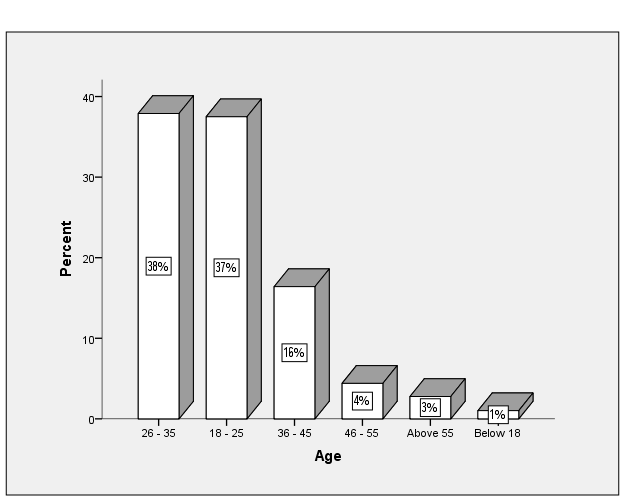
The majority of respondents fell within the 26-35 age group. Figure 1 provides a detailed breakdown of the age distribution.
Figure 1: Age range of respondents
Educational level
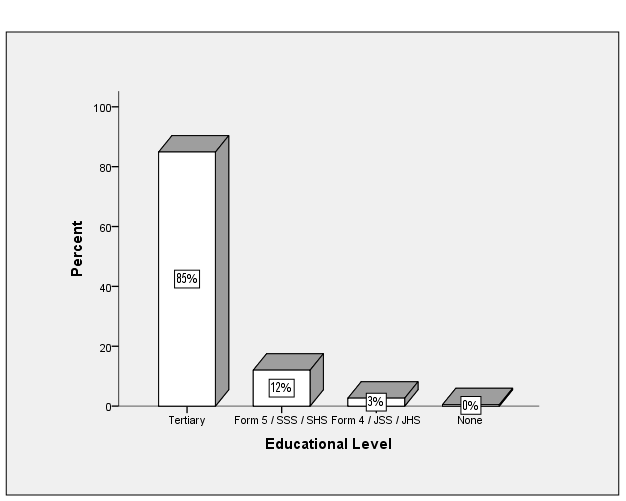
Eighty-five percent of the respondents had tertiary education, with at least a form 4/JSS/JHS qualification. Figure 2 provides a detailed overview of the educational backgrounds of the participants.
LOO
Figure 2: Educational levels of respondents
Greatest security concern
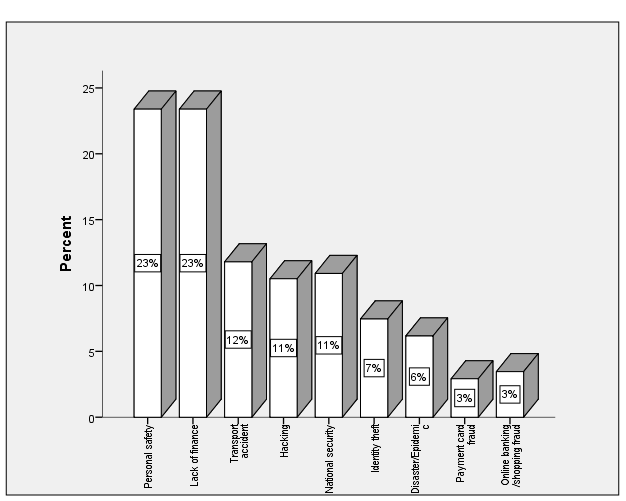
Most respondents identified their inability to meet financial obligations and personal safety as their top concerns. Transport accident followed closely behind. Figure 3 illustrates the detailed breakdown of these responses.
Figure 3: Greatest security concern to respondents
When analyzing the data by demographics, males predominantly listed inability to meet financial obligations as their greatest concern, followed by personal safety. In contrast, females primarily cited personal safety as their top concern, followed by financial obligations.
Among those aged 18-25 and 46-55, personal safety was the main concern. Respondents aged 26-45 mostly cited financial obligations as their top concern. Those over 55 years of age ranked national security as their greatest concern.
Those with first and second cycle education mainly highlighted personal safety as their primary concern, whereas those with tertiary education tended to prioritize financial obligations.
Least security concern
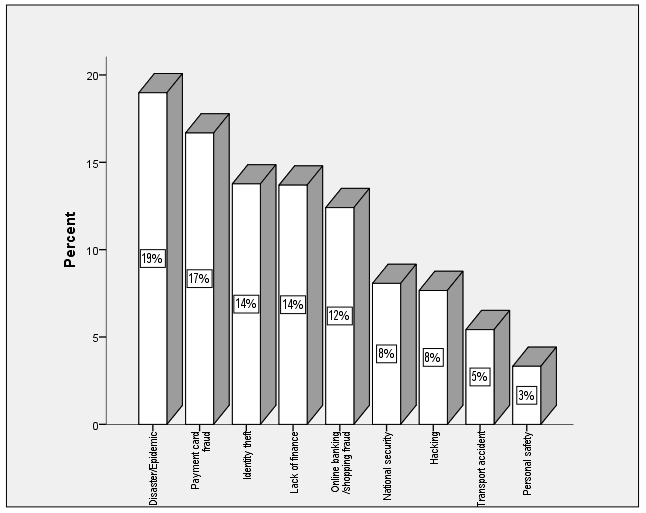
Disaster/epidemic was the most commonly cited least concern, followed by payment card fraud. Figure 4 provides further details on these responses.
Figure 4: Least security concern to respondents
Demographic analysis revealed that females primarily listed lack of finance and the security of online banking/shopping as their least concerns, while males largely cited disaster/epidemic. Among those aged 18-45, disaster/epidemic was the least concern, whereas those aged 46-55 primarily cited financial obligations. Individuals over 55 years of age tended to rank identity theft as their least concern.
Those with first and second cycle education primarily listed disaster/epidemic as their least concern, while those with tertiary education more often cited payment card fraud.
Analysis
The findings reveal that the inability to meet financial obligations and personal safety remain the top concerns among respondents. This aligns with last year’s results. The high percentage scores for these two issues underscore their significance to the participants.
Transport accident, as the third most significant concern, highlights the need for safer transportation systems. It is evident that factors such as gender, age, and education level influence the perception of security threats.
Payment card fraud and identity theft, which ranked lower than disaster/epidemic, suggest that information security is not a major concern for many residents of Ghana. Again, demographic factors play a role in shaping these perceptions.
Conclusion
The results clearly emphasize the importance of financial and personal security over information security for residents of Ghana.
Over six years of conducting the survey, the consistent finding remains that the inability to meet financial obligations and personal safety are the top security concerns for Ghanaians.
We would like to express our deep appreciation to all the respondents and supporters who contributed to this survey. We look forward to your continued support, and may the almighty bless you abundantly.
Alhaji is an Information Security Consultant and Director of Information Security and Data Protection at IIPGH.
For comments, contact the author at mysherrif@gmail.com or call +233243835912.


