Kim’s Journey into Art Investment
Kim, a 58-year-old nearing retirement, is increasingly concerned about the instability of traditional investment options like stocks and real estate. The stock market’s high volatility and the burden of regulations and taxes on real estate have led him to explore alternative investments that offer stability and potential for enhancing his quality of life. Recently, he discovered art collection as a promising option. Beyond the joy of appreciating artwork, he was surprised by the significant tax benefits associated with it.
Kim learned that acquiring or holding artworks domestically does not incur acquisition tax or holding tax, making it an attractive addition to his retirement asset portfolio. His interest in art expanded from domestic works to overseas galleries and art fairs, prompting him to consider the tax implications of purchasing artworks internationally.
Art Assets Without Holding Tax
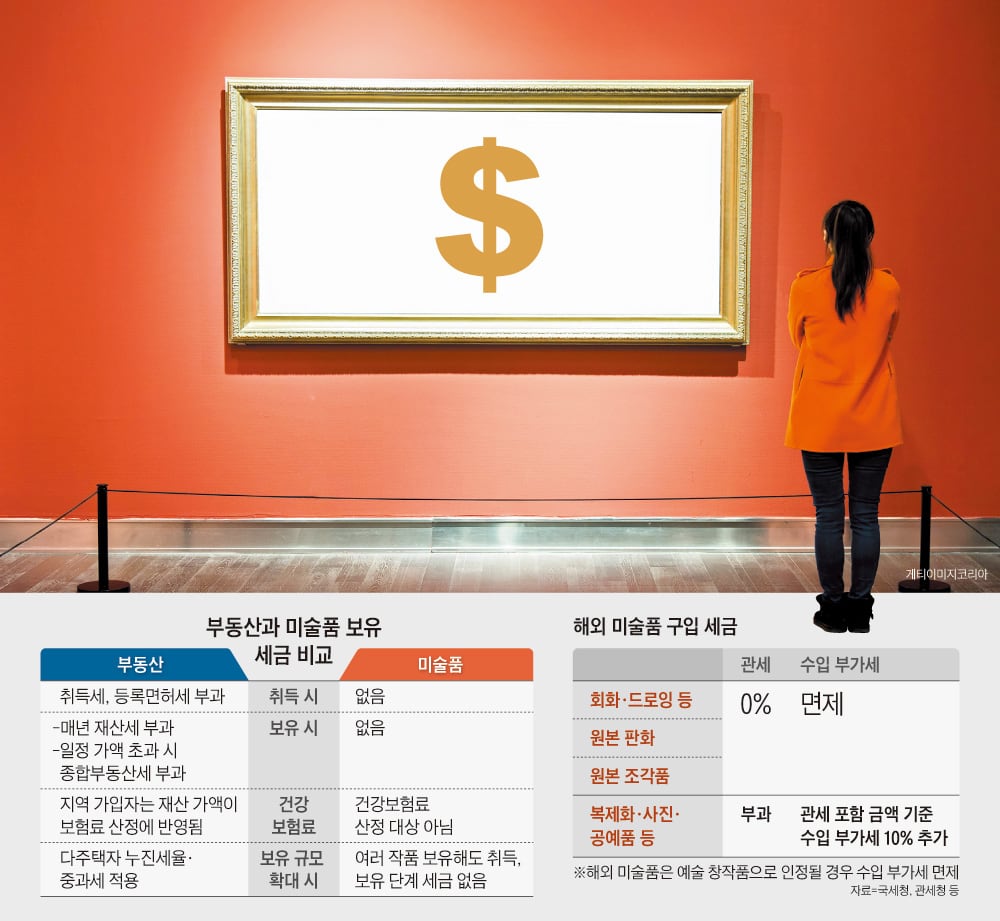
When purchasing real estate, one must pay acquisition tax along with registration license tax during the process of registering and recording ownership. During the holding period, property tax is imposed, and if the real estate value exceeds a certain threshold, comprehensive real estate tax is added. Regional health insurance subscribers have their insurance premiums calculated based on property, so even if their income is not high, merely owning real estate can lead to increased monthly burdens.
In contrast, artworks do not have a registry like real estate, so acquisition tax or registration tax is not imposed. Merely owning an artwork does not create a separate taxable event, so there is almost no tax burden from the time of acquisition. During the holding period, property tax or comprehensive real estate tax does not occur, and it is also not included in the calculation of health insurance premiums. The act of collecting and storing artworks is not subject to tax. This is why artworks are referred to as “assets without holding tax.” While real estate becomes more burdensome with progressive tax rates and surtaxes as more properties are owned, a major advantage of artworks is that there is no separate tax burden at the acquisition or holding stage, even when multiple pieces are owned.
Lower Capital Gains Tax Burden Compared to Real Estate
Capital gains tax on real estate is burdensome due to progressive tax rates and surtaxes. However, the tax scope and rates for artworks are significantly more lenient. Artworks by domestic living artists at the time of transfer are tax-exempt regardless of the transfer amount. Artworks by deceased domestic artists or overseas artists are also non-taxable if the transfer value is 60 million Korean won or less. Even if the transfer value exceeds 60 million Korean won, the tax burden is not significant. This is because up to 100 million Korean won in transfer value, 90% can be recognized as necessary expenses, and 80% for amounts exceeding 100 million Korean won. Additionally, if an artwork is held for over 10 years, 90% of the transfer value is recognized as necessary expenses regardless of the amount. After deducting these expenses, the remaining amount is taxed at a single rate of 22% without being combined with other income. The tax is withheld as other income tax, and the tax obligation is thereby concluded.
For example, assume Mr. Kim purchased an artwork by an overseas artist for 20 million Korean won and sold it for 80 million Korean won. In this case, since the transfer value (80 million Korean won) exceeds 60 million Korean won, it becomes subject to taxation. However, 90% of the transfer value, 72 million Korean won, is recognized as necessary expenses. Thus, the taxable base is 8 million Korean won after deducting expenses, and applying a 22% tax rate results in an actual tax payment of 1.76 million Korean won. Although a profit of 60 million Korean won was made, the tax burden is less than 3%.
Customs Duty Exemption for Overseas Purchased Artworks
Then, what tax issues arise when purchasing artworks overseas? Artworks imported from overseas are classified according to the HS product classification table, and customs duties are calculated by applying the corresponding tax rate. According to the Harmonized System (HS Code), pure artworks such as paintings, drawings, and subject paintings (9701), original prints (9702), and original sculptures (9703) have 0% customs duty, and if recognized as artistic creations, import VAT is also exempted. In other words, paintings or drawings purchased directly overseas do not incur separate customs duties or import VAT upon entry into the country.
However, not all works are classified as artistic creations. If classified under different codes, such as reproductions, photographs, or crafts, customs duties are imposed, and an additional 10% import VAT is applied to the taxable base including the customs duty amount. Since taxes are calculated based on the total amount including not only the artwork price but also transportation and insurance costs, the actual burden can increase. Therefore, before purchasing an artwork overseas, it is necessary to confirm whether it can be recognized as an artistic creation. Additionally, local VAT incurred during the purchase varies according to national regulations. The European Union (EU) applies VAT to art transactions, with rates approximately between 5% and 20% depending on the country. However, foreigners can reclaim this through a refund process if they export the artwork overseas.
Price Volatility and Liquidity Must Be Considered
The presence of Korean collectors in the international art market is gradually increasing. As direct purchases by domestic collectors at overseas auctions and galleries increase, tax issues arising during artwork importation have become a practical concern. Customs classifies all artworks according to HS codes, which affects the customs duty rate and whether import VAT is imposed. Therefore, before purchasing an artwork, it is important to confirm the applicable HS code and tax criteria.
As a retirement asset, art investment has clear advantages due to lower tax burdens, but overseas purchases require careful examination of differing tax rates and regulations by country. Notably, Europe plans to expand VAT reduction systems for artworks starting in 2025, which could serve as a new opportunity for Korean collectors. Although art investment is tax-advantaged, price volatility and liquidity issues must also be considered. If utilized as part of a retirement asset portfolio, it may be possible to reduce tax burdens while gaining cultural satisfaction.


