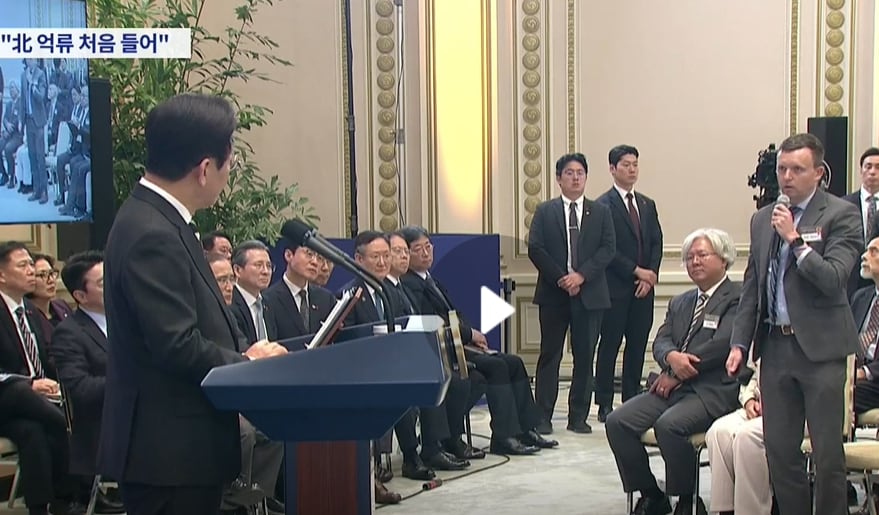
President Lee Jae-myung sparked controversy by stating, “This is the first I’ve heard of it,” regarding the North Korean regime’s detention of South Korean citizens during a press briefing with foreign journalists on the 3rd.
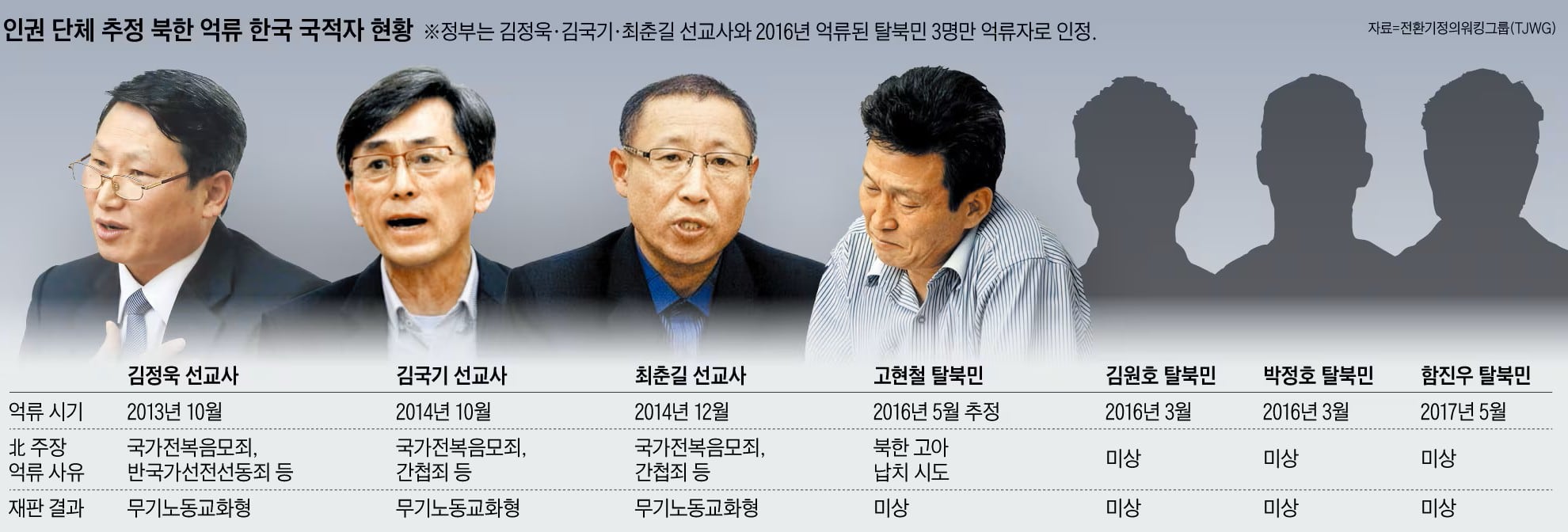
At the event, Chad O’Carroll, a reporter for the U.S.-based North Korea-focused media outlet *NK News*, asked about the cases of missionaries Kim Jeong-wook, Kim Guk-gi, and Choi Chun-gil, who were sentenced to labor re-education camps in North Korea in 2015 and remain detained. He inquired about the government’s response. President Lee then turned to National Security Adviser Wi Sung-lac and asked, “Is it true that South Korean citizens are being held?” He also questioned, “When and under what circumstances were they detained?” O’Carroll responded, “It’s surprising that the president was unaware.”
The revelation that the president was unaware of South Koreans being detained in North Korea shocked families of abductees and related organizations. If the president is unaware of citizens detained under Kim Jong-un’s regime, how can the government properly address wartime and postwar abduction issues? Critics also question the state’s commitment to resolving North Korea’s brutal crimes.
6·25 War Abductees’ Families Association: “We Feel Anger and Grief”
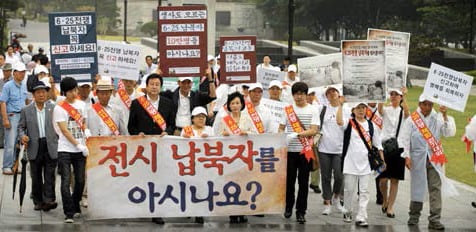
The 6·25 War Abductees’ Families Association strongly condemned President Lee’s remarks in a statement released the following day, the 4th. The association stated, “We feel crushing grief and anger at the president’s bewildered reaction to the mention of South Koreans detained in North Korea.” It criticized the government’s “complacent” attitude toward both recent detainees and wartime abductees.
The association added, “The cases mentioned by the foreign reporter are recent and officially acknowledged by North Korea, but their roots lie in the forced abduction of over 100,000 civilians during the Korean War.” It continued, “Despite countless inter-Korean talks over 75 years, not a single abductee has been repatriated or even confirmed alive. If the government cannot recognize incidents from just a decade ago, how can it properly address wartime abductions from 75 years ago?”
Restarting Activities in 2000: The ‘Second Generation’
I have covered this association since 2011, after returning from my posting in Washington. At the time, its chairperson was Lee Mi-il, a 62-year-old woman with a spinal disability, standing 135 cm tall. Her father, Lee Seong-hwan, was taken by North Korean forces in September 1950 and never returned. Lee Mi-il fell from a stone step at age two due to a caregiver’s mistake, injuring her spine. She later contracted tuberculosis, living with disabilities her entire life. She graduated from Ewha Womans University in 1971, married, but divorced in 1987 due to societal prejudice and life constraints caused by her disability.
The decisive moment for her activism was the 2000 inter-Korean summit. While postwar abductions gained media attention, wartime abductions were ignored. Lee recalled, “I thought someone would step forward, but everyone remained silent.” She added, “Though physically weak, I had to act. Why were capable people silent when 80,000 were abducted?”
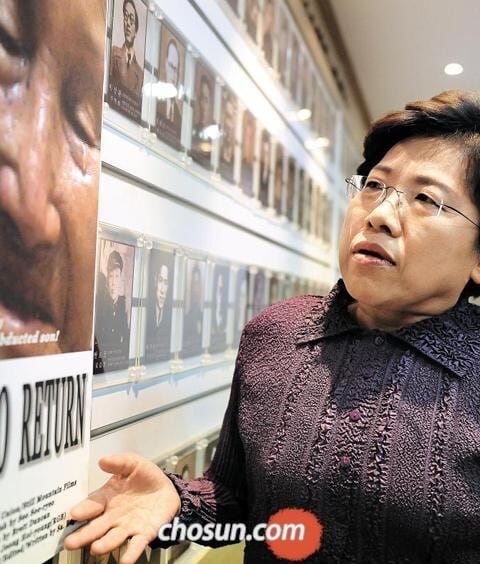
The association was originally founded in August 1951 in Busan as the “6·25 War Abductees’ Families Association” and registered with the Ministry of Public Information in September of the same year. It continued as the “Korean 6·25 War Abductees’ Families Association” until 1953 but halted activities due to lack of progress. After a long hiatus, it was re-registered in November 2000 under the Ministry of Unification as the “6·25 War Abductees’ Families Association,” marking the start of its second phase. In 2005, it opened the “Korean War Abduction Archives” to systematically document cases.
Pushing for Wartime Abduction Legislation: “Operating Like a Military Command”
Lee Mi-il focused on passing a special law for wartime abductees. She said, “We ran the office like a military command to pass the law.” Names and constituencies of lawmakers were posted on walls, and members were assigned to lobby specific representatives. This effort revived legislation that had been rejected in the 16th and 17th National Assemblies.
In 2009, lawmakers Kim Moo-sung and Park Sun-young, moved by the association’s work, proposed the “Act on the Identification of Truths and Restoration of Honor for Korean War Abductees.” A public hearing co-hosted by the two lawmakers on February 27 drew 600 participants, including association members. The bill, signed by 89 lawmakers, received support from Democratic Party members Kim Jin-pyo and Song Min-soon, who stated, “This must be done.” It passed the National Assembly in March 2010.
“Gratitude Over Resentment Toward the State”
On August 2, 2011, one year and five months after the law’s passage, Lee Mi-il expressed gratitude at a meeting chaired by Prime Minister Kim Hwang-sik. Though only 55 wartime abductees were officially recognized out of an estimated 82,959, she harbored no resentment. She said, “I am proud of South Korea’s prosperity. Even after 60 years, the government’s efforts to resolve wartime abductions fill me with national pride. Those who sacrificed for the nation’s founding must now find peace.”
Days later, when asked why she emphasized gratitude despite the government’s past inaction, she replied:
— Despite the government’s lack of support, why express gratitude?
“I attended church and prayer centers often due to my disability. I always prayed for South Korea’s success. Though I couldn’t attend Kyunggi Girls’ Middle School or Ewha Womans University due to prejudice, I still love this country. It seemed pitiful, and I thought the government had no choice but to act as it did. My criticism stemmed from patriotism.”
— Why raise wartime abductions after over half a century?
“While liberation in 1945 was important, the 1948 founding of South Korea was more crucial. Wartime abductees were casualties during the nation’s formative years. South Korea is no longer a weak ‘shrimp caught between whales.’ Many leaders from politics, medicine, and business were abducted. Previously, we were too busy surviving to address this, but now is the time to act. That is the state’s duty.”
“What Does Kim Jong-il Want by Holding Fragile Women and Children?”
When asked if addressing abductions could hinder inter-Korean relations, she countered: “South Koreans enjoy prosperity, but over 80,000 remain detained in the North. Erasing their history reflects defeatism.” She urged the government to pressure North Korea internationally, stating, “While focused on defense, we must expose North Korea’s crimes.”
That day, a full-page ad titled “Save the Daughter of Tongyeong” appeared, urging the rescue of Oh Gil-nam’s family, detained in North Korea. Lee remarked, “If wartime abductions were globally known, would Oh’s tragedy have occurred? If North Korea’s abductions were acknowledged post-war, they might not have dared abduct fishermen or students.” She denounced Kim Jong-il: “What does he intend by holding fragile women and children?”
Rejected for TV Interviews Due to Disability and Voice
Lee initially funded the association herself. “In 2011, we received our first government grant of 100 million Korean won, all for projects. Some suggest demanding more funds, but I cannot. Public money is sacred—more so than personal funds. I allocate 10 million won monthly from rental income of a building on land left by my father to pay staff salaries. Abduction work is my main job; building management is secondary.”
Her disability and deep voice caused pain. She recalled, “A broadcaster refused an interview, saying my voice was unpleasant and I was disabled—right in front of me. I wished I had a better appearance then.”
“Why Absorb the Abduction Task Force into the Separated Families Division?”
Due to Lee Mi-il’s declining health, Lee Ui-sung became chairperson in 2023. In a phone call on the 12th, Lee Ui-sung expressed concern that interest in abduction issues might wane under President Lee’s administration. He criticized the Ministry of Unification’s reorganization, which merged the presidential abduction task force into the “Separated Families and Abductees Division.”
Lee Ui-sung stated, “This merger dilutes abduction issues into family reunification.” He called the foreign press controversy “symbolic of the current administration’s indifference.” He demanded an official apology from the president, foreign minister, and unification minister; a presidential abduction task force; mandatory “Forget-Me-Not” badges for public servants (symbolizing remembrance of abductees); and support for wartime abductees’ families, who receive no compensation unlike victims of military or police actions during the war.
May this incident bring wider awareness to wartime and postwar abductions and fulfill the association’s long-cherished goals.