Burundi’s President Faces Paradox as AU Chair Amid Ongoing Conflict in DR Congo
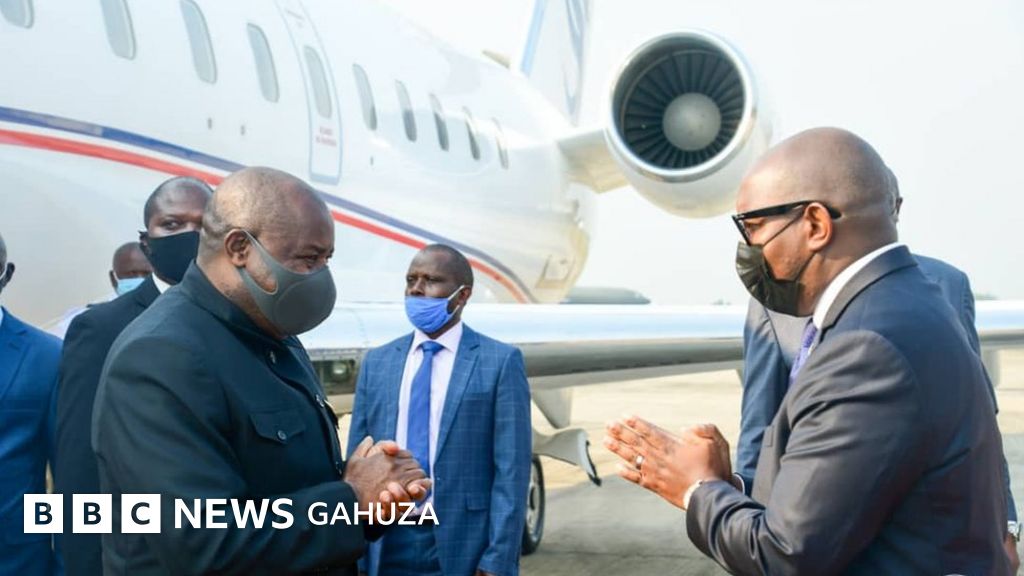
When Burundian President Evariste Ndayishimiye assumed the chairpersonship of the African Union (AU) on February 14 during the 39th Ordinary Session of the Assembly of Heads of State and Government in Addis Ababa, he stepped into a role meant to reflect Africa’s commitment to unity, dialogue, and the protection of fundamental rights. As AU chairperson, he is expected to advance peace and uphold the African Charter on Human and Peoples’ Rights, which guarantees the right to life and the right of communities to exist in dignity and security. Yet at a time when he takes on the continental responsibility, conflict continues in eastern DR Congo with his army’s role well documented. The AU itself is expected to help resolve the situation through mediation.
For over two years, Burundian troops have been deployed in eastern DR Congo and fighting alongside the Congolese army coalition in the war with AFC/M23 rebels. They have been accused of rights abuses, including imposing a blockade on the Banyamulenge community in Minembwe, South Kivu, restricting their access to food, medicine, and other essential supplies and starving the civilians. Members of this community have filed a lawsuit against the Burundian government with the East African Court of Justice.
Burundian troops were accused of leading operations of the Congolese government coalition in early December, before the AFC/M23 took control of Uvira city. The rebels alleged that airstrikes on Kamanyola border town were launched from Bujumbura Province. Burundian troops are reported to have redeployed to Uvira since mid-January when the AFC/M23 withdrew from the strategic city, which has seen a relapse in violence against civilians and Banyamulenge.
It is against this backdrop that analysts say Ndayishimiye’s new role as AU chair presents a troubling paradox.
A Troubling Paradox
Alex Mvuka, a Congolese independent researcher, argues that Burundi’s continued military involvement in South Kivu exposes structural weaknesses within the African Union itself. “On the ground, Burundian forces have continued deployment,” Mvuka said. “We are talking about numbers quite close to 20,000 troops again, similar to what we had before Uvira was captured by AFC/M23.”
“Just to give you a number, every day there are about 140 bombs shelled on the local people,” he said. He further noted that the pattern reflects the targeting of Tutsi communities. “There is an intention to kill and destroy one group of people because of who they are,” he said. “The Banyamulenge are considered a problem simply because of their identity.”
Mvuka links Burundi’s involvement to three motivations: ethnic ideology, perceived security concerns linked to Rwanda, and financial pressures in the Burundian economy. “[Ndayishimiye] sees South Kivu as a security and economic zone,” Mvuka said. “For him, Minembwe represents the home of the Tutsi, and wherever the Tutsi are, he believes they must attack Burundian bases.” He disputes those security claims. “There is no ground to support such claims,” he said, arguing that Rwanda’s post-genocide trajectory has focused on internal reconstruction.
He also cites Burundi’s economic strain, including fuel shortages and foreign currency constraints. “The only way to survive is being commissioned to fight the war in DR Congo so it can be paid and bring some revenue,” he said.
For Mvuka, the issue is not merely political optics. “We know that Burundi is leading by example of doing exactly the opposite of what AU stands for,” he argued. “You cannot have someone who’s working against the values and principles of the institution and to have that kind of person to head such an institution. It is extremely wrong and unethical.”
Ideology and Genocide Concerns
Among those voicing concern over Ndayishimiye’s position at the AU is genocide survivor and author Gustave Mukurarinda, who argues that the issue goes beyond politics or military alliances. For him, it is about ideology, how it is spreading, how it normalises violence, and how silence at the top can legitimise it.
“As a genocide survivor, it’s a disaster,” Mukurarinda said of Ndayishimiye’s elevation to the AU chairmanship. He acknowledges that the position rotates among heads of state. Yet, he argues, timing and context matter. For Mukurarinda, Burundi’s reported cooperation with the FDLR, a Kinshasa-backed militia group linked to perpetrators of the 1994 Genocide against the Tutsi, is particularly alarming. He sees this not simply as a tactical alliance, but as a convergence rooted in a shared hostility toward Congolese Tutsi communities and Kinyarwanda speakers.
“Being in DR Congo is not just about supporting the Congolese regime,” he says. “It’s the ideology they are sharing.” Mukurarinda points to repeated hate speech broadcast in DR Congo, including rhetoric that mirrors extremist narratives used in Rwanda before 1994, as proof that genocide ideology is resurfacing in public discourse.
In his view, such language is not incidental. “Genocide does not start overnight,” he noted. “It begins with words. It begins with an ideology that is repeated again and again, until violence feels justified.”
Mediation Credibility at Stake
Vianney Rurangirwa Shumbusho, a crisis observer, frames his concerns around mediation credibility and continental representation. “A person becomes the chair of the AU for a year, and during that time they represent the image of the African continent in the international arena,” Shumbusho said. “Therefore, giving that position to someone who is actively involved in the conflict in eastern DR Congo raises serious concerns.”
He stresses that neutrality is essential for credible mediation. “It cannot work for him to be part of the mediation,” he said. “Being in a position like his requires neutrality so that he wins the trust of the two conflicting parties. Right now, that does not apply to Ndayishimiye because he is on the battlefield against one of them.”
Shumbusho adds that if Ndayishimiye intends to champion peace in line with AU principles, Burundi’s military role must be reconsidered. “As long as he still has troops there and openly supports one side, presenting himself as a peace champion would be a contradiction,” he said.