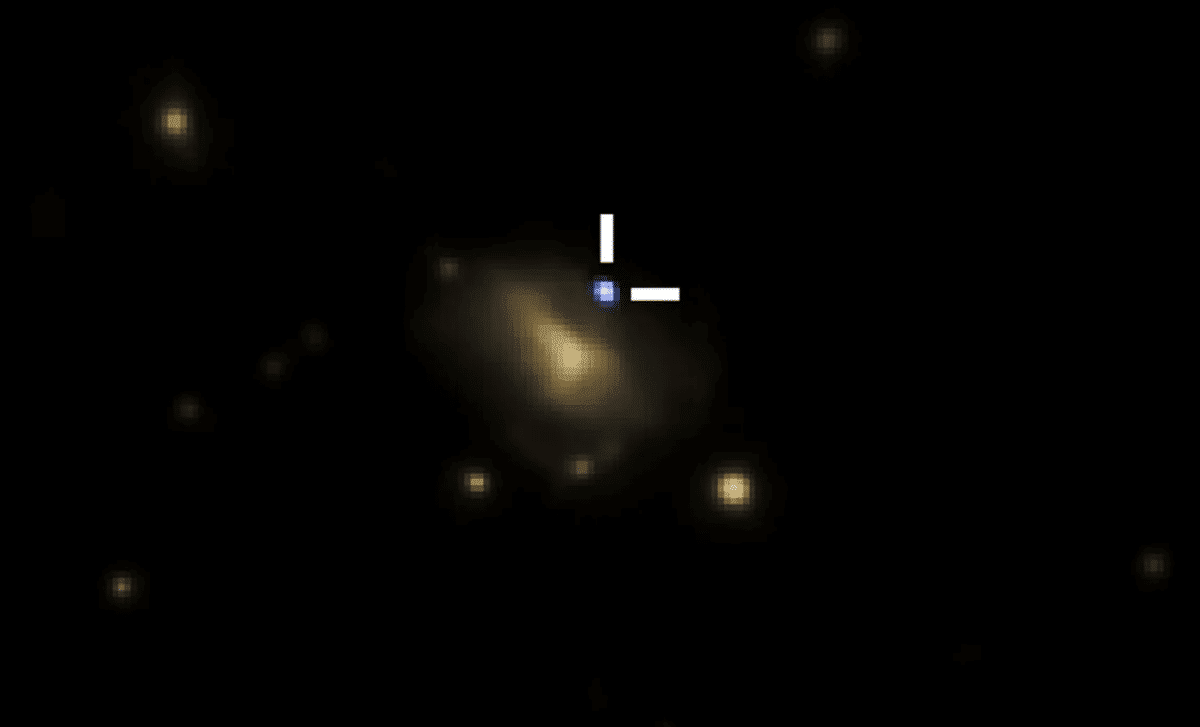
A new study available via arXiv, sheds light on the enigmatic phenomenon ofLuminous Fast Blue Optical Transients (LFBOTs). These intense blue flashes have left scientists puzzled for years, but the latest discovery involving AT 2024wpp could help uncover the true source. The research highlights the surprising involvement of black holes in this phenomenon, rather than the traditional stellar explosions that scientists initially suspected.
The Mystery of LFBOTs
Luminous Fast Blue Optical Transients (LFBOTs) are bright flashes of light, lasting just a couple of days, with a distinctive blue hue. Although these bursts are relatively brief, their intensity and peculiar characteristics have left astronomers scratching their heads. LFBOTs emit an ultraviolet signature, leaving behind faint traces of X-rays and radio waves, which suggests that their origin lies far beyond ordinary stellar events like supernovae or black hole activity involving typical gas consumption. The most recent discovery, AT 2024wpp, is among the brightest of these mysterious flashes, and its extraordinary features have pointed scientists in a new direction.
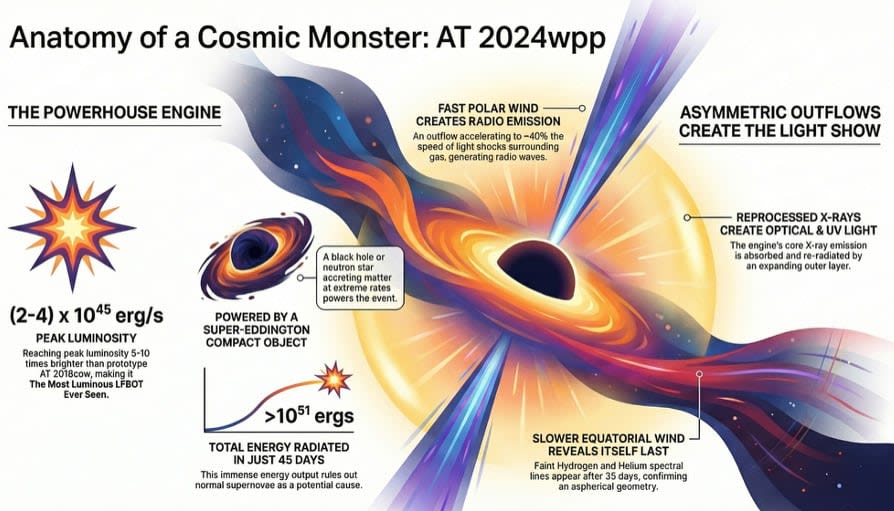
AT 2024wpp is so powerful that it could never have been a supernova. In fact, it’s estimated to be 100 times brighter than the average supernova. To understand this scale, consider that supernovae typically release vast amounts of energy, converting up to 10 percent of the star’s mass into pure energy. However, the sheer energy radiated by AT 2024wpp far exceeds this. According to Natalie LeBaron, a graduate researcher at UC Berkeley and first author of the study available on ArXiv, “The sheer amount of radiated energy from these bursts is so large that you can’t power them with the collapse and explosion of a massive star – or any other type of normal stellar explosion.” This discovery led to a critical reevaluation of the previous models of stellar explosions.
The Role of Black Holes in LFBOTs
While the exact mechanics of LFBOTs remain elusive, the new findings point strongly to the involvement of a black hole. However, this isn’t your typical black hole. Rather than one devouring surrounding gas, the black hole responsible for AT 2024wpp seems to be destroying an entire companion star. And surprisingly, this black hole is not as massive as the supermassive black holes we typically associate with star-shredding events. It’s estimated to be no larger than 100 times the mass of our Sun. This contrasts with the larger black holes usually thought to be responsible for tearing apart stars in such dramatic fashion.
The idea that a relatively small black hole could cause such a massive and intense burst of energy challenges previous assumptions about these cosmic events. This research suggests thatthe mechanism of LFBOTs is more complex than simply the collapse of a massive star or the collapse of a supermassive black hole into a nearby star.
“The main message from AT 2024wpp is that the model that we started off with is wrong,” says LeBaron. “It’s definitely not caused by an exploding star.”
This pivotal statement directs the focus to alternative causes and pushes the boundaries of what we know about black holes and the way they interact with their surroundings.
The Significance of AT 2024wpp in the Context of Gravitational Wave Studies
The implications of the AT 2024wpp discovery extend beyond just understanding these bursts. The data collected from this LFBOT may also provide valuable insights into the behavior of black holes. Black hole mergers are often studied through gravitational wave observatories, but the connection between such events and visible light has remained elusive. The study of LFBOTs like AT 2024wpp, however, could offer a new way to link these observations. Raffaella Margutti, UC Berkeley associate professor of astronomy and physics, notes that theorists have proposed many ways to explain the large black holes observed by gravitational wave observatories like LIGO. LFBOTs, she says, provide a “completely different angle” for studying these black holes, revealing more about their origins and evolution.
In addition, by observing LFBOTs in the context of their host galaxies, researchers can gain a more detailed understanding of the locations of these black holes. As Margutti adds, LFBOTs allow astronomers to “characterize the precise location where these things are inside their host galaxy, which adds more context in trying to understand how we end up with this setup – a very large black hole and a companion.”
The Evolution of Companion Stars and Black Holes
A crucial aspect of this study is the identification of the companion star that was destroyed by the black hole. Researchers believe the companion star to AT 2024wpp was an evolved Wolf-Rayet star—an old and massive star nearing the end of its life cycle. These stars are known for their strong stellar winds and for shedding large amounts of mass during their lifetimes. When such a star gets too close to a black hole, the gravitational pull of the black hole can rip it apart, leading to explosive events like the one seen with AT 2024wpp.
The destruction of this companion star releases massive amounts of material that falls toward the black hole. As the material gets caught in the black hole’s accretion disk, it emits intense radiation, including the X-rays and ultraviolet light observed in this event. Some of the material is ejected in powerful jets, traveling at nearly 40 percent the speed of light. These jets interact with surrounding gas, producing the radio wave emissions seen in LFBOTs.
The data suggests that such events might be more common than previously thought, with a potential connection between black hole activity and the evolutionary paths of companion stars. The findings may also offer a new way to study the relationship between black holes and their environments.
Enjoyed this article? Subscribe to our free newsletter for engaging stories, exclusive content, and the latest news.