The Evolution of Pop Mart: From Hype to Longevity
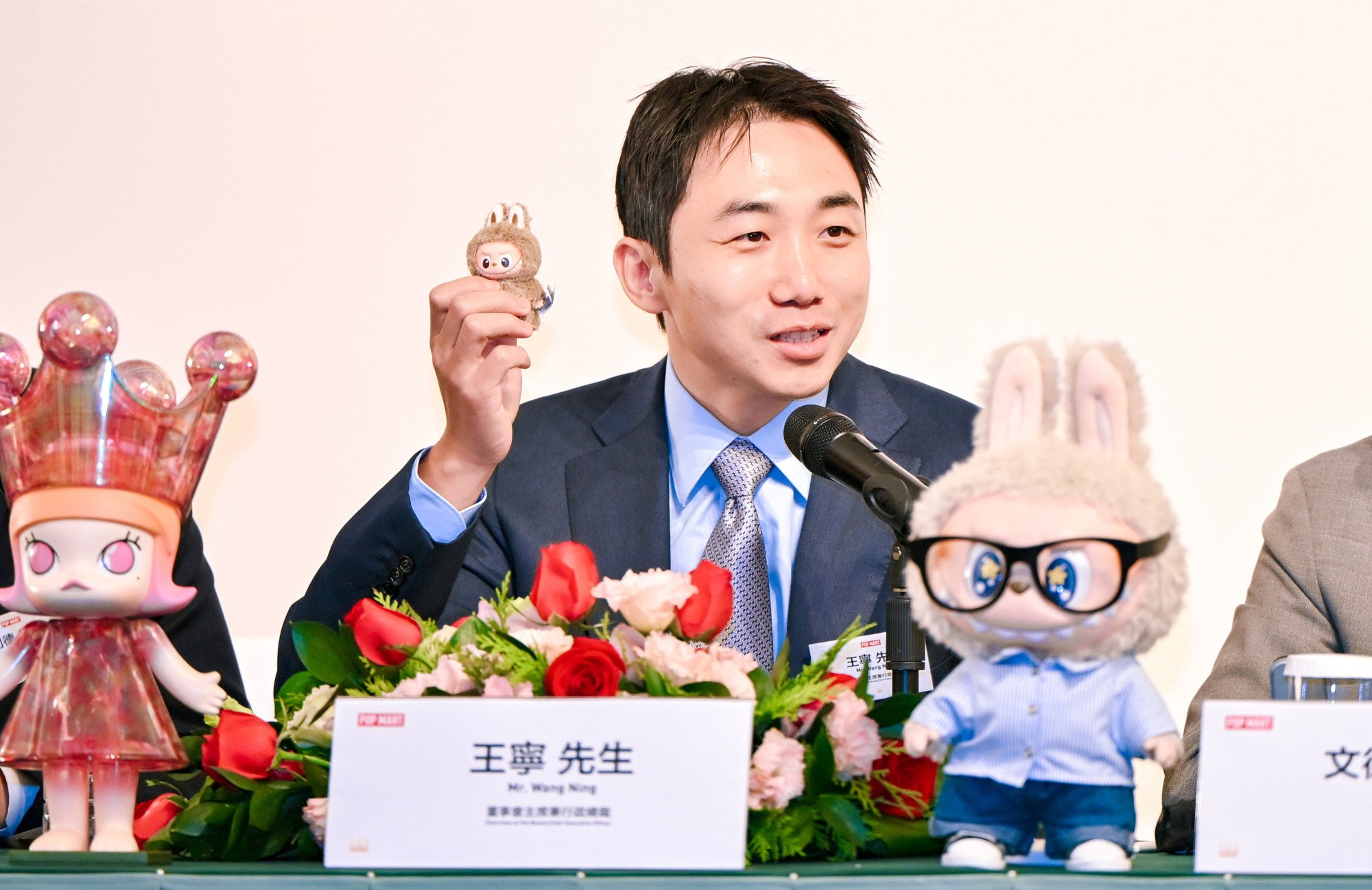
Around a decade ago, during a train ride through China, Wang Ning, the founder and chairman of Beijing-based international art toy brand Pop Mart, shared his early entrepreneurial experiences with designer Kenny Wong Shun-ming. As a fresh graduate, Wang struggled to sell affordable men’s suits sourced from Yiwu in Zhejiang province, experimenting with small-scale arbitrage and learning firsthand how difficult it was to connect products with consumers.
The experience, Wong recalled, shaped Wang’s later understanding that branding and emotional connection could matter as much as the product itself. He later described spotting a Michael Jackson poster bearing the words “This is it” while job-hunting—a moment that crystallized that insight.
[Wang soon registered China’s first trademark (of “This is it”) and launched a Michael Jackson exhibition; a success that taught him the transformative power of branding,” Wong, the designer of the much-beloved big-eyed and pouty-mouthed character Molly, said in an interview.]
The company philosophy that emerged from this early experience—building products around story, identity, and emotional connection—is now being tested. As secondary-market prices for Pop Mart’s breakout figure Labubu fall sharply and the company’s shares swing more than 40 percent from last year’s peak, the enduring appeal of its Molly doll offers a counterpoint.
Now celebrating her 20th anniversary, Molly offers a blueprint for endurance against Labubu’s volatility, highlighting the tension between cultivating durable cultural icons and riding viral hype cycles.
“Pop Mart’s revenue source is quite concentrated on Labubu. The firm needs to show the market that it can continuously launch popular IPs and turn them into major revenue drivers,” said Kenny Ng Lai-yin, a strategist at Everbright Securities International.
For Molly, Ng said he believed sales growth could remain steady. However, a larger contribution from the character would help reassure investors concerned about sustainability, he added.
Wang, aiming to operate IPs without restraints, officially signed a partnership with Wong for the exclusive rights to Molly in 2016. With Pop Mart’s resources, Molly expanded into sculptures, blind boxes, vinyl dolls, action figures, and special editions, while crossovers with celebrities such as Nicholas Tse Ting-fung broadened her appeal.
Wong said the company also incorporated his ideas around environmental protection and education, introducing more sustainable materials and supporting art programs in underdeveloped regions—steps that reinforced the character’s long-term cultural positioning.
Pop Mart has since extended Molly into social media engagement, community building, exhibitions, and offline events, as well as immersive experiences at its IP-themed POP LAND, demonstrating the company’s operational approach to developing IP, according to Wang Tao, public affairs general manager of the toy giant.
Once Pop Mart’s top revenue driver, Molly remains a core performer and now ranks as the company’s second-largest income source after Labubu.
To celebrate the character’s anniversary, Wang even arranged a symbolic gesture in early February: a capsule carrying Molly into space, which later returned and was unpacked by her creator.
The anniversary also comes as art-toy IP moves further into mainstream consumer branding, with smartphone maker Honor launching its first handset featuring toy-themed design elements in January.
Pop Mart’s revenue from artist IPs surged 231.6 percent year-on-year to 12.23 billion yuan (US$1.77 billion) for the first half of 2025, accounting for 88.1 percent of the total.
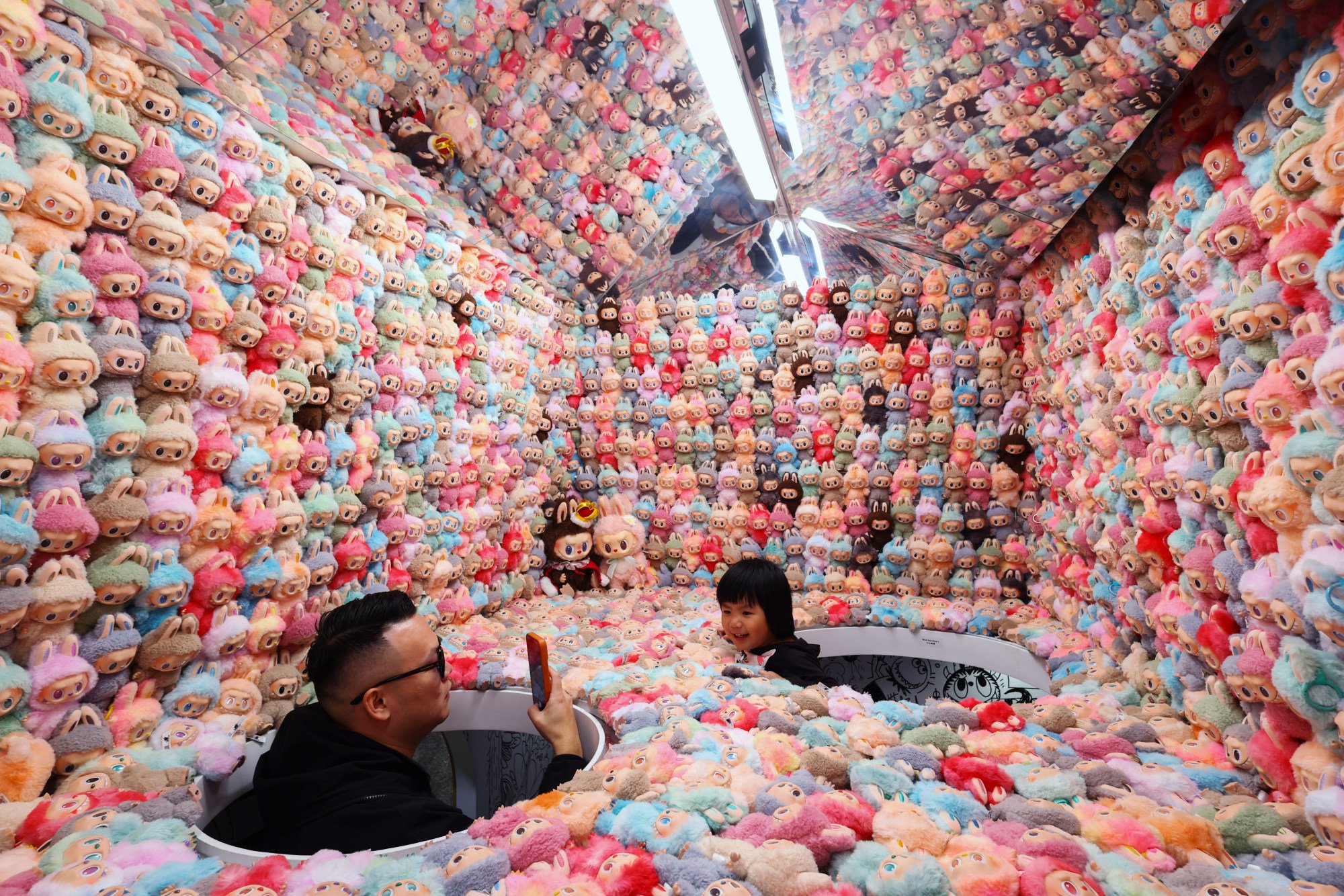
Yet Molly’s limelight has increasingly been eclipsed by Labubu, whose popularity surged after K-pop star Lisa from Blackpink showcased the toy on social media in 2024, igniting demand first across Asia and now in global markets.
Labubu was at one point priced at more than 20 times its retail value in secondary markets in 2025, becoming Pop Mart’s most successful line to date.
The frenzy drove the company’s shares sharply higher—at one stage surging as much as 277 percent in late August—and lifted its market capitalization to more than HK$430 billion, surpassing that of Hong Kong property heavyweights CK Asset Holdings and Sun Hung Kai Properties.
Pop Mart’s share price dropped from a peak of HK$339.80 in late August to HK$187.70 by the end of the year, fueling debate over whether the company’s success had become too reliant on short-lived hype.
For the first six months of 2025, The Monsters—the series that includes Labubu—generated 4.8 billion yuan, or 34.7 percent of total revenue, compared with Molly’s 9.8 percent.
For investors, the contrast between Molly and Labubu can resemble a portfolio split between steadier, bond-like IPs and more volatile, equity-style breakout hits.
For the full year, Labubu’s sales volume exceeded 100 million units, chairman Wang Ning said at an internal gala, according to mainland media. Pop Mart, however, insists the character’s rise reflects long-term cultivation rather than a short-term craze.
“Our goal is not to chase the next Labubu, but to build a diverse ecosystem where multiple IPs can mature, resonate, and endure commercially and culturally over the long term,” Wang Tao said.
Newer series such as Twinkle Twinkle—launched in 2024 and contributing 2.8 percent of first-half revenue in 2025—are part of that effort to broaden the pipeline.
Analysts expect the company to shift from Labubu-led acceleration to a more balanced growth trajectory driven by retail expansion and a wider mix of IP.
Macquarie highlighted strong demand for new Twinkle Twinkle releases and projected the contribution of Pop Mart’s top IPs to rise from 43 percent of revenue in 2025 to 48.6 percent this year, setting a bullish target price of HK$470.
Morgan Stanley said US sales could prove resilient and maintained Pop Mart as a top pick with a target price of HK$325, while HSBC Global Investment Research argued concerns over a Labubu slowdown had largely been priced in.
“We remain confident in Pop Mart’s proven ability to incubate and globalize new IPs, supporting the future breakout of IP franchises beyond Labubu,” HSBC analysts said in a February note, offering a target price of HK$354 apiece.
But not all observers are convinced. Bernstein analysts warned that overseas expansion and rising investment could weigh on profitability in the near term, while Ng at Everbright cautioned that reliance on a single breakout IP remained a risk until other characters achieve double-digit revenue contributions.
To diversify, Pop Mart is accelerating international expansion. The company plans to open more than 20 new stores in the United States through a partnership with Simon Property Group.
During the recent visit of British Prime Minister Keir Starmer to China, Pop Mart announced that it would locate its European headquarters in London and open 20 new outlets in the region.

Revenue from the Americas surged 1,142 percent in the first half of 2025, while Europe and other regions grew 729 percent, far outpacing mainland China’s 135 percent increase.
Together with the two recent share repurchases in January, shares of Pop Mart rebounded 39 percent to HK$247.4 as of February 13 from this year’s trough of around HK$178.
Executives also emphasize localization, citing initiatives such as a four-meter Molly figure in traditional Thai attire at the brand’s Bangkok flagship and the cultivation of IP from multiple cultural backgrounds.
Starting from the exclusive partnership with Molly, Pop Mart now operates 16 series and has achieved global recognition, gaining inclusion on the TIME100 Most Influential Companies in 2025.
BOC International has forecast that the overseas markets could be Pop Mart’s primary focus this year, with a localisation strategy to cater to the consumer appetites of individual markets.
BOC International also estimated that the capacity expansion of the company’s Mexico factory may help lower tariff costs by 30 percent and ease the burden on the supply chain for products sold in North America.
The company is now navigating a delicate balance: cultivating new breakout hits while sustaining legacy icons that anchor its brand. Analysts point to its supply chain, storytelling capabilities, and retail footprint as buffers against the volatility tied to any single character’s cycle.
Facing some talks that his success was just luck, Wong insisted “I think luck is something one creates.”
For Wang Ning and Pop Mart, the challenge now is to turn that philosophy into a repeatable model—building not just the next viral sensation, but a portfolio of characters capable of enduring beyond the hype.